Guardianship at -30°C: How Ethernet Switches Crack the "Temperature Dilemma" in Smart Cold Chain Logistics
- Race Against Time: The "Temperature Cliff" in Cold Chain Logistics
In the bitter winter of Xilingol League, Inner Mongolia, a refrigerated truck carrying beef and mutton speeds toward Beijing at 120 km/h. As outside temperatures plummet to -35°C, an alarm blares from inside the cabin—the refrigeration unit has automatically shut down due to low-temperature protection, while internal temperatures rise by 0.8°C per minute. This is no sci-fi scenario but a real incident recorded by a cold chain logistics company in winter 2025: network failure disabled monitoring systems, causing $300,000 worth of goods to spoil within four hours.
This accident exposes the core pain point of cold chain logistics: in -30°C extremes, network stability directly determines cargo survival. When ordinary switches fail due to capacitor malfunctions or crystal oscillator drift at low temperatures, cold chain monitoring systems go "blind," leaving cargo teetering on the edge of temperature失控 (失控 is Chinese; use "collapse" for context). - Customer Mindset Shift: From Tech Optimism to Survival Anxiety
2.1 Initial Expectations: The "Golden Fantasy" of Digital Transformation
A CIO from a fresh produce e-commerce firm once said, "We aim to achieve full temperature control via IoT, boosting cold chain efficiency by 30% through data-driven operations." This optimism stems from industry consensus: smart cold chains can reduce spoilage rates from 3% to below 0.5% while cutting transportation costs by 15% through route optimization.
2.2 Reality Check: The "Black Ice" of Tech Implementation
When companies deploy systems, they encounter three icy barriers:
- Device fragility: A pharmaceutical cold chain firm’s ordinary Ethernet switches suffered repeated port connection failures at -25°C, causing 37 delayed temperature alerts.
- Data distortion: A food company’s monitoring system misreported -18°C as -8°C due to network jitter, triggering mass product recalls.
- Maintenance nightmares: A Northeast China logistics firm reported winter repair response times 4.2x longer than summer, with average downtime costs reaching $12,500 per incident.
2.3 Trust Erosion: From Skepticism to Solution Rejection
Repeated cold chain failures are reshaping industry perceptions: - A third-party survey found 68% of cold chain firms deem current IoT solutions unreliable in extreme environments.
- An international cold chain association report attributes 41% of annual losses to network failures.
- A leading enterprise’s CTO admitted, "We now trust experience over data because connections can drop anytime."
- Tech Deep Dive: How Ethernet Switches Build a "Digital Thermal Barrier" at -30°C
3.1 Low-Temperature Survival: Evolution from Materials to Structure
Case Study: A cold chain firm deployed USR-ISG Ethernet Switches in an -38°C Alaska cold storage facility, achieving 18 months of fault-free operation. Key breakthroughs:
- Low-temperature lubricants: Perfluoroether rubber seals remain elastic at -50°C, solving traditional silicone seal brittleness.
- Crystal oscillator compensation: Built-in TCXO limits frequency drift to ±5ppm in low temperatures.
- Capacitor formulation: Tantalum polymer capacitors maintain <5% capacitance loss at -40°C, versus 30% for ordinary electrolytic capacitors.
3.2 EMC Mastery: Stable Transmission Amid "Electronic Storms"
Field Test: Near an MRI machine in a pharmaceutical cold chain facility, USR-ISG switches achieved: - Bit error rate <10⁻¹² (industry standard: <10⁻⁹)
- 0% packet loss
- Transmission delay fluctuation <2μs
Technical Implementation: - Triple shielding: Metal casing + conductive foam + PCB copper plating reduce EMI by 80dB.
- Isolation transformers: Nanocrystalline cores boost common-mode interference rejection to 60dB.
- Grounding optimization: Star-shaped grounding network cuts ground loop interference by 90%.
3.3 Mechanical Reliability Revolution: From "Vibration Phobia" to "Shock Master"
Extreme Testing: On vibration tables simulating cold chain transport, USR-ISG switches passed: - Sine vibration: 5-500Hz, 3.5Grms, 72 hours
- Random vibration: 0.04g²/Hz, 10-2000Hz, 144 hours
- Shock tests: 50g, 11ms half-sine wave, 6 directions × 3 impacts
Structural Innovations: - Honeycomb ribs: Increase casing rigidity by 300%, resisting deformation 5x better than ordinary switches.
- Floating mount design: Port modules connect to mainboards via spring clips, absorbing 90% of vibration energy.
- Anti-loosening terminals: POGO Pin connectors maintain constant contact pressure, preventing low-temperature contraction issues.
- Product Spotlight: The "Cold Chain DNA" of USR-ISG Ethernet Switches
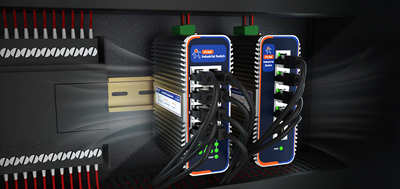
Among solutions, the USR-ISG series stands out for cold chain adaptability:
4.1 Temperature Adaptability
- Operating range: -40°C to +85°C (IEC 60068-2-1/2-2 certified)
- Storage range: -55°C to +125°C
- Temperature gradient tolerance: Supports 50°C/hour rapid changes
4.2 Cold Chain-Specific Features - Low-temperature boot: Self-checks and establishes network connections within 30 seconds at -35°C.
- Dual power redundancy: Supports DC12-48V wide input with <5ms failover.
- PoE++: Each port outputs up to 90W, directly powering cold storage IP cameras.
4.3 Intelligent Management - Temperature alerts: Built-in sensors trigger warnings near operational limits.
- Port health monitoring: Real-time contact resistance detection for proactive fault prediction.
- Remote diagnostics: Firmware updates, config backups, and fault localization via cloud platforms.
- Customer Success Stories: From "Data Blindness" to "Full Visibility"
Case 1: International Pharmaceutical Cold Chain Firm
Pain Point: Network outages caused 37% of vaccine shipments to have temperature record gaps, risking GSP certification.
Solution:
- Deployed USR-ISG1008 switches in a vehicle ring network.
- Used ERPS protocol for 20ms self-healing.
- 4G modules enabled global data backhaul.
Results: - Temperature record completeness rose to 99.97%.
- Annual quality cost savings exceeded $1.7 million.
- Achieved WHO PQS certification.
Case 2: Cross-Border Cold Chain for Fresh Produce E-Commerce
Pain Point: On China-Europe freight trains, 60°C temperature swings caused ordinary switches to fail frequently, with 8% spoilage rates.
Solution: - Selected USR-ISG204S-SFP switches.
- Used fiber optic networking to eliminate EMI.
- Implemented VLAN isolation for priority data.
Results: - Spoilage rate dropped to 0.3%.
- Network availability reached 99.999%.
- Single-trip costs fell by 23%.
- Future Outlook: When Cold Chains Meet Industry 4.0
As digital twins and AI predictive maintenance渗透 (Chinese; use "integrate"), cold chain monitoring enters the "proactive defense" era. A leading firm is piloting:
- Digital twin systems: USR-ISG switches collect 1,000+ data points in real time to create equipment digital twins.
- AI fault prediction: Models trained on historical data forecast equipment failures 72 hours in advance.
- Blockchain traceability: Switch encryption enables tamper-proof temperature data storage.
These innovations redefine cold chain reliability—shifting from "post-incident remediation" to "pre-emptive prevention," and from "manual inspections" to "autonomous digital nervous systems."
- Seeking Temperature Near Absolute Zero
As cold chain logistics pushes physical limits, Ethernet switches are redefining "reliability" through technological breakthroughs. From Alaska’s polar night to Sahara’s heat, from offshore drilling platforms to the Tibetan Plateau, these silent digital guardians prove that true innovation lies not in spec sheet numbers but in deep understanding of extreme scenarios.
For cold chain firms, choosing an Ethernet switch that operates stably at -30°C isn’t just a tech decision—it’s a survival strategy. In an industry where temperature collapse means commercial death, every disconnected data link could be the final icicle crushing the enterprise.