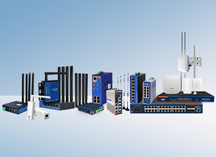
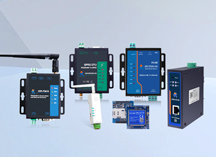
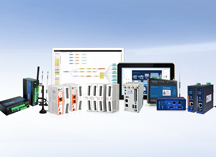
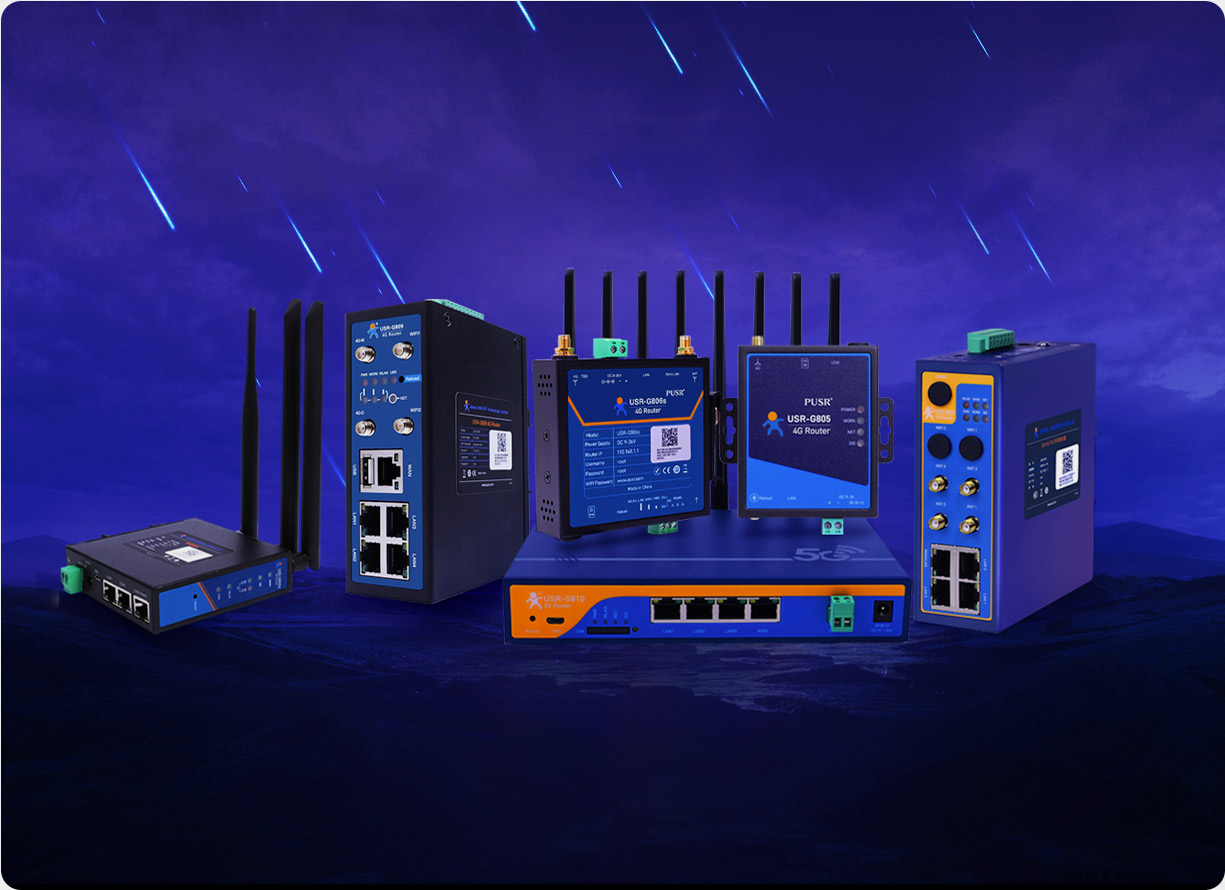
When it comes time to choose an industrial router, the most common question is: 4G or 5G? There is no one-size-fits-all answer—only the answer that fits the application. Industrial routers on the market can be broadly divided into two camps: 4G industrial router represented by the G806w, and 5G industrial router represented by the G816. To decide, break the deployment down into three questions and work through them one by one.
Bandwidth is the first hard requirement, and it comes down to peak uplink throughput.
Most industrial workloads generate far less data than expected:
Estimated at "a few messages at a time, a few hundred bytes each," these workloads leave plenty of headroom on a 4G uplink. A 4G industrial router like the G806w handles them comfortably, at a lower cost for both the hardware and the data plan.
The signal to look at 5G is equally clear: sustained video backhaul. A single 1080p surveillance stream typically runs at 2–4 Mbps; a few concurrent streams, plus backhaul to the platform, push uplink demand from kilobytes up to tens of megabits per second. That is where a 5G industrial router like the G816 comes in.
How to judge: total up "concurrent video streams × per-stream bitrate," compare it against realistic uplink bandwidth (4G typically delivers tens of Mbps, 5G an order of magnitude higher), and keep 30%–50% headroom. Data-only workloads are fine on 4G; with continuous video or large-file uploads, move straight to 5G.
The second question is about the site topology.
With one or two Ethernet devices on site—say, a single PLC or an HMI—the G806w's three Ethernet ports plus Wi-Fi cover the whole setup. Fewer devices mean simpler wiring and no reason to step up to a more expensive platform.
It is different when the site becomes a small network of its own: PLCs, HMIs, cameras, and NVRs all need IP addresses, and some setups also hang serial devices off the router. With multiple devices running at once and cameras constantly exchanging data with the NVR, port count and gigabit-speed LAN become must-haves. That is exactly where the G816 fits in: multiple gigabit ports plus a serial interface, replacing the "router + switch" combination with a single unit.
A quick rule of thumb: one or two devices and modest internal traffic—the G806w covers it; many devices and heavy traffic inside the site—choose the G816.
The reliability requirement decides whether redundancy is worth paying for.
For unattended sites and production lines that run 24/7, a broken link means downtime, a surveillance blind spot, or a gap in data. These applications cannot accept the risk of a single SIM on a single carrier, so they need dual-SIM redundancy: when the primary SIM loses signal or runs out of credit, the router switches to the backup automatically. Dual-SIM, high-availability operation is exactly where the G816 is at home.
Conversely, where staff are on site, downtime is manageable, and recovery is fast, a single-SIM G806w is enough—no point paying for redundancy that never gets used.
Two more factors are easy to overlook:
|
Decision factor |
Choose G806w (4G) |
Choose G816 (5G) |
|
Application |
PLC monitoring, basic SCADA, machine remote access |
Video backhaul, demanding remote applications |
|
Uplink bandwidth |
KB-level to low Mbps |
Sustained tens of Mbps and above |
|
On-site devices |
A few Ethernet devices |
Many Ethernet/serial devices; gigabit required |
|
Link requirements |
Single SIM acceptable |
Dual-SIM redundancy, high availability |
|
Budget & scale |
Multi-site, cost-sensitive |
High value per site, room to grow |
If 4G is enough, pick the G806w; if the requirement is 5G, high bandwidth, or more interfaces, pick the G816. Work through the three questions—data volume, device count, and link reliability—and the right model becomes obvious. The rest is deployment.