5G+AI Edge Computing Embedded Single Board Computer: The Hardware Solution That Gives AGVs Workshop-Level Real-Time Decision-Making Capability
Last year, a client came to me and said something I still remember:
"Our AGV runs fast enough, but the moment it encounters a person, it goes dumb — it's not that it can't avoid obstacles, it's just half a beat too slow."
Half a beat.
In a lab, half a beat is nothing. On the workshop floor, half a beat is someone almost getting hit, a production line almost shutting down, a project almost falling apart.
He asked me: Can you make the AGV judge for itself — is this person just passing by, or are they blocking my path? Can it make that decision within 100 milliseconds, instead of sending data back to a server and waiting 300 milliseconds for a command?
Yes. But it's not something a faster WiFi can solve. What you need to replace is the embedded single board computer inside the AGV's "brain."
You might think AGVs aren't smart enough because the algorithms are weak.
Not entirely.
Corvalent's industrial PC fundamentals article states it clearly:
"Industrial PCs are designed to operate in demanding environments… Unlike consumer-grade PCs, industrial PCs are built to withstand these harsh conditions."
But what it doesn't fully explain is — most embedded single board computer sused in AGVs simply weren't designed for "edge intelligence."
The traditional AGV architecture looks like this:
Sensors → Collect data → Send to WiFi → Deliver to server → Server computes → Sends command back → AGV executes
One command, running through three nodes. Latency of 300–800 milliseconds. In a high-speed workshop, that's the distance between an accident and safety.
There's a data point in Nalarobot's selection guide you absolutely must see:
"According to a recent industry report, around 21% of all equipment failures come from unsuitable environmental conditions."
21% of failures come from environmental mismatch. But there's another category of hidden failures that the data doesn't capture — safety incidents and production line interruptions caused by "decisions that are too slow."
These incidents won't show up in your failure reports. But they will show up in your project review meeting.
Let's strip the concepts clean first.
5G solves the "communication pipeline" problem — low latency, high bandwidth, massive connections. An AGV on the workshop floor is simultaneously communicating with dozens of devices and multiple base stations. 4G can't handle it. WiFi can't handle it even less.
AI edge computing solves the "where is the decision made" problem — not everything needs to go back to the cloud. A person suddenly appears in front of the AGV. That decision must be made locally, within 100 milliseconds. Wait for the cloud to respond? The person has already been hit.
Put these two together, and you get "workshop-level real-time decision-making capability."
In plain language:
| Scenario | Traditional Solution | 5G+AI Edge Solution |
|---|---|---|
| Obstacle suddenly appears ahead | Send to server → wait 300ms → receive command → brake | Local AI judgment → brake within 50ms |
| Multiple AGVs at an intersection | Central scheduling queue → pass one by one | Edge board real-time negotiation → pass simultaneously without collision |
| Production line temporary reroute | Manually issue new path → 5-minute shutdown | Edge AI autonomous planning → switch without stopping |
| Unmanned workshop at night | Run on preset routes → stop when encountering unexpected events | Real-time sensing + decision-making → autonomously handle exceptions |
Eurocoin's article on CPU selection said something very accurate:
"AI-based systems or digital signage demand significantly higher CPU and GPU performance."
The edge AI on an AGV demandsten times morefrom the embedded single board computer than digital signage does. Because it's not "displaying content" — it's saving lives.
Many people think just picking an "embedded single board computer with AI acceleration" is enough.
Too naive.
Let me list the six most real pain points from the actual workshop floor. Look at them and tell me which one you haven't encountered:
You want to run YOLO object detection, SLAM mapping, and path planning on the AGV — all three tasks simultaneously.
A standard embedded single board computer'sNPU has less than 2 TOPS of compute. The moment you load your model in, the frame rate drops below 5 fps. What's 5 fps? At 1 m/s, the AGV moves 20 centimeters between frames. 20 centimeters — that's enough to hit someone.
Nalarobot puts it plainly:
"Look for a multi-core CPU with a high clock speed. This allows for better multitasking and processing efficiency."
Multi-core, high-frequency, plus an independent NPU. Missing any one of the three, and your AI is just decoration.
This is the trap most people fall into.
The embedded single board computer runs perfectly fine on its own. The moment you plug in a 5G module, the system starts randomly rebooting. Why? The power draw and electromagnetic interference from the 5G module punch through the already-tight power delivery and signal integrity.
Corvalent's article specifically mentions:
"Industrial power supplies are designed to handle high electrical loads, voltage fluctuations, and environmental stressors."
If your board's power design didn't leave headroom for the 5G module, that's not the module's problem — it's the board's problem.
Summer workshop. No air conditioning. Ambient temperature easily hits 40–45°C.
If your embedded single board computer uses fan cooling, dust clogs the heatsink within three months. If it's passively cooled but the thermal design is poor, the CPU throttles down to 60% of its original speed.
What does 60% throttling mean? Your AI inference goes from 50ms to 150ms. 150ms in an AGV scenario is the difference between "safe" and "dangerous."
Nalarobot's cited data:
"Inadequate cooling increases failure rates by up to 40%."
Not trying to scare you. It's real.
One AGV needs to connect: LiDAR, depth camera, IMU, encoder, safety bumper, 5G module, PLC communication port…
A standard embedded single board computer gives you 4 USB, 2 serial ports, 1 LAN port. Count them. Enough?
Nope. You have to add expansion boards. After that, the form factor grows, power consumption rises, and failure points multiply.
Your AGV project cycle is 3 years. If theembedded single board computeryou chose gets discontinued by the supplier next year, what about spare parts for the 500 AGVs behind it?
Eurocoin puts it well:
"The performance, reliability, and long-term availability of your industrial PC systems directly impact uptime, maintenance costs, and overall system stability."
Long-term supply isn't a bonus — it's a requirement.
Domestic projects are one thing. The moment your AGV needs to sell to Europe or North America, CE, FCC, and Class B certifications are all mandatory.
Many embedded single board computers work fine domestically, but when it comes to export projects, the certifications can't be produced, and the entire delivery cycle gets dragged out by two months.
Reverse the six pain points above, and you get your selection checklist:
| Dimension | Minimum Requirement | Ideal State |
|---|---|---|
| CPU | 8+ cores, ≥2.0 GHz clock speed | Multi-core + independent NPU, AI compute ≥6 TOPS |
| Memory | 16GB | 32GB, supports model resident in memory |
| Cooling | Passive cooling | Fully passive fanless, withstands 45°C ambient |
| 5G Support | Compatible with 5G modules | Native 5G interface, independent power design |
| I/O | USB×4 + Serial×4 + LAN×2 | Rich I/O, sensors connect directly without expansion boards |
| Lifecycle | 3-year supply guarantee | 5+ years, same architecture continuous iteration |
| Certification | Basic EMC | CE + FCC + Class B complete |
Take this checklist to the market and you'll find — products that meet all of it simultaneously can be counted on one hand.
After all those pain points, let's get to the product.
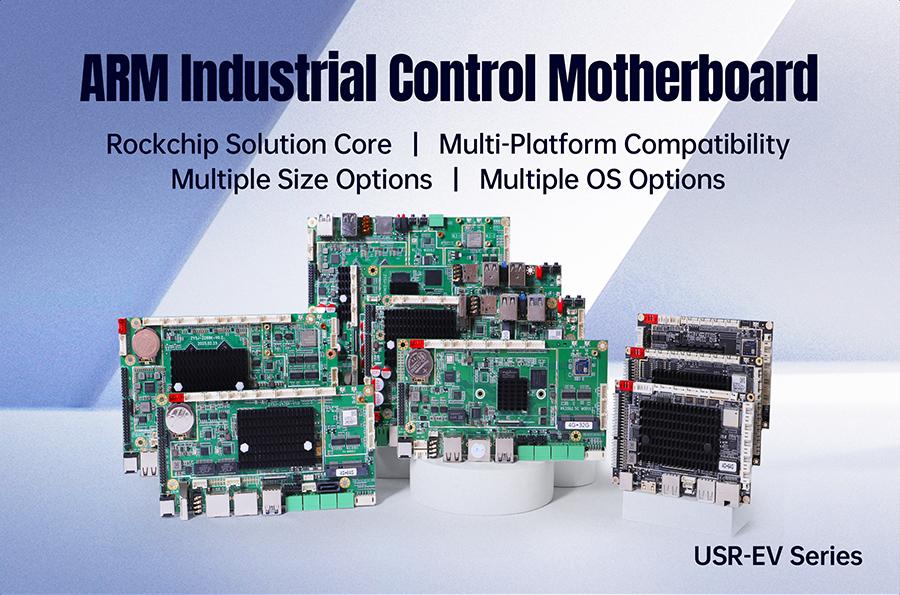
TheUSR-EV series embedded single board computer is one of the solutions I've seen that comes closest to that "ideal state" checklist above.
I'm not saying it's perfect. I'm saying its capability model happens to sit right in the sweet spot of AGV edge AI requirements:
| AGV Edge Computing Pain Point | USR-EV Series' Corresponding Capability |
|---|---|
| AI models can't run | Integrated high-compute NPU, supports real-time inference of YOLO/SLAM and other mainstream models |
| 5G module crashes the system | Independent power domain design, 5G module electrically isolated from main system — no interference |
| Throttling at 40°C workshop | Fully passive fanless cooling, wide-temp design -20°C~60°C continuous full-load operation |
| Can't connect all sensors | Rich I/O interfaces — LiDAR/camera/PLC/encoder connect directly, minimal need for expansion boards |
| Will it still be available next year? | Long lifecycle supply, industrial-grade component selection — not a consumer-grade retrofit |
| Export certification gets stuck | CE/FCC certified, compliant out of the box |
| Board too big to fit in the AGV | Compact design, fits neatly into AGV control boxes |
It's not a "can do everything" universal board. It's a dedicated board that hasthought through AGV edge AI clearly.
People who work on AGV projects don't fear technical difficulty the most.
They fear that when something goes wrong, no one takes the hit.
Algorithm won't converge? Your problem. Communication drops? Your problem. AGV hits someone? Still your problem.
The embedded single board computer you choose is your "stand-in" on the floor. It runs the AI for you, handles the communication for you, refuses to throttle in a 40°C workshop for you, refuses to reboot at 3 AM for you.
Pick right, and it's your most reliable teammate. Pick wrong, and it's the biggest "pit" in your project review meeting.
Put theUSR-EV serieson your comparison list. Use the table above, line by line.
But remember one thing:
An AGV's intelligence isn't in the cloud. It isn't in the algorithm PowerPoint. It's on that palm-sized embedded single board computer.
Pick the right board, and your AGV isn't a "dumb transporter" — it's a truly thinking workshop partner.