5G+cellular router: The Solution to Breaking Down "Data Silos" in Smart Manufacturing Production Lines
In the wave of smart manufacturing, data has become the core element driving production. However, many manufacturing enterprises are trapped in the dilemma of "data silos": production line equipment operates independently, and data cannot be interconnected; incompatible protocols between different systems hinder information transmission; high network latency and poor stability render real-time monitoring and decision-making ineffective... These issues not only reduce production efficiency but also cause enterprises to miss out on golden opportunities for digital transformation.
"We've invested a lot of money in upgrading equipment, so why has production line efficiency decreased instead?" The confusion of a manager at an auto parts factory echoes the sentiments of countless manufacturing enterprises. In the transition to smart manufacturing, technological bottlenecks are often more fatal than a shortage of funds. The emergence of 5G+cellular routers is providing a key to unlocking this predicament.
In traditional production lines, devices such as PLCs, sensors, and robots often use proprietary protocols from different manufacturers (e.g., Modbus, Profinet, EtherCAT, etc.), resulting in inconsistent data formats that are difficult to directly interconnect. For example, in an electronics manufacturing enterprise, the SMT placement machine and AOI inspection equipment were incompatible in protocol, requiring manual data export and analysis, which led to a defect detection delay of up to 4 hours and annual losses exceeding RMB 10 million.
Pain Point Empathy:
"We've tried using middleware to convert protocols, but every time we upgrade equipment, we have to re-adapt, and the maintenance costs are terrifying." - IT Manager at a Home Appliance Enterprise
Industrial scenarios have extremely high requirements for network latency and reliability. For example, robotic arm collaboration requires millisecond-level response times, while traditional Wi-Fi or 4G networks often suffer from signal interference and insufficient bandwidth, leading to delayed or lost commands and causing accidents such as equipment collisions and production interruptions. In a remote-controlled overhead crane project at a steel enterprise, network latency increased the error rate by 30%, ultimately forcing a return to manual operation.
Pain Point Empathy:
"Every time the network fluctuates, the production line has to be shut down for inspection. Workers complain that 'the network is harder to predict than the weather.'" - Production Supervisor at a Chemical Enterprise
Traditional industrial networks rely on wired connections, with wiring costs accounting for more than 30% of total project investment. More challenging is the poor flexibility of wired networks, which makes it difficult to adapt to the rapid adjustment needs of production lines. A 3C manufacturing enterprise spent 2 months and over RMB 2 million just on rewiring for a new automated production line, severely delaying the product launch cycle.
Pain Point Empathy:
"We want to implement flexible manufacturing, but every time we adjust the production line layout, it's a major undertaking, so in the end, we just give up." - Factory Manager at a Toy Enterprise
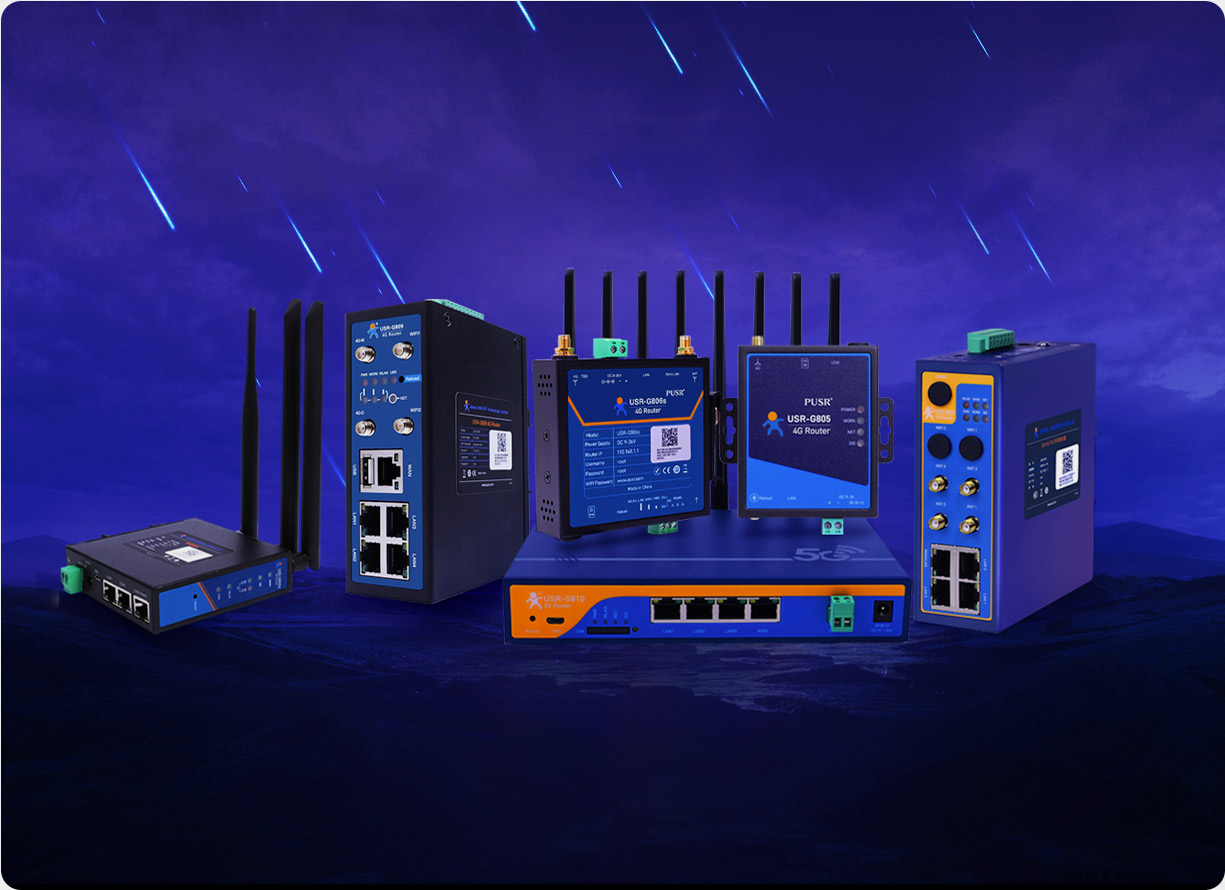
The 5G+cellular router supports dozens of industrial protocols such as Modbus, Profinet, and OPC UA through its built-in protocol conversion engine, enabling automatic parsing and standardized transmission of device data. For example, the USR-G816 cellular router can simultaneously connect PLCs, sensors, and robots, using edge computing to unify multi-source data into JSON format for direct upload to the cloud or local MES system, eliminating intermediate protocol conversion links and improving data transmission efficiency by 80%.
Scenario-Based Case Study:
After adopting the USR-G816, an auto parts enterprise reduced the data interconnection time between its SMT placement machine and AOI inspection equipment from 4 hours to 5 minutes, decreased the defect miss rate to 0.2%, and saved over RMB 3 million in annual quality inspection costs.
The three characteristics of 5G networks (10Gbps bandwidth, 1ms latency, and million-level connections) provide an ideal carrier for industrial control. The 5G+cellular router ensures network stability through the following technologies:
Dual-Link Backup: Supports intelligent switching between 5G+wired/Wi-Fi networks, automatically switching to a backup link in case of a primary link failure to ensure "zero interruption" of business.
Edge Computing: Deploys AI algorithms locally on the router for real-time analysis of critical data (e.g., equipment vibration, temperature), with abnormal detection latency below 10ms, 10 times faster than cloud processing.
QoS Guarantee: Allocates dedicated channels for control commands through VLAN division and bandwidth priority configuration to avoid interference from high-traffic services such as video surveillance.
Scenario-Based Case Study:
After deploying the USR-G816, a steel enterprise reduced the network latency of its remote-controlled overhead crane from 200ms to 8ms, eliminating operation errors and saving over RMB 5 million in annual equipment collision losses.
The 5G+cellular router adopts a wireless design, supporting PoE power supply and rail-mounted installation, enabling rapid deployment in mobile scenarios such as AGV trolleys and inspection robots. Its IP30 protection rating and -20℃~75℃ wide temperature operating capability adapt to harsh industrial environments, reducing maintenance costs associated with wired connections.
Scenario-Based Case Study:
Through the wireless networking capabilities of the USR-G816, a 3C manufacturing enterprise shortened its production line adjustment cycle from 2 months to 1 week, reduced the cost of adding new production lines by 60%, and successfully achieved its flexible production goal of "launching 2 new products per month on average."
Many enterprises, when first introduced to 5G+cellular routers, express concerns about technological stability (e.g., insufficient 5G private network coverage) and cost issues (e.g., higher unit prices for routers compared to traditional equipment). However, with a 90% reduction in 5G module prices (targeted for 2027) and the implementation of subsidy policies for "5G+Industrial Internet" projects, small and medium-sized enterprises can now access these technologies at a low cost. For example, the USR-G816 supports Redcap lightweight 5G modules, reducing power consumption by 40% and costing only one-third of traditional 5G modules, making them affordable for small and medium-sized enterprises.
Customer Testimonial:
"We were initially worried that 5G routers would be too expensive, but after learning about the policy subsidies, the actual procurement cost was lower than upgrading our wired network." - CIO at a Textile Enterprise
Enterprises often worry that new equipment will be incompatible with existing systems or increase operational burdens. The 5G+cellular router addresses these concerns through the following designs:
Open Ecosystem: Supports the OpenWrt open-source system, allowing custom development of drivers and protocol stacks for seamless integration with any industrial platform.
Cloud Management: Enables remote configuration, firmware upgrades, and fault diagnosis of devices through the USR Cloud platform, improving operational efficiency by 90%.
Standardized Interfaces: Provides a rich set of interfaces including RS232/485, Ethernet, and Wi-Fi, compatible with over 90% of industrial equipment.
Customer Testimonial:
"Previously, modifying a production line required our IT team to be on-site for a week, but now we can complete the configuration in 5 minutes using the cloud platform." - IT Manager at an Equipment Manufacturing Enterprise
The value of the 5G+cellular router lies not only in solving current pain points but also in reserving space for future upgrades. Its edge computing capabilities support local AI model inference, enabling enterprises to gradually implement advanced applications such as predictive maintenance and quality traceability as data accumulates. For example, the USR-G816 has integrated the TensorFlow Lite framework, allowing enterprises to develop their own equipment fault prediction models and reduce unplanned downtime by 50%.
Customer Testimonial:
"We used the data collected by the router to train an AI model, and now we can predict equipment failures 3 days in advance, reducing maintenance costs by 40%." - Equipment Director at a Chemical Enterprise