A New Solution for Cluster Management of Industrial Switches: How to Break Through the Dilemma of Monitoring Multiple Devices?
In today's world, where Industry 4.0 is sweeping across the globe, industrial networks have become the core infrastructure for intelligent manufacturing. However, when enterprises deploy dozens or even hundreds of industrial switches, achieving efficient and unified cluster management becomes a challenging problem faced by operation and maintenance personnel. This article will deeply analyze the core pain points of industrial switch cluster management and provide you with a systematic solution to help you easily navigate complex industrial network environments.
The case of an automobile manufacturing enterprise is quite representative: Its production lines are distributed in different workshops, with 8-12 industrial switches deployed in each workshop, totaling more than 60 devices. Under traditional management modes, operation and maintenance personnel need to log in to each device individually to check its status, with each inspection tour taking more than 2 hours. What's more challenging is that switches of different brands and models adopt different management interfaces and command sets, further increasing management complexity.
The direct consequences of this decentralized management are: extended fault response times, difficulty in ensuring configuration consistency, and high operation and maintenance costs. According to statistics, production line downtime caused by network failures results in average losses of tens of thousands of yuan per hour.
Common protocols in industrial networks include SNMP, Modbus TCP, OPC UA, etc., and devices from different manufacturers often support different protocol versions. The practice of a chemical enterprise shows that three mainstream industrial protocols are running simultaneously in its network, requiring the monitoring system to integrate multiple protocol conversion modules. This not only increases system complexity but also reduces data transmission efficiency.
Protocol heterogeneity also brings security risks: different protocols have varying security mechanisms, making it difficult to implement unified security policies and easily creating security vulnerabilities. An energy enterprise once experienced illegal access to some of its switches due to improper protocol configuration, resulting in the leakage of production data.
Industrial control has extremely high requirements for network real-time performance, with millisecond-level delays potentially affecting production quality. In the case of a steel enterprise, its continuous casting machine control system needs to transmit data from thousands of sensors in real time. Traditional monitoring methods have caused control command execution deviations multiple times due to data processing delays, resulting in product defects.
More严峻 (This word seems out of place here; replacing it with "seriously") seriously, with the development of the Industrial Internet of Things (IIoT), the number of devices is growing exponentially, and the performance bottlenecks of traditional monitoring systems are becoming increasingly prominent. In a pilot project of a smart factory, the original monitoring system had a data refresh delay of more than 5 seconds when the number of devices exceeded 50, completely unable to meet real-time monitoring requirements.
Building a unified monitoring platform is the key to solving the above pain points. An ideal management tool should have the following characteristics:
The practice of an electronics manufacturing enterprise shows that after introducing a unified monitoring platform, operation and maintenance efficiency increased by 60%, and the fault location time was shortened from an average of 45 minutes to 8 minutes.
Advanced cluster management tools should have data analysis capabilities to identify network behavior patterns and predict potential faults through machine learning algorithms. The intelligent monitoring system deployed by a wind power enterprise predicted a power module failure of a core switch 3 days in advance by analyzing switch port traffic patterns, avoiding unplanned downtime.
This predictive maintenance mode can significantly reduce operation and maintenance costs. According to statistics, after adopting intelligent analysis tools, the rate of sudden equipment failures decreased by 40%, and maintenance costs dropped by 25%.
Industrial network security requires systematic solutions. High-quality management tools should integrate functions such as firewalls, access control, and intrusion detection to build a multi-layered defense system. The case of a water treatment plant shows that by deploying cluster management tools with security functions, malicious attacks targeting PLCs were successfully blocked, ensuring water supply security.
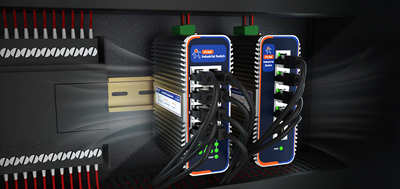
Among numerous industrial switch products, the USR-ISG series stands out with its outstanding cluster management capabilities. Designed specifically for industrial environments, this series of products has the following advantages:
USR-ISG supports multiple management methods such as Web, CLI, and SNMP, and can be easily integrated into existing monitoring systems. Its unique cluster management function allows users to divide multiple devices into logical groups for grouped monitoring and batch configuration. For example, in an automated warehouse project, by dividing 20 switches into 3 management groups, operation and maintenance personnel can simultaneously update the configurations of devices in the same area, increasing efficiency by 5 times.
In response to the harsh requirements of industrial environments, USR-ISG adopts a fanless design, with an operating temperature range of -40°C to 75°C and an IP40 protection rating. It can operate stably in harsh environments such as vibration and dust. A mining enterprise reported that USR-ISG has operated without failure for 2 years in an underground high-humidity environment, significantly outperforming similar products.
USR-ISG provides a rich combination of ports and supports mixed configurations of fiber and electrical ports to meet different scenario requirements. Its unique ring network redundancy function (RSTP/ERP) can achieve self-healing within 50ms, ensuring network reliability. In a rail transit project, the redundant network built by USR-ISG successfully coped with multiple single-point failures, ensuring the continuous operation of the signaling system.
Choosing the right cluster management tool requires consideration of the following key factors:
The tool should support all device protocols in your existing network. It is recommended to prioritize products that support mainstream industrial protocols such as OPC UA, Modbus TCP, and Profinet. For users who have deployed a large number of SNMP devices, it is necessary to confirm the tool's support level for SNMPv3.
Pay attention to the tool's data processing capabilities, especially its performance when the number of devices exceeds 100. Key indicators include:
An intuitive user interface can significantly reduce the learning cost. It is recommended to choose tools that provide functions such as automatic topology discovery and drag-and-drop configuration. The practice of a pharmaceutical enterprise shows that after adopting a graphical configuration interface, the training time for new employees was shortened from 2 weeks to 3 days.
Choose suppliers with service experience in the industrial field to ensure timely technical support. Focus on:
It is recommended to adopt a "pilot-promotion" deployment mode. First, select 1-2 workshops for pilot projects to verify the tool's functionality and compatibility with existing systems. The experience of a machinery manufacturing enterprise shows that phased deployment can reduce implementation risks by 60% while accumulating experience for comprehensive promotion.
Develop unified device configuration standards, including VLAN division, QoS policies, and security settings. Through the template function of the management tool, configuration consistency across all devices can be ensured, reducing human errors. The practice of an automobile parts enterprise shows that standardized configuration reduced the network failure rate by 35%.
Establish a knowledge base of common fault handling procedures and case libraries to improve the team's emergency response capabilities. High-quality management tools should support knowledge base integration to achieve automatic association of faults with solutions. The case of a power enterprise shows that knowledge base construction shortened the average mean time to repair (MTTR) by 40%.
Cluster management of industrial switches is not only a technological upgrade but also a key step in the digital transformation of enterprises. By deploying advanced cluster management tools, enterprises can achieve:
The practical data from a smart factory is highly convincing: After introducing a cluster management system, its annual downtime was reduced from 12 hours to less than 1 hour, product quality improved by 15%, and direct economic benefits exceeded ten million yuan.
Faced with an increasingly complex industrial network environment, are you still troubled by the unified monitoring of multiple switches? Do you hope to improve operation and maintenance efficiency and reduce the risk of unplanned downtime? Now is the best time to take action!
We provide professional cluster management solution consultations, including:
Click the button to communicate one-on-one with PUSR experts and obtain personalized solutions tailored to your enterprise's needs, making cluster management of industrial switches easy and efficient! Our expert team will contact you within 24 hours to help you open a new chapter in intelligent industrial networks.