Analysis of Edge Computing Capabilities of 4G Modem: How to Achieve Local Data Preprocessing and Filtering?
In the wave of the Industrial Internet of Things (IIoT), data has become a core element driving scenarios such as intelligent manufacturing, smart energy, and smart logistics. However, among the massive amounts of data generated by industrial on-site equipment, less than 20% has actual analytical value, while the remaining 80% is redundant or noise data. If all data is transmitted to the cloud without screening, it will not only occupy a large amount of bandwidth resources and increase cloud storage and computing pressure but also cause critical data to be drowned out by noise, affecting the accuracy of real-time decision-making. How to leverage the edge computing capabilities of 4G modem to achieve local data preprocessing and filtering has become key to solving this pain point.
Industrial on-site equipment (such as PLCs, sensors, and meters) typically collect data at millisecond-level frequencies, but a large amount of this data consists of duplicate or invalid values. For example, a vibration sensor in a wind farm collects 1,000 data points per second, but 90% of this data has minimal fluctuation ranges under normal operating conditions and only needs to be uploaded in abnormal situations. If all data is directly transmitted to the cloud, a single device will generate more than 2.5GB of redundant data per month, resulting in a network bandwidth occupancy rate of up to 80% and a threefold increase in cloud storage costs.
In scenarios such as power failure warnings and intelligent manufacturing production line control, the real-time processing of data directly determines system safety and production efficiency. For example, in a scenario where the temperature of circuit breaker contacts in a substation is monitored, temperature anomalies need to trigger alarms within 100 milliseconds. However, the delay in transmitting data to the cloud and then issuing instructions via traditional 4G modem exceeds 500 milliseconds, failing to meet real-time requirements. By using local edge computing, data parsing, anomaly judgment, and alarm triggering can be completed within 10 milliseconds, improving response speed by 50 times.
Industrial data contains sensitive information such as equipment operating parameters and process flows. If this data is uploaded directly to the cloud without processing, it may face risks of data leakage or malicious attacks. For example, a car manufacturing enterprise once experienced an attack on its cloud database, resulting in the leakage of core process parameters and direct economic losses exceeding ten million yuan. Through local edge computing, data can be desensitized before leaving the equipment, with only statistical results or encrypted key parameters being uploaded, significantly reducing security risks.
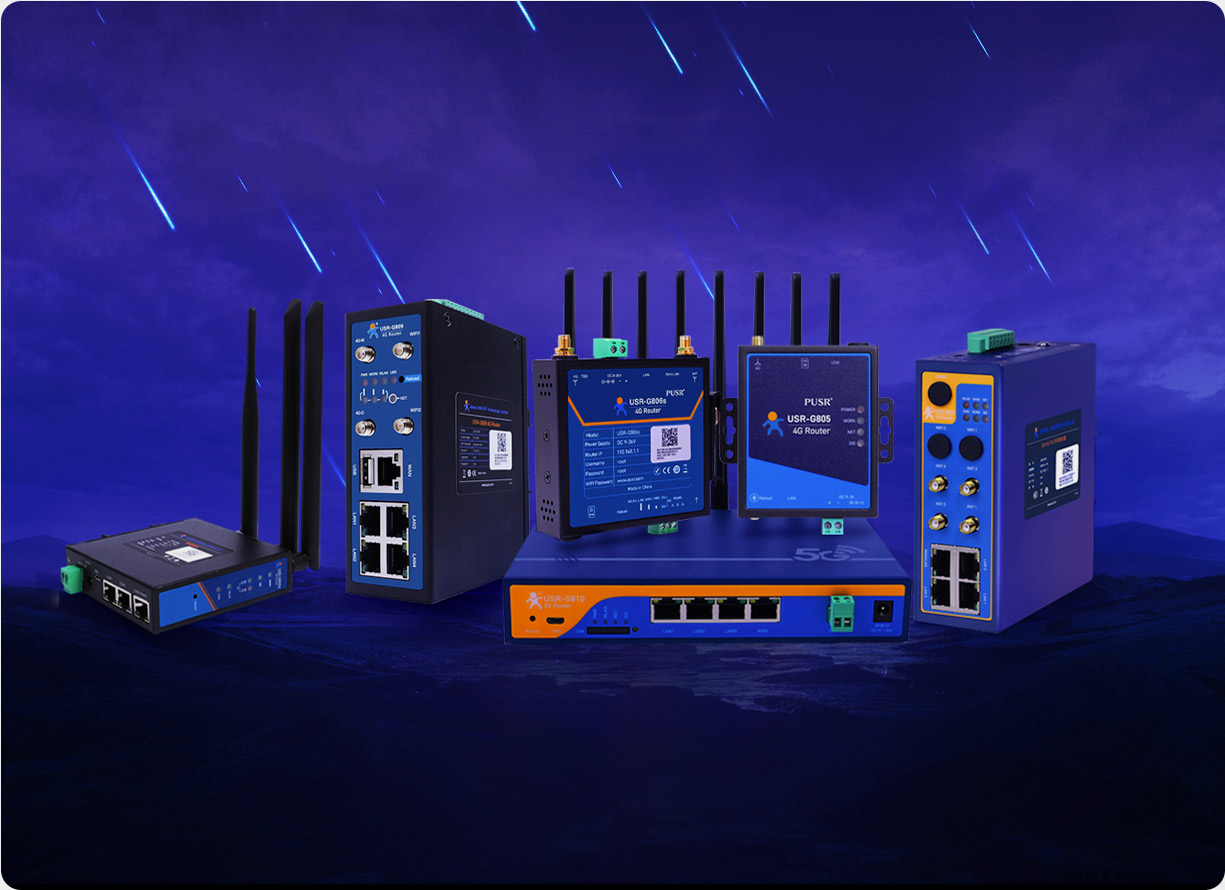
Traditional 4G modems only have data transparent transmission functions, while modern 4G modems (such as the USR-G771) have upgraded from "data transporters" to "local intelligent nodes" by integrating edge computing modules. Their core capabilities include:
In industrial scenarios, equipment operating conditions (such as load and ambient temperature) change dynamically, and fixed thresholds may lead to false alarms or missed alarms. The USR-G771 supports dynamic threshold adjustment based on a sliding window algorithm, which can automatically calculate reasonable threshold ranges under current operating conditions based on historical data. For example, in power load monitoring scenarios, when load fluctuations exceed 20% of the historical average, the system automatically adjusts the current overload threshold to avoid false alarms triggered by short-term load surges.
Industrial on-site equipment uses diverse protocols (such as Modbus RTU, OPC UA, and DL/T 645), while cloud platforms typically require unified data formats (such as JSON and XML). The USR-G771 supports the parsing of more than 20 industrial protocols, can convert raw data from different protocols into standard formats, and add metadata such as device identifiers and timestamps for unified cloud processing. For example, converting register values in the Modbus RTU protocol into JSON format {"temperature": 25.5, "current": 10.2} and adding device IDs and collection times enables "plug-and-play" cloud connectivity.
In the event of network interruptions or cloud failures, the USR-G771 can locally store data in a 16GB eMMC memory and support 72-hour caching. After the network is restored, the system automatically resumes transmitting breakpoint data in chronological order to avoid data loss. For example, in remote oil and gas pipeline monitoring scenarios, the USR-G771 achieves stable connectivity in weak signal environments of -110dbm through satellite communication, ensuring data integrity even during network interruptions.
A wind farm deployed 50 wind turbine generators, with each unit equipped with three vibration sensors collecting 1,000 data points per second. In the traditional solution, all data was uploaded to the cloud via a 4G modem, resulting in a bandwidth occupancy rate of up to 90% and cloud analysis delays exceeding 500 milliseconds. After adopting the USR-G771:
A car manufacturing enterprise's production line deployed 200 PLCs, each collecting 100 process parameters (such as temperature, pressure, and rotational speed) and uploading data once per second. In the traditional solution, the cloud needed to process 20,000 data points per second, resulting in excessive server loads and control instruction issuance delays exceeding 200 milliseconds. After adopting the USR-G771:
Ensure that the 4G modem supports the protocols of target devices (such as Modbus RTU, OPC UA, and DL/T 645).
Prioritize 4G modems that support emerging transmission protocols such as MQTT over QUIC to adapt to different network environment requirements.
Choose a 4G modem that supports SSL/TLS encrypted transmission and two-way certificate verification to prevent data leakage.
Prioritize 4G modems equipped with hardware-level security chips (such as TPM 2.0) to achieve encrypted data storage and secure booting.
Choose a 4G modem that has passed IP67 protection level and EMC Level 4 certifications to withstand high temperatures, high humidity, and strong electromagnetic interference.
Prioritize 4G modems that support wide voltage input (9-36V) and rail mounting for easy on-site deployment.
In the wave of the Industrial Internet of Things, edge computing 4G modems have become key devices for solving pain points related to data redundancy, real-time performance, and security. Through local preprocessing and filtering, 4G modems can intercept 80% of redundant data at the edge and only upload 20% of key data to the cloud, significantly reducing bandwidth, storage, and computing costs. At the same time, local real-time decision-making capabilities improve system response speeds by more than 10 times, providing reliable guarantees for scenarios such as power failure warnings and intelligent manufacturing production line control.
If you are facing challenges such as low industrial data processing efficiency, poor real-time performance, or high security risks, please contact us. We will provide you with customized edge computing 4G modem solutions to assist you in your industrial intelligence upgrade!