On livestock farms where feed trucks come and go all day, weighing often still runs the old way: the weighbridge reading gets copied onto paper by whoever is on gate duty, and silo levels get estimated by someone climbing the tower. The numbers end up scattered across notebooks, and discrepancies only surface at month-end reconciliation, with no way to trace where they came from. Changing this does not require replacing the existing weighbridge or silo load cells. What is missing is simply a path for carrying data from the weighing indicator up to the cloud. Along that path, weighbridges and silos call for different approaches.
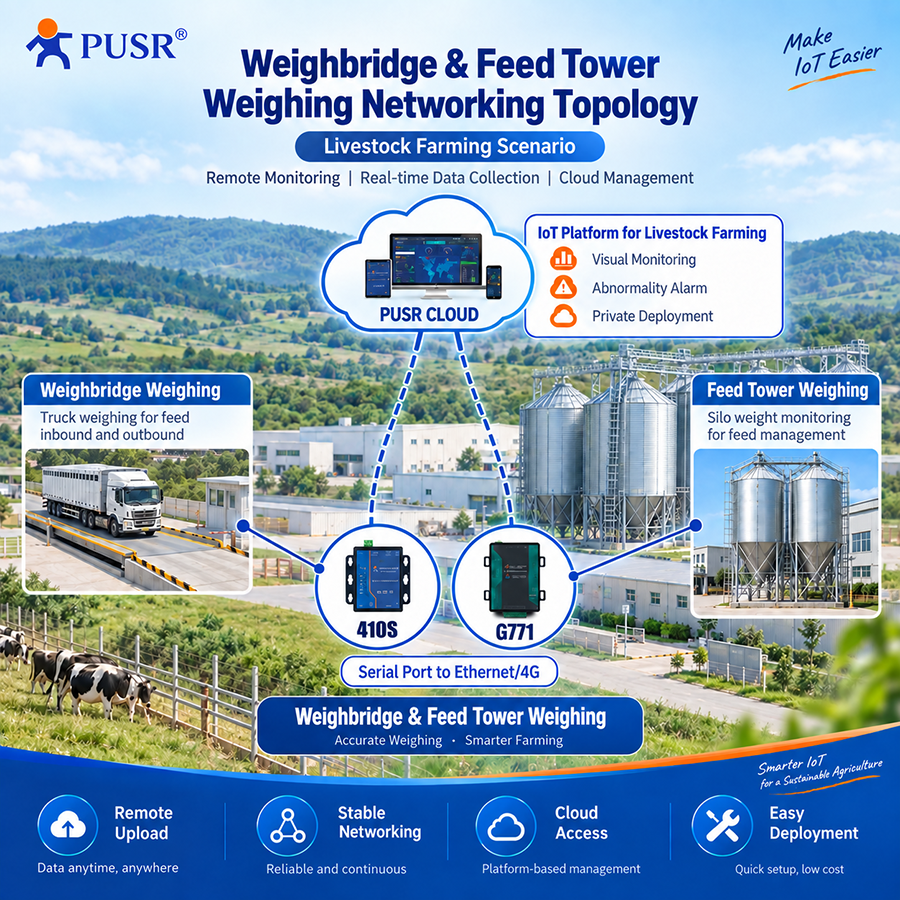
Weighbridge weighing covers inbound and outbound feed trucks. A truck is weighed empty on entry and loaded on exit (or the other way round), and the difference gives the net weight — the raw basis for reconciling how much feed was purchased and how much was consumed. The requirement here is accuracy, traceability, and association with vehicle records.
Silo weighing covers inventory management on the pen side. Load cells at the base of each silo output the current feed weight continuously, and managers use it to plan refill cycles and to catch abnormal consumption. Silos are spread out across the pen area, so the requirement is remote visibility and an automatic alert when levels fall below a threshold.
What the two have in common: weighing indicators almost always output over RS232 or RS485. The networking task is to get that serial data delivered reliably to a management platform.
Which path applies depends on the network conditions at each site.
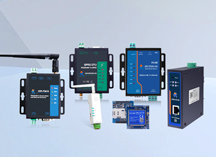
Where cabling exists, use a serial to ethernet converter.Weighbridge houses usually have a duty room and broadband access. Connect the indicator's RS232 or RS485 to the PUSR serial to ethernet converter USR-TCP232-410s, plug the device's RJ45 port into the site router, and data travels over Ethernet straight to the cloud platform. This path is stable, low-latency, and carries no cellular data charges — a fit for weighbridges, which are fixed points with high weighing frequency.
Where cabling does not exist, use an industrial cellular modem.Silos tend to sit at the edge of the pen area, where pulling cable is expensive or simply not feasible. The load cell's serial port connects to the PUSR industrial cellular modem USR-G771, which sends data to the cloud over 4G. The device ships with a DIN-rail clip, so it drops straight into the control cabinet beside the tower, and its wide-voltage terminal input takes power from the local switching supply.
Both paths converge on the same platform. The topology uses PUSR Cloud, which provides visualization, alarm handling and private deployment. For livestock groups that must keep data on premises, MQTT can also be used to connect to a self-hosted server.
USR-TCP232-410s (serial to ethernet converter):Its RS232 and RS485 ports work independently at the same time, so one unit can handle the weighbridge indicator and a backup weighing channel simultaneously. Supported protocols include TCP/UDP, MQTT, and conversion between Modbus TCP and Modbus RTU — whether the indicator speaks a proprietary protocol or standard Modbus, there is a way to interface. Operating range is -40°C to 85°C with DC 5–36 V input; the serial and Ethernet loops are rated for 1 kV surge and burst, the power loop for 2 kV, which suits the dust, humidity and thunderstorm-season electrical noise of a weighbridge house. Dual watchdogs and automatic reconnection reduce site visits. Edge computing allows polling and filtering rules to be preconfigured on the device so only meaningful data is reported, easing the load on the platform.
USR-G771 (industrial cellular modem):Built on Cat-1, it supports all three major carriers and remains compatible with China Mobile and China Unicom 2G networks, keeping a fallback connection alive when network technology shifts in remote farming areas. Both RS232 and RS485 interfaces are provided to match common weighing modules, and MQTT, TCP, UDP, HTTP and Modbus are supported. An independent hardware watchdog handles lockups and FOTA enables remote firmware upgrades — both matter when silo sites are spread far apart.
1 wiring. Connect the indicator's RS485 A/B lines (or RS232 TX/RX) to the matching serial terminals on the device and take care of the common ground. For the weighbridge, connect the 410s Ethernet port to the router; for the silo, fit the antenna on the G771 and power it up.
2 configure the networking mode. On the LAN, the 410s can run as a TCP Server so the weighbridge PC reads data directly, or in MQTT mode to connect straight to the cloud platform. The G771 needs only the server address and port entered as specified by the platform.
3 enable the registration packet and heartbeat. Both devices support a registration packet plus bidirectional heartbeat, letting the platform identify online status and letting the device reconnect automatically when the link drops.
4 configure the platform side. Bind the devices, define data points, set up inbound/outbound weighing records for the weighbridge, and configure a lower-limit alarm threshold for silo levels so a push notification goes out when feed runs short.
Grounding and surge protection. The weighbridge area is open ground, and surge risk rises during thunderstorm season. Bond the device's ground terminal reliably and add signal surge protectors on outdoor cabling.
Plan for network outages. Choose models that buffer offline data and backfill it once connectivity returns, so reconciliation records have no gaps.
Weighbridges handle inbound and outbound flows; silos handle inventory. Two paths, one platform — and since the cost sits mainly in two networking devices, the approach stays affordable even for smaller farms.