Application of Industrial Panel PC in Environmental Monitoring: How to Support PM2.5/CO₂/Noise Sensors?
Introduction: The Digital Revolution in Environmental Monitoring
Driven by the dual goals of Industry 4.0 and carbon neutrality, environmental monitoring is transforming from the traditional "manual sampling + laboratory analysis" model to "real-time sensing + intelligent decision-making." Real-time monitoring of key environmental parameters such as PM2.5, CO₂, and noise has become a core requirement for smart cities, industrial parks, and campus health. However, traditional monitoring solutions face three major pain points: data silos, delayed responses, and high maintenance costs. The emergence of industrial panel PC, with their integrated "sensing-transmission-processing-display" design, provides a comprehensive solution for environmental monitoring. This article takes the USR-SH800 industrial panel PC as an example to analyze how it achieves intelligent upgrades in environmental monitoring through hardware integration, edge computing, and AI algorithms.
PM2.5: The World Health Organization (WHO) states that for every 10 μg/m³ increase in PM2.5 concentration, the all-cause mortality rate rises by 6%. In industrial parks and transportation hubs, real-time PM2.5 monitoring can trigger dust removal equipment联动 (linkage) to reduce health risks.
CO₂: In enclosed spaces such as classrooms and conference rooms, CO₂ concentrations exceeding 1000 ppm significantly reduce cognitive ability. Linking CO₂ monitoring with fresh air systems improves indoor air quality (IAQ).
Noise: Traffic noise accounts for over 70% of urban noise pollution. Real-time noise maps assist urban planning, while industrial noise monitoring prevents hearing damage.
Data Silos: PM2.5, CO₂, and noise sensors typically operate independently, requiring data aggregation through different platforms with delays of up to several hours.
Delayed Responses: Traditional solutions rely on cloud processing, leading to data loss during network outages and an inability to trigger local linkages (e.g., fan start/stop).
High Maintenance Costs: Multi-device deployments require separate power supplies and communication modules, along with professional maintenance, with annual costs reaching up to 30% of equipment costs.
Industrial panel PC achieve closed-loop management in environmental monitoring through a three-tier architecture: "sensing layer - edge layer - application layer." Taking the USR-SH800 as an example, its core design is as follows:
The USR-SH800 supports over 2000 industrial protocols, including RS485, Modbus RTU/TCP, and OPC UA, enabling seamless integration with mainstream environmental sensors:
PM2.5 Sensors: Such as the Plantower PMS7003, which uses laser scattering to output real-time particulate matter concentrations with an accuracy of ±10 μg/m³.
CO₂ Sensors: Such as the Sensirion SCD41, which employs NDIR (non-dispersive infrared) technology with a lifespan exceeding 5 years and an error of ≤ ±30 ppm + 3% of the reading.
Noise Sensors: Such as the GRAS 40PH, with a frequency response range of 10 Hz–20 kHz and a dynamic range of 140 dB, meeting industrial-grade monitoring needs.
Case Study: After deploying the USR-SH800 in a smart park, a single device integrated PM2.5, CO₂, and noise sensors, reducing the data collection cycle from 5 minutes to 10 seconds and eliminating the need for additional protocol conversion modules.
The USR-SH800 is equipped with an RK3568 quad-core processor (2.0 GHz) and a 1.0 TOPS NPU, supporting edge computing and AI inference:
Data Cleaning: The Kalman filter algorithm eliminates sensor noise, improving data stability. For example, CO₂ sensors may produce fluctuations in ventilated areas, which edge computing smooths out.
Anomaly Detection: LSTM neural networks predict sensor failures. After deployment in a factory, fault prediction accuracy reached 92%, reducing unplanned downtime by 60%.
Linkage Control: When PM2.5 > 75 μg/m³ or CO₂ > 1000 ppm, fans and fresh air systems are automatically triggered with a response time of <1 second.
Data Comparison: Traditional cloud processing solutions have a delay of approximately 3–5 seconds, while the USR-SH800's edge computing reduces this delay to milliseconds, meeting real-time control requirements.
The USR-SH800 features a built-in 10.1-inch touchscreen and Linux Ubuntu system, supporting web configuration and local data visualization:
Multi-Parameter Dashboard: Real-time display of PM2.5, CO₂, and noise values with trend curves, supporting threshold exceedance alarms (e.g., red highlighting).
Noise Maps: GIS-based noise source localization assists urban planning. After deployment by a city's transportation department, noise complaints decreased by 40%.
Historical Data Analysis: Supports data export in CSV/Excel formats for environmental audit compliance.
User Feedback: After using the USR-SH800, teachers in a school could directly view classroom CO₂ concentrations on the screen without relying on mobile apps, improving operational convenience by 70%.
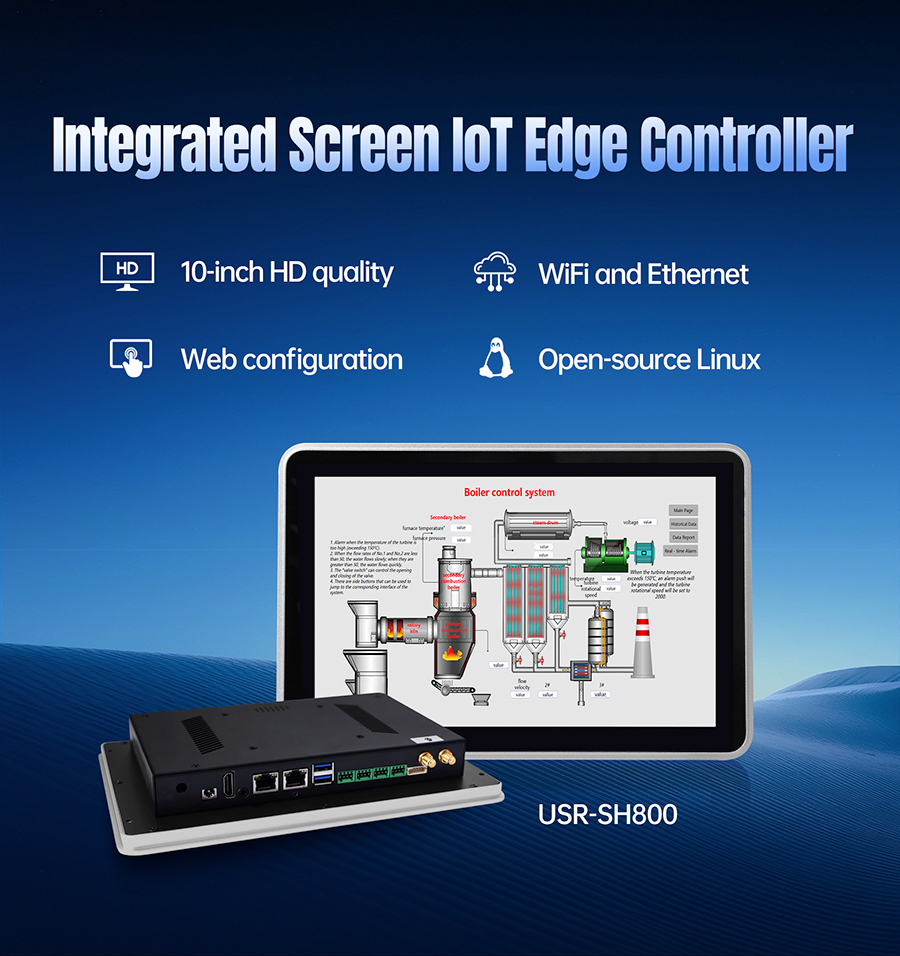
Environmental Adaptability: Operates in temperatures ranging from -20°C to 70°C and humidity levels of 5%–95% RH (non-condensing), suitable for outdoor monitoring.
Anti-Interference Capability: EMC Level 4 protection resists electromagnetic interference in industrial settings.
Scalability: Supports multi-link communication via 4G/Wi-Fi/Ethernet with automatic reconnection during network outages and a data loss rate of <0.1%.
WukongEdge Edge Platform: Provides drag-and-drop configuration tools for rapid deployment of monitoring interfaces without programming.
AI Model Library: Includes pre-trained models for noise classification and PM2.5 prediction, supporting TensorFlow Lite inference.
Open Interfaces: Offers RESTful API and MQTT protocol support for integration with platforms like USR Cloud and Alibaba Cloud.
Deployment Costs: A single device integrates multiple sensors, reducing cable and power supply module purchases and lowering overall costs by 35%.
Maintenance Costs: Supports remote firmware upgrades (OTA), reducing fault diagnosis time from 2 hours to 10 minutes.
Energy Efficiency: Standby power consumption is <5 W, just 1/5 of traditional industrial PCs.
After deploying the USR-SH800, a key high school achieved the following:
Classroom Air Quality Monitoring: CO₂ sensors in each classroom automatically activate fresh air systems when concentrations exceed thresholds, reducing student dizziness by 50%.
Campus Noise Management: Noise sensors in playgrounds and cafeterias trigger broadcast reminders when thresholds are exceeded, reducing noise complaints by 65%.
Energy Optimization: PM2.5 monitoring links with air purifiers to avoid inefficient operation, saving 12,000 kWh annually.
A chemical park used the USR-SH800 to build an environmental monitoring network:
Fugitive Emission Monitoring: PM2.5 sensors at plant boundaries upload data in real-time to environmental authorities' platforms, avoiding penalty risks.
Safety Alerts: CO₂ sensors detect tank leaks, reducing leak detection time from 30 minutes to 1 minute.
Noise Compliance: Noise maps locate high-noise equipment, guiding the installation of soundproof enclosures and improving compliance to 98%.
In the era of carbon neutrality and smart manufacturing, environmental monitoring has evolved from an "optional feature" to a "must-have." The USR-SH800 industrial panel PC provides a highly reliable and cost-effective solution for PM2.5, CO₂, and noise monitoring through the deep integration of hardware, edge computing, and AI algorithms. Whether for smart campuses, industrial parks, or urban governance, the USR-SH800 delivers integrated "sensing-processing-display" capabilities to help clients maximize the value of environmental data.
Act Now: Contact PUSR for customized USR-SH800 solutions, including: