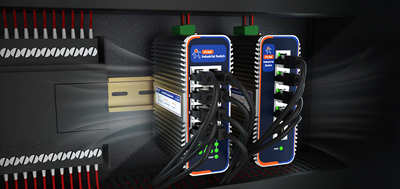
At an unmanned site deep in a remote area, an industrial cellular router goes down. There is no IT staff on site. The nearest maintenance engineer is a two-hour drive away.
This is a problem teams deploying distributed industrial infrastructure face all the time.
Security and maintenance for an industrial cellular router is not solved by buying a device that supports VPN and calling it a day. It covers the full lifecycle, from out-of-box configuration and online firmware updates to anomaly alerts and eventual decommissioning. Here is how to handle each stage in practice.
Once a router is installed at a remote site, physical access becomes a luxury. The initial configuration directly determines how much trouble follow-up maintenance will cause.
Factory default passwords are the first thing automated vulnerability scanners try. Change them on installation day. Do not wait until the schedule clears up.
DMZ, UPnP, Telnet—many routers ship with these features enabled. Unmanned sites do not need this kind of convenience. Closing unused ports reduces the attack surface.
Built-in SIM cards used in industrial scenarios should have APN authentication configured. This prevents unauthorized SIM cards from accessing the internal network when inserted. This layer of protection works without any onsite presence.
Between the moment a firmware vulnerability is discovered and the moment a patch is released, there is a window of exposure. Remote sites sit wide open during that gap.
Check vendor security bulletins every quarter. Firmware updates for industrial cellular routers do not push automatically like smartphones. They need manual triggering. Put a calendar reminder in place. Do not rely on memory.
Routers with a remote management cloud platform can receive firmware updates over the air. No need to plug in a cable at the site. Once the cloud management channel is configured, the update flow is straightforward: log into the platform → select the device → push the update → the device restarts and applies it automatically.
Before pushing a new firmware to production, deploy it on a local test unit first. Verify compatibility with existing business software, SCADA systems, or serial peripherals. This step saves hours of on-site troubleshooting down the road.
Industrial data being intercepted is not an "if" but a "when." Cellular signals travel over the air spectrum and, in theory, anyone can pick them up.
PPTP has known vulnerabilities. Do not use it. IPSec or OpenVPN are the current mainstream choices for industrial scenarios. If the goal is to establish a tunnel between two router endpoints, IPSec offers better hardware-accelerated performance. If the goal is to connect to multiple cloud providers, OpenVPN provides more flexibility.
Some sites connect to multiple cloud platforms simultaneously. A router that supports connecting to three different OpenVPN servers at once can switch to a backup server when the primary line fails, keeping security intact without interruption.
Manual OpenVPN parameter entry is error-prone. Routers that support one-click import of .ovpn files and PKCS#12 certificate files significantly reduce configuration mistakes. A misconfiguration is itself a security vulnerability.
At remote sites, the biggest security threats are often not active hacker intrusions. Equipment going offline, signal degradation, and traffic anomalies expose issues first.
A sudden router disconnect could mean a power outage, an unpaid SIM bill, or the device being physically removed. Offline alerts should push via both email and SMS so someone always sees them.
Continuously dropping signal strength means communication quality is deteriorating. Weak signal not only degrades data transmission but may also force the device to increase transmit power, shortening its hardware lifespan.
Exhausted SIM data plans bring operations to a halt. More seriously, a sudden traffic spike may indicate the device has been hijacked and is participating in a DDoS attack.
No amount of encryption matters if the router keeps rebooting on its own.
Hardware watchdog plus software watchdog provides a dual recovery mechanism. If the system freezes, the router restarts itself. Unmanned sites do not need someone to press a reset button.
Environmental control at remote sites is usually minimal. Summer heat, winter freezing ground—an operating range from -35°C to 75°C handles outdoor conditions far better than a consumer-grade -20°C to 60°C spec.
Surges, electrostatic discharge, and electromagnetic interference at industrial sites are not abstract laboratory concepts. EMC certification, ESD protection, and surge suppression should be verified during the selection phase, not investigated after a failure occurs.
An industrial cellular router typically lasts between five and eight years. In that span, it goes through not only technology iterations but also shifts in security standards.
Record each router's MAC address, SIM number, installation location, and firmware version. When something goes wrong, you should be able to find the right device information within a minute.
Every six months, check VPN connection logs, open port status, and firmware versions. This can be done remotely via cloud platform. No site visit required.
When replacing a device or closing a site, remotely wipe the configuration through the cloud platform first, then physically recover the hardware. Cancel the SIM card and revoke VPN keys.
Security maintenance for industrial cellular routers at remote sites boils down to three things: the ability to manage remotely, the ability to report anomalies, and the ability to patch vulnerabilities online.
When selecting equipment, do not look at bandwidth and signal strength alone. Cloud platform support, VPN protocol options, hardware watchdogs, and wide operating temperature ranges—these behind-the-scenes capabilities determine how long a device can reliably hold up without human intervention.
On the operations side, getting three practices in place—firmware update calendar, quarterly security audit, and anomaly alert response workflow—will resolve most issues before they become incidents.