Cellular Wireless Router: The "Data Hub" and "Scheduling Brain" of Distributed Energy Systems
In a photovoltaic-storage flexible DC interconnection system on the Qinghai Plateau, a 50 MW photovoltaic power station and a 25 MW/50 MWh energy storage system achieved stable operation in a high-altitude environment under the coordination of an energy router. Data shows that the voltage fluctuation on the grid side of the system decreased by 60%, and the ability to suppress photovoltaic output fluctuations improved by 1.8 times. This case reveals a core issue: the large-scale development of distributed energy systems is undergoing a profound transformation from "device connection" to "data-driven". And the cellular wireless router is an indispensable "data hub" and "scheduling brain" in this transformation.
A distributed photovoltaic project in an industrial park once faced such a dilemma: A 6 MW photovoltaic array and a 3 MW/12 MWh energy storage system were connected via ordinary routers, but data collection only covered 30% of key parameters. Moreover, devices from different brands adopted seven protocols such as Modbus and IEC 61850, resulting in chaotic data formats. Operation and maintenance (O&M) personnel had to manually integrate Excel spreadsheets, and the time for fault location increased from 30 minutes to 4 hours.
The essence of the pain point: The "connection" of traditional routers only solves physical-layer interoperability, while what distributed energy systems need is semantic-layer interoperability—that is, device data can be uniformly parsed and correlated for analysis.
In a photovoltaic-storage microgrid in an industrial park in Jiangsu, there was a 15% power mismatch between the energy storage system and photovoltaic output. The reason is that ordinary routers cannot transmit real-time state-of-charge (SOC) data of the energy storage to the energy management system (EMS) in a timely manner, causing the energy storage charging and discharging strategies to lag behind the photovoltaic output curve. As a result, the average daily photovoltaic consumption rate was only 82%, and the system line loss was as high as 6.8%.
The essence of the pain point: Energy scheduling requires a "millisecond-level" data response speed, and the latency and packet loss rate of traditional routers are destroying the economic viability of distributed energy.
In 2024, a new energy power station suffered an advanced persistent threat (APT) attack due to a router firmware vulnerability, resulting in 12 inverters being remotely locked and direct economic losses exceeding 2 million yuan. Investigation found that the router used default passwords and did not enable VPN encryption, becoming a "backdoor" for hacker intrusion.
The essence of the pain point: The open architecture of distributed energy expands the attack surface for cyber threats, and the security design of traditional routers can no longer cope with the threats in the era of the industrial Internet.
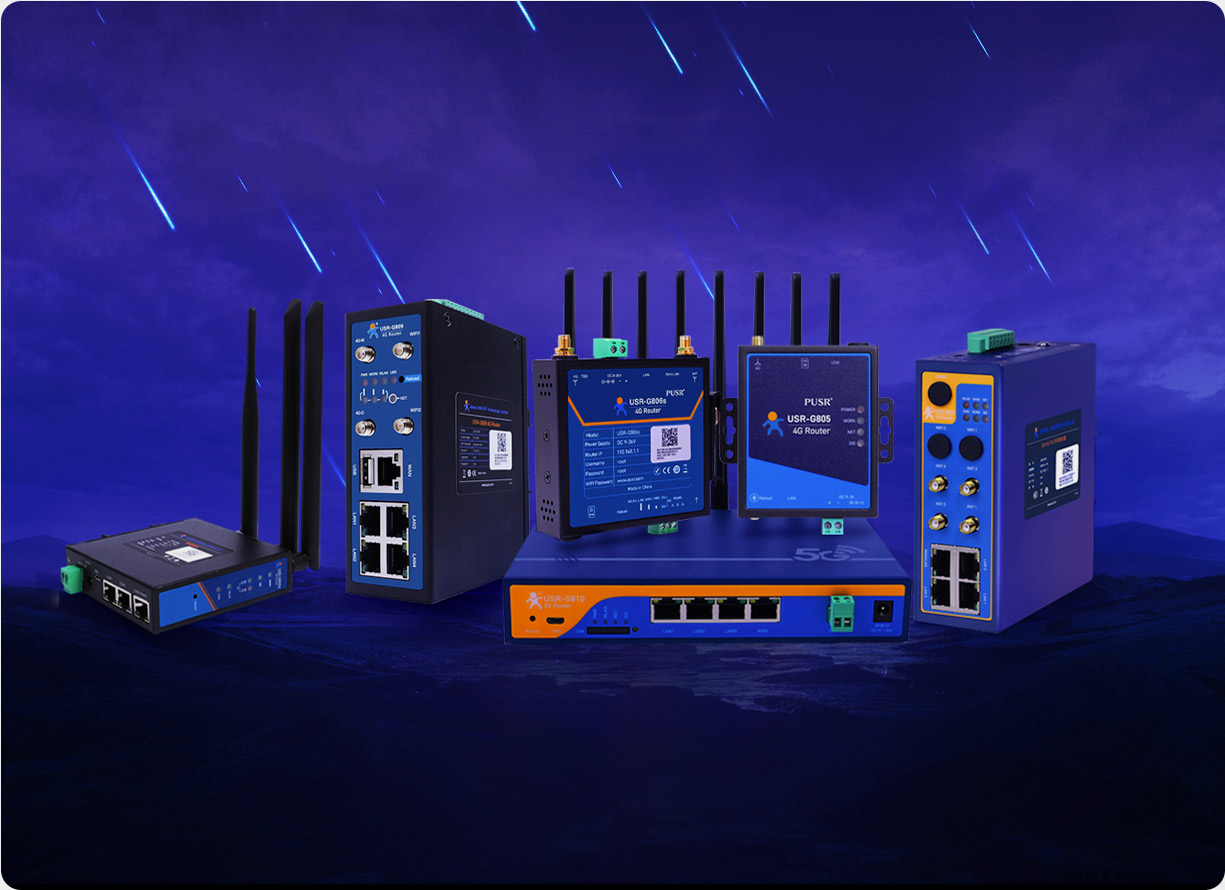
The USR-G809s cellular wireless router, through its built-in protocol conversion engine, supports 12 industrial protocols such as Modbus TCP/RTU, IEC 61850, and DL/T 645. It can automatically identify device data formats and convert them into a unified JSON structure. In a wind farm case, this router integrated supervisory control and data acquisition (SCADA) data from 32 wind turbines, weather station data, and box transformer data into standard MQTT messages, improving the data parsing efficiency of the EMS system by 80%.
Technical implementation:
Hardware layer: Adopts a dual-core ARM Cortex-A72 processor, supporting 100,000 protocol conversion instructions per second.
Software layer: Pre-installed with an industry protocol library and supports custom protocol expansion.
Interface layer: Provides 4 LAN + 1 WAN + RS485/RS232 serial ports, covering over 90% of industrial devices.
The USR-G809s compresses data transmission latency to within 20 ms through 5G/4G multi-mode redundant communication and an edge computing architecture. In the Qinghai Plateau photovoltaic-storage project, this router collected over 200 parameters in real time, such as photovoltaic inverter output power, energy storage SOC, and load demand. Through its built-in improved droop control algorithm, it achieved dynamic port power balancing, increasing the photovoltaic consumption rate to 97% and reducing system line loss to 2.2%.
Technical implementation:
Network layer: Supports 5G SA/NSA dual-mode with a peak rate of 1.2 Gbps.
Edge layer: Equipped with a lightweight AI model for local execution of tasks such as power prediction and fault diagnosis.
Scheduling layer: Deeply integrated with the EMS system and supports IEC 61970/61968 standard interfaces.
The USR-G809s adopts a triple security mechanism of "whitelist + encrypted tunnel + behavior audit":
Access security: Supports MAC address binding and 802.1X authentication to reject unauthorized device access.
Transmission security: Built-in with five VPN protocols including IPSec, OpenVPN, and GRE, with data encryption strength up to AES-256.
Management security: Provides firewall, network address translation (NAT), and demilitarized zone (DMZ) functions, supporting operation log auditing and abnormal behavior alerts.
In a distributed energy project in a chemical industrial park, this router successfully blocked 12 distributed denial-of-service (DDoS) attacks and 3 malicious code injections through the above mechanisms, improving system availability to 99.99%.
In a "photovoltaic + energy storage + charging" system in an automobile manufacturing park, the USR-G809s plays a core scheduling role:
Data collection: Connects 5 MW of photovoltaic power, 2 MW/4 MWh of energy storage, and 50 charging piles, collecting parameters such as power, voltage, and current in real time.
Optimized scheduling: Dynamically adjusts energy storage charging and discharging strategies based on time-of-use electricity prices and load forecasts, increasing peak-valley arbitrage revenue by 35%.
Demand response: Automatically reduces charging pile power during grid load peaks to receive demand response subsidies.
Implementation effect: The overall energy efficiency of the system increased by 18%, and annual electricity cost savings reached 4.2 million yuan.
In a rural microgrid in an agricultural county in northwest China, the USR-G809s solves three major problems:
Weak network coverage: Ensures a 99.5% data transmission success rate in -40°C environments through LoRa + 4G dual-link backup.
Economical operation: Optimizes diesel generator start-stop strategies based on photovoltaic output and load forecasts, reducing fuel consumption by 28%.
Intelligent O&M: Predicts equipment failures 48 hours in advance through vibration and temperature sensors, reducing unplanned downtime by 72%.
Implementation effect: The construction cost per station decreased from 150,000 yuan to 50,000 yuan, and the number of O&M personnel reduced from 10 to 2.
In an offshore wind farm in the East China Sea, the USR-G809s achieves three major breakthroughs:
Corrosion-resistant design: Ensures stable operation in high-humidity marine environments with an IP68 protection rating and salt spray filtration device.
Low-power operation: Solar + battery hybrid power supply with power consumption below 0.5 W, supporting 7 days of continuous operation.
AR O&M: Supports expert remote guidance for on-site maintenance by transmitting 8K video streams through 5G networks, reducing fault repair time by 60%.
Implementation effect: Annual O&M costs decreased by 58%, and power generation increased by 3.2%.
With the advancement of the "dual carbon" goals, distributed energy systems are evolving towards "source-grid-load-storage integration." Cellular wireless routers will undertake more complex roles:
Digital twins: Build virtual energy systems through real-time data streams to achieve operational simulation and optimization.
Blockchain transactions: Support peer-to-peer (P2P) energy transactions, making distributed energy a tradable "digital asset."
AI scheduling: Integrate deep reinforcement learning algorithms to achieve autonomous optimization and decision-making of energy systems.
As a new generation of cellular wireless router, the USR-G809s has pre-installed these capabilities: Its ARM Cortex-A78 processor supports TensorFlow Lite inference, enabling local operation of energy forecasting models; its built-in SECP256K1 encryption chip supports blockchain signature verification; and its support for time-sensitive networking (TSN) protocols provides deterministic latency guarantees for real-time energy transactions.
As distributed energy shifts from "supplementary energy" to "primary energy," its management paradigm is undergoing a fundamental transformation: from "device-centric" to "data-centric," and from "manual scheduling" to "intelligent autonomy." The cellular wireless router, as a "connector" and "accelerator" of this transformation, is redefining the value creation mode of energy systems—it not only enables devices to "speak" but also makes data "think," ultimately achieving "self-awareness, self-decision-making, and self-optimization" of energy.
As the project leader in Qinghai said, "In the past, we worried about energy not being 'connectable.' Now we worry about data not being 'usable.' The USR-G809s has made us feel for the first time that energy management can be so 'transparent' and 'intelligent.'" This may be the most profound value of the cellular wireless router—it gives every unit of electricity in distributed energy its own "digital identity."