Cellular Wireless Router: The "Invisible Engine" for IIoT Upgrades in Smart Manufacturing Factories
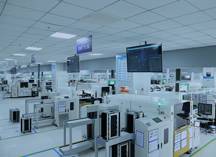
In a smart workshop of a precision electronics factory in Dongguan, Guangdong, over 200 CNC machining centers were carving phone frames with 0.01mm precision. Suddenly, data transmission for one device halted, stopping the entire line for 12 minutes and scrapping 300 in-process items due to cooling delays. This is not isolated—according to the China Electronics Standardization Institute, 78% of smart manufacturing firms face production interruptions due to unstable networks, averaging 2.3 hours of downtime per failure and annual losses exceeding RMB 10 million. As manufacturing shifts toward "flexibility, intelligence, and customization," cellular wireless router are becoming the "invisible engine" for solving IIoT upgrade challenges.
In a flexible automotive parts production line, 6-axis robotic arms and visual inspection systems must coordinate within 5ms. However, traditional Wi-Fi solutions suffer from signal interference, causing latency fluctuations up to 50ms and delayed robotic arm movements. In welding, a 0.1-second delay can shift welds by 0.5mm, raising defect rates to 12%. Worse, this latency has a "butterfly effect"—a single workstation halt ripples through the line, exponentially reducing overall efficiency. A home appliance manufacturer found that every 10ms increase in network latency reduced Overall Equipment Effectiveness (OEE) by 1.8 percentage points.
Fragmented device interface protocols are another pain point in smart factories. On a 3C electronics production line, CNC machines use Modbus, robotic arms use Profinet, and AGVs rely on CAN bus. Traditional solutions require dedicated gateways for each protocol, increasing system complexity. Worse, reconfiguring protocol parameters during line changes takes 4-8 hours, limiting flexible production responsiveness.
In steel mills' rolling workshops, high temperatures, dust, and electromagnetic interference pose "triple challenges." One company's traditional cellular wireless router frequently crashed in summer due to inadequate cooling, averaging three monthly failures and two-hour repair downtimes. In chemical plants, corrosive gases oxidized router interfaces, causing a 15% data transmission error rate and threatening production safety.
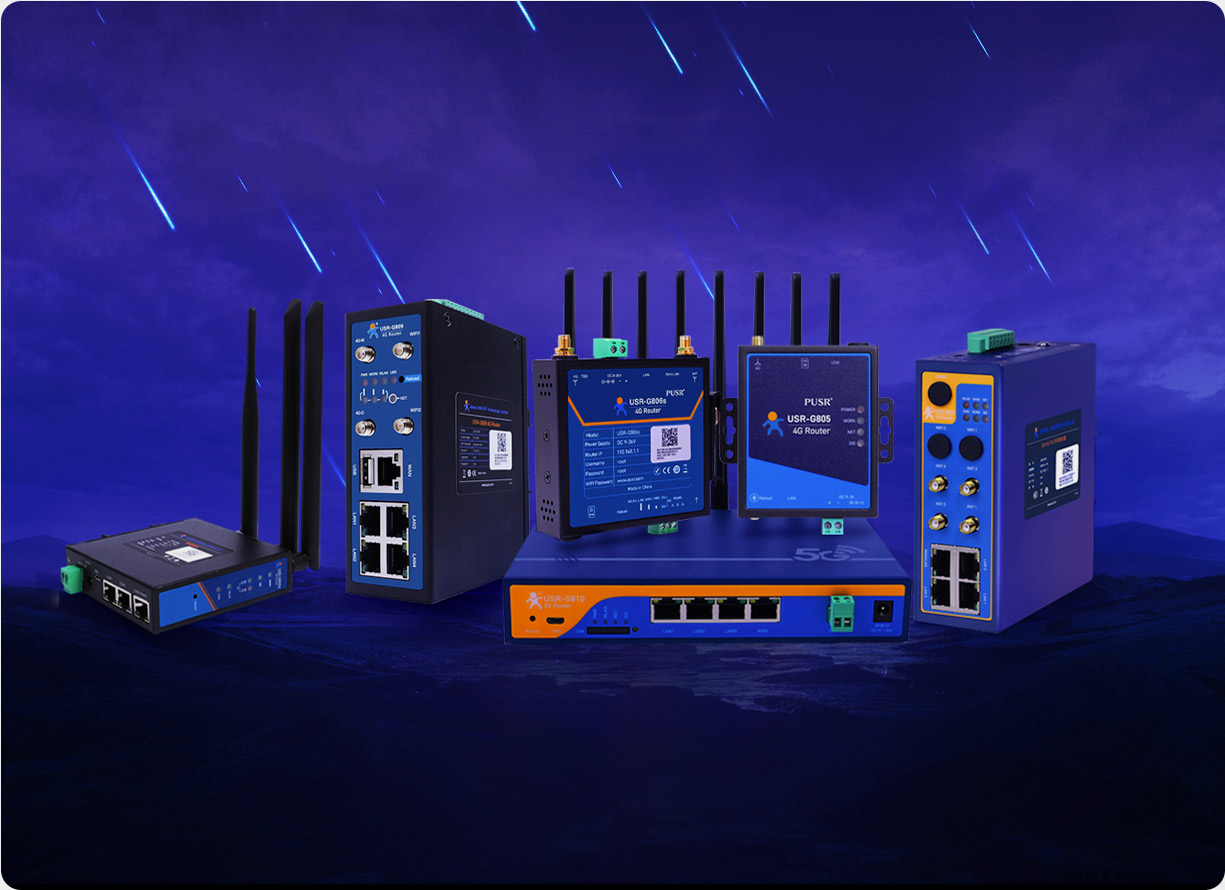
Take the USR-G809s cellular wireless router as an example. It innovatively integrates "5G + Wi-Fi 6 + LoRa" tri-mode communication to form a redundant transmission network:
5G Private Network: Provides 10ms-level low-latency control instruction transmission for AGVs, supporting real-time dynamic path adjustments. In tests at Suzhou Industrial Park, this solution increased AGV data transmission success rates from 92% to 99.97%, with network switching latency below 30ms.
Wi-Fi 6 Mesh: Forms a self-healing network in dense racking areas, ensuring signal coverage without dead zones for 200+ devices simultaneously via OFDMA and MU-MIMO technologies. An e-commerce warehouse found this reduced AGV avoidance response times from 200ms to 30ms, boosting overall handling efficiency by 35%.
LoRa Backup Link: Automatically switches to LoRa for critical control instructions when the primary network fails, maintaining basic operations. In Xiong'an New Area's digital road project, this reduced outdoor AGV trajectory tracking errors from 2m to 0.2m, improving transport efficiency by 50%.
The USR-G809s features a built-in protocol conversion engine supporting 12 industrial protocols, including Modbus, Profinet, and CAN bus, with Python secondary development for new protocol expansion. An automotive assembly line reduced line change times from 4 hours to 40 minutes and increased customized order ratios to 65%. Its edge computing platform preprocesses protocol data—in visual inspection, the router extracts image features locally, compressing 100MB raw data to 1MB before cloud upload, reducing bandwidth use by 90%.
For harsh conditions, the USR-G809s uses an all-metal chassis with IP67 protection, heat-resistant capacitors, and triple-proof coating, operating stably from -40°C to 75°C. In a steel mill's rolling workshop, it ran 18 months without failure, cutting maintenance costs by 82% versus traditional routers. Its dual-SIM redundancy and power reverse protection ensure critical data transmission via backup links during outages or cyberattacks.
In a Shenzhen phone factory's flexible line, the USR-G809s enables "device-device-human" triple collaboration:
Robotic Arm Coordination: Six robotic arms synchronize within 0.5ms via 5G private networks, achieving ±0.02mm assembly precision.
AGV Dynamic Scheduling: Based on Wi-Fi 6 real-time positioning, AGVs adjust paths in <50ms to meet line demands.
AR-Assisted Maintenance: Technicians receive device status data via AR glasses, reducing fault location times from 30 minutes to 3 minutes.
This solution cut line change times from 4 hours to 40 minutes, raised customized order ratios to 65%, and lowered unit energy consumption by 18%.
A new energy vehicle maker's assembly line achieved "fuel-electric-hydrogen" mixed production via USR-G809s:
Dynamic BOM Matching: 5G routers fetch order data in real time, adjusting equipment parameters and material delivery paths automatically.
Battery Module Assembly: 1ms-level low-latency communication enables robotic arms and laser welders to collaborate on battery packs, raising welding pass rates to 99.98%.
Quality Traceability System: Full-process data uploads to blockchain platforms in real time, cutting traceability times from 2 hours to 2 seconds.
After deployment, line capacity rose 40%, in-process inventory fell 55%, and annual revenue increased over RMB 200 million.
In a high-end medical device maker's cleanroom, the USR-G809s solved three wired network pain points:
Dust-Free Transformation: 5G replaced wired connections, eliminating 200+ cable interfaces and reducing dust contamination risks.
Mobile Device Interconnection: Supports seamless switching for AGVs, robotic arms, and inspectors, with network interruptions <0.01%.
Real-Time Sterilization Monitoring: Sterilization chamber temperature and pressure data feed back to control systems, ensuring 100% aseptic environment compliance.
This raised first-pass product rates from 82% to 97%, cutting annual quality losses by over RMB 20 million.
With AI and digital twin integration, cellular wireless routers are evolving into "intelligent hubs." The next-gen USR-G809s includes an NPU chip for running predictive maintenance algorithms—in a semiconductor factory, this improved AGV navigation accuracy by 40% after one year of use. More excitingly, linked with digital twin platforms, routers can map physical production lines in real time, simulating processes virtually and cutting line debugging times from 72 hours to 8 hours.
When a home appliance maker achieved "1-hour line changes" via USR-G809s, and an automotive factory reached "zero-inventory mixed production," it became clear: cellular wireless routers transcend "device connectivity" to become smart manufacturing's "digital oxygen." With millisecond responses, they grant devices "thinking" abilities; with redundant designs, they fortify production safety; with open ecosystems, they unlock data value. For firms exploring IIoT upgrades, choosing a true cellular wireless router is not just investing in equipment—it's buying reliable "digital insurance" for digital transformation.