"Digital Twin" in Automobile Manufacturing: How IoT Enables Production Lines to "See the Future"?
In the grand narrative of automobile manufacturing, the production line is the "invisible battlefield" of this industrial revolution. The precision of every weld, the torque of every bolt, and the stamping angle of every sheet metal determine whether a car can stand out in the fierce market competition. However, traditional automobile manufacturing is facing unprecedented challenges: stagnant production efficiency, frequent equipment failures leading to shutdowns, quality defects triggering recalls, and a surge in demand for flexible production. These issues are like invisible shackles, holding back the footsteps of automakers.
In this "digital breakthrough," digital twin technology is becoming the key to breaking the deadlock. By deeply integrating the physical and virtual worlds through the Internet of Things (IoT), it endows production lines with the ability to "see the future"—predicting failures in advance, optimizing production processes, simulating the introduction of new models, and reducing energy consumption costs. The digital twin is not just a technological revolution but a necessary path for automobile manufacturing to transition from "rigid production" to "flexible intelligent manufacturing."
In traditional automobile manufacturing, equipment failures are the "number one killer" of production efficiency. Take the final assembly line of a joint-venture automobile factory as an example. A sudden failure of a key piece of equipment can cause the entire production line to stagnate for several hours, with a single shutdown loss reaching hundreds of thousands of yuan. More troublingly, failures often have a "hidden" nature—early abnormal signals such as vibrations and temperatures are difficult to detect manually. By the time the failure becomes apparent, the damage is already irreparable.
Customer Psychology Insight:
"We're racing against time every day, but equipment failures are always like a time bomb. We never know when it will explode." The helplessness of a production director at an automobile factory reveals the anxiety of "passive response" in traditional manufacturing.
Automobile manufacturing involves thousands of components and hundreds of processes. Any deviation in any link can lead to quality defects. For example, a new energy vehicle brand once recalled a large number of vehicles due to welding defects in battery packs, resulting in losses exceeding 100 million yuan. Traditional quality control relies on manual sampling inspections and post-event analysis, making it difficult to cover full-process data. Tracing the root cause of defects is like "blind men touching an elephant"—only seeing parts but not the whole picture.
Customer Psychology Insight:
"We've invested a lot of resources in quality inspection, but defects are still hard to prevent. Where is the problem? We can't see it clearly at all." The confusion of a quality department manager reflects the "powerlessness" of traditional quality control.
Automobile manufacturing is an energy-intensive industry, with energy consumption in processes such as stamping, welding, and painting accounting for up to 30% of production costs. Traditional energy management relies on manual statistics and experience-based adjustments, making it difficult to match production loads in real-time, leading to waste phenomena such as "overpowering a small load" or "underpowering a large load." Additionally, equipment maintenance costs are high, and the "one-size-fits-all" approach of regular maintenance further drives up costs.
Customer Psychology Insight:
"Energy consumption and maintenance costs are like two bottomless pits. We know they can be optimized, but we don't know where to start." The sigh of an energy management manager at a factory reveals the "confusion" of traditional cost control.
As the automobile market shifts from a "seller's market" to a "buyer's market," consumers' personalized demands for models and configurations have surged. Traditional production lines use "dedicated equipment + fixed processes," making it difficult to quickly switch models, leading to an increasingly sharp contradiction between "mass production" and "small-batch customization." A new energy vehicle company once missed a hundred-million-yuan order due to its inability to quickly adjust its production line.
Customer Psychology Insight:
"We want to transition to flexible production, but our existing equipment and technology simply don't support it. Rebuilding the production line? The cost is too high, and the risk is too great." The hesitation of a factory planning director reflects the "dilemma" of traditional manufacturing transformation.
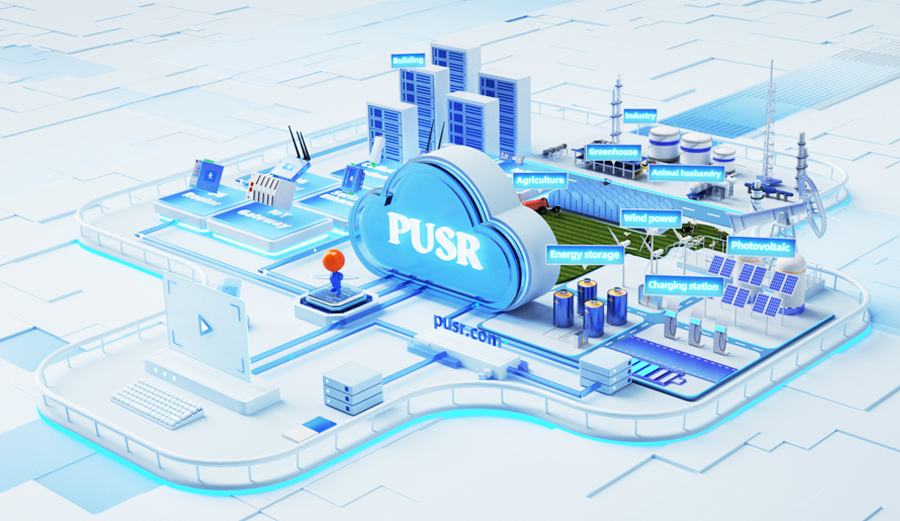
The core of digital twin technology is to create a "virtual doppelganger" for the physical production line—collecting equipment status, process parameters, quality data, etc., in real-time through IoT sensors and constructing a digital model that runs synchronously with the physical world in virtual space. This model can not only "mirror" reality but also predict the future through simulation and AI, endowing the production line with the ability to "see the future."
The digital twin monitors key parameters such as vibrations, temperatures, and currents of equipment in real-time through IoT sensors. Combining historical failure data and AI algorithms, it constructs an equipment health model. When parameters deviate from the normal range, the system issues an early warning in advance and predicts the time, location, and impact scope of the failure.
Case:
After deploying a digital twin system on the final assembly line of a joint-venture automobile factory, vibration and temperature sensors were used to monitor the operating status of key equipment in real-time. The system predicted severe bearing wear on a conveyor three days in advance and recommended replacement. The factory arranged maintenance in a timely manner, avoiding production line shutdowns and reducing single-shutdown losses by 500,000 yuan.
Customer Value:
"The digital twin has turned us from 'firefighters' into 'prevention experts.' Equipment failures are no longer time bombs but hidden dangers that can be dismantled in advance." The gratitude of an equipment maintenance supervisor at a factory reflects the improvement in production stability brought by failure prediction.
The digital twin uses virtual simulation technology to "rehearse" process parameters before production. For example, in the welding process, the system can simulate weld quality under different currents and voltages to find the optimal parameter combination; in the painting process, the system can predict paint film thickness under different spraying angles to avoid sagging or thin coating.
Case:
When introducing a new model, a new energy vehicle company simulated the battery pack welding process through a digital twin system. The system found that the original welding sequence would cause local overheating and weld cracks. After the engineers adjusted the welding sequence, the weld pass rate increased from 92% to 98.5%, avoiding the risk of mass recalls.
Customer Value:
"The digital twin allows us to 'see' quality issues before production. This is much cheaper and faster than post-event tracing." The recognition of a quality engineer reflects the dual improvement in cost and efficiency brought by quality optimization.
The digital twin collects equipment energy consumption data through IoT and constructs an energy consumption prediction model in combination with production plans. The system can dynamically adjust equipment power according to real-time production loads to avoid waste such as "overpowering a small load"; at the same time, it optimizes equipment start-stop sequences through simulation to reduce standby energy consumption.
Case:
After deploying a digital twin system in the painting workshop of an automobile factory, the system dynamically adjusted the heating time by monitoring the oven temperature and equipment power in real-time. After the transformation, oven energy consumption decreased by 15%, and the painting cost per vehicle decreased by 20 yuan, saving more than 10 million yuan in annual energy consumption costs.
Customer Value:
"Energy management has finally turned from a 'black box' into a 'transparent box.' We can not only see where every unit of electricity goes but also optimize it precisely." The excitement of an energy management manager reflects the breakthrough in cost control brought by intelligent optimization.
The digital twin supports the rapid switching and reconstruction of production lines through virtual simulation technology. For example, when introducing a new model, the system can simulate the production line layout, equipment location, and logistics path in virtual space to find the optimal solution; when producing multiple varieties in mixed flows, the system can dynamically adjust the production sequence according to order priorities to avoid overall efficiency degradation caused by "bottleneck processes."
Case:
A joint-venture automobile factory achieved flexible transformation of its final assembly line through a digital twin system. The system supports mixed production of six models, reducing production line switching time from 8 hours in traditional modes to 2 hours and shortening order delivery cycles by 20%.
Customer Value:
"Flexible production is no longer a 'luxury' but a 'necessity.' The digital twin allows us to respond quickly to market changes and seize every order opportunity." The confidence of a factory planning director reflects the improvement in market competitiveness brought by flexible production.
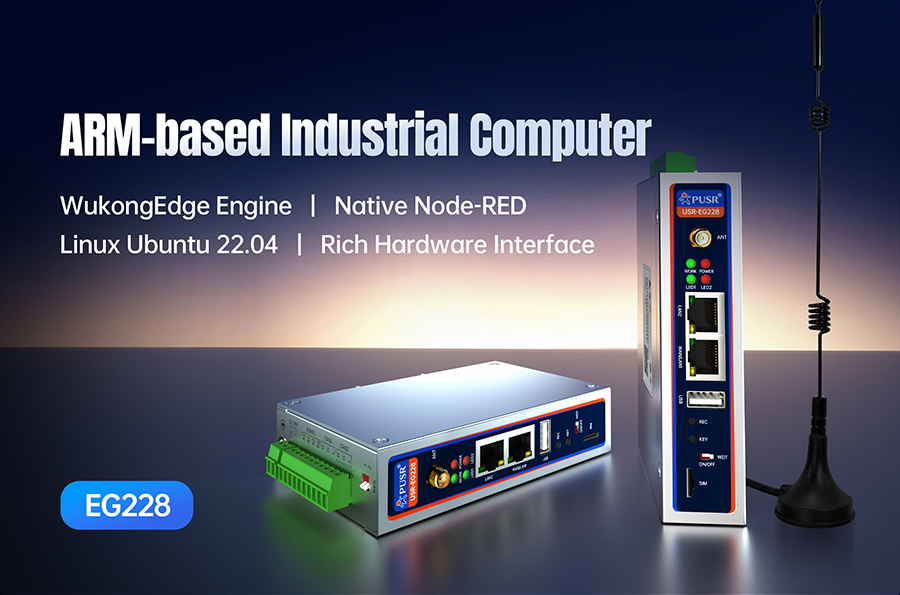
The realization of digital twins relies on powerful data collection, edge computing, and real-time communication capabilities. In this link, the fanless industrial PC USR-EG228 has become the "key hub" supporting the implementation of digital twins with its high performance, high reliability, and easy integration.
USR-EG228 supports multiple industrial protocols such as Modbus, OPC UA, and CAN, allowing it to easily connect to traditional industrial equipment such as stamping machines, welding robots, and painting equipment without the need for additional protocol conversion modules, reducing deployment costs.
USR-EG228 is equipped with a high-performance processor, enabling it to complete edge computing tasks such as equipment status monitoring and process parameter analysis locally. This avoids uploading all raw data to the cloud, reducing network bandwidth pressure while ensuring real-time performance—failure warning response times can be shortened to seconds.
USR-EG228 supports multi-network combinations such as 4G/Wi-Fi/Ethernet, allowing it to adapt to the network environments of different areas in factories; its industrial-grade design (IP65 protection, -20℃~60℃ wide temperature working range) ensures stable operation of the equipment in harsh environments, reducing maintenance costs.
USR-EG228 provides rich API interfaces and development toolkits, supporting integration with systems such as MES and ERP. At the same time, it can carry user-defined AI algorithms to meet personalized needs. For example, an automobile factory developed an equipment health prediction model based on USR-EG228, increasing the accuracy of failure prediction to 95%.
On the "invisible battlefield" of automobile manufacturing, digital twin technology is reshaping production logic with its ability to "see the future." It enables equipment failures to be predictable, quality issues to be controllable, energy consumption costs to be optimizable, and flexible production to be achievable—these goals that were once considered "ideal" are now becoming a reality through the deep integration of IoT and digital twins.
For automobile manufacturers, the digital twin is not just a technological upgrade but a survival competition. Those who can take the lead in building a "virtual doppelganger" and achieving "seeing the future" will seize the initiative in this transformation, moving from "manufacturing" to "intelligent manufacturing" and from "following" to "leading." And fanless industrial PC like USR-EG228 are the indispensable "digital cornerstones" in this transformation—they make technology implementation simpler and bring the future within reach.