Disaster Recovery Design of IoT Gateway in Hybrid Cloud Scenarios: Deep Integration of Local Caching and Cloud Synchronization
In the wave of Industry 4.0 and smart manufacturing, hybrid cloud architecture has become the core infrastructure for enterprise digital transformation due to its flexibility, resource elasticity, and cost optimization capabilities. However, the unique characteristics of industrial scenarios—such as dispersed equipment, sensitive data, and high real-time requirements—pose stringent challenges to hybrid cloud architecture: How can "zero data loss, low latency, and high availability" be ensured during the synchronization of industrial data between local caching and the cloud? This article provides an in-depth analysis of the disaster recovery design methodology for IoT gateway in hybrid cloud scenarios from three dimensions: technical architecture, disaster recovery strategies, and practical case studies.
Industrial equipment generates data characterized by "three highs": high frequency (millisecond-level collection), massive volume (single devices generating GB-level data daily), and heterogeneity (over 20 protocols, including Modbus, OPC UA, and Profinet). Traditional solutions relying on public network transmission or local server storage lead to three major issues:
Security risks: Global industrial control system attacks increased by 47% year-on-year in 2024, with public network transmission vulnerable to man-in-the-middle attacks.
Latency sensitivity: Modbus RTU protocol transmission delays exceed 3 seconds across network segments, failing to meet real-time control requirements.
High management costs: An electronics manufacturing enterprise deploying 200+ devices needed to maintain 12 independent management systems, with annual operation and maintenance costs exceeding 2 million yuan.
Enterprises must simultaneously meet:
RPO (Recovery Point Objective) approaching zero: Ensuring zero data loss.
RTO (Recovery Time Objective) < 5 minutes: Guaranteeing rapid business recovery.
Controllable costs: Avoiding excessive investment.
Traditional solutions (e.g., dual-active data centers) can achieve RPO=0 but are prohibitively expensive to build. Public cloud disaster recovery, while cost-effective, relies on network stability, making RTO difficult to guarantee. Hybrid cloud architecture, through the combination of "local caching + cloud synchronization," becomes the key to solving this dilemma.
As the "data hub" of hybrid cloud architecture, the IoT gateway must possess three core capabilities:
Protocol conversion: Supporting over 20 industrial protocols, including Modbus RTU/TCP, OPC UA, and Profinet, for seamless device integration.
Edge computing: Performing data cleaning, aggregation, and preliminary analysis locally to reduce cloud load.
Secure transmission: Encrypting data through VPN tunnels (e.g., IPSec, OpenVPN) to ensure secure transmission across public networks.
Typical architecture:
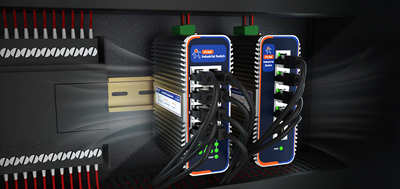
Device Layer → IoT Gateway (USR-M300) → Local Caching (SSD/HDD) → Hybrid Cloud Storage Gateway → Cloud Storage (OSS/S3)
Synchronous replication: Core data (e.g., production recipes, equipment status) uses "local write + real-time cloud synchronization" to ensure RPO=0.
Asynchronous replication: Non-critical data (e.g., logs, monitoring data) uses "local caching + scheduled batch uploads" to reduce bandwidth usage.
Conflict resolution: Employing CRDT (Conflict-Free Replicated Data Types) algorithms to resolve data conflicts during concurrent writes across multiple nodes.
Case study: An automotive manufacturer achieved synchronous replication of PLC control instructions via the USR-M300 gateway, enabling seamless takeover by cloud backups with RTO < 30 seconds during local data center failures.
Containerized deployment: Packaging industrial applications (e.g., SCADA, MES) as Docker containers for rapid cross-cloud migration.
Intelligent traffic scheduling: Dynamically allocating traffic through Global Server Load Balancing (GSLB), such as:
Prioritizing local cache access during normal local network operation.
Automatically switching to cloud copies during local failures.
Routing based on multiple dimensions, including geolocation, cost, and business priority.
Code Example (Python Dynamic Weight Algorithm):
python
defdynamic_weight(metrics):latency_weight=1/(metrics['latency']+1e-6)# Lower latency, higher weightcpu_weight=1-metrics['cpu_usage']# Lower CPU usage, higher weightreturnlatency_weight*0.6+cpu_weight*0.4# Composite weightDual-channel connectivity: Connecting local data centers to the cloud via dedicated lines (e.g., AWS Direct Connect) while deploying VPNs as backup links.
Link detection and automatic switching: The USR-M300 gateway supports custom probe servers, switching to backup links within 10 seconds upon primary link failure.
Case study: A wind farm achieved automatic switching to cellular networks via USR-M300's 4G/5G dual-mode communication during fiber optic interruptions, ensuring continuous upload of turbine data.
The performance of the IoT gateway directly impacts disaster recovery effectiveness in solution implementation. The USR-M300 is an ideal choice due to the following features:
Southbound interfaces: Supporting mainstream industrial protocols such as Modbus RTU/TCP, Profinet, and EtherNet/IP, enabling direct connection to PLCs like Siemens S7-1200 and Mitsubishi FX series.
Northbound interfaces: Built-in MQTT client supporting JSON/Protobuf data formats for seamless integration with platforms like EMQX and Alibaba Cloud IoT.
Expansion capabilities: Modular design allowing stacking of 4G/5G, LoRa, and other modules for adaptability to complex network environments.
VPN acceleration engine: Integrated dedicated encryption chip delivering 200 Mbps IPSec VPN throughput, 3x faster than software solutions.
Secure boot: Firmware signature verification based on TrustZone technology to prevent malicious code injection.
Access control: Supporting 802.1X authentication and MAC address binding to block unauthorized device access.
Data preprocessing: Built-in rule engine enabling complex operations like temperature-to-actual power conversion and vibration-to-RMS value calculation.
Intelligent alerts: Supporting threshold triggering and anomaly detection, such as automatic DingTalk/email notifications when liquid levels exceed 90%.
Local decision-making: Python scripting for control, such as automatic factory lighting adjustment based on light intensity.
Application scenarios:
Cross-factory collaboration: A group achieved MES system interconnection across 12 production bases via USR-M300+VPN networking, reducing order delivery cycles by 40%.
Predictive maintenance: After deployment at a wind farm, vibration analysis enabled 72-hour advance warnings of gearbox failures, reducing unplanned downtime by 65%.
Energy management: Connecting to 2,000+ electricity meters and uploading energy consumption data to a private cloud via MQTT, saving 3.8 million yuan in annual electricity costs.
A automotive component manufacturer's core transaction system required:
RPO=0: Zero data loss for production recipes, equipment status, etc.
RTO<5 minutes: Rapid business recovery during failures.
Compliance: Data transmission and storage must meet ISO 27001 standards.
Network architecture:
Local data center connected to Alibaba Cloud via a 1 Gbps dedicated line.
USR-M300 gateways deployed with IPSec VPN as backup links.
GSLB for dynamic traffic scheduling.
Data synchronization:
Core data (e.g., PLC control instructions) synchronously replicated via USR-M300's MQTT broker for real-time cloud upload.
Non-core data (e.g., logs) asynchronously replicated with hourly batch uploads.
Disaster recovery switching:
GSLB automatically switched traffic to cloud copies during local failures.
USR-M300 gateways maintained cloud connectivity via 4G links, ensuring continuous control instruction delivery.
After recovery, incremental synchronization returned cloud data to local storage.
RPO: Achieved zero data loss through synchronous replication and CRDT algorithms.
RTO: Fault switching time < 3 minutes, an 80% improvement over traditional solutions.
Cost: 60% investment savings compared to dual-active data center solutions.
After implementing this solution, a manufacturing enterprise achieved the following improvements:
| Metric | Before Transformation | After Transformation | Improvement |
| Device Wake-Up Response Time | 15 minutes | 20 seconds | 97.8% |
| Network Attack Incidents | 12/year | 0/year | 100% |
| Operation and Maintenance Labor Costs | 8 personnel/year | 3 personnel/year | 62.5% |
| Production Data Utilization Rate | 35% | 89% | 154% |
Driven by Industry 4.0 and China's "Made in China 2025" policy, data has become a core asset for enterprises. This solution, through deep integration of hybrid cloud architecture and IoT gateways, addresses security vulnerabilities in traditional industrial networks while unlocking the efficiency potential of IoT technologies.
Next Steps:
Free consultation: Submit a requirement form to receive tailored network topology design and device selection recommendations.
POC testing: Apply for a USR-M300 trial unit to validate core scenarios within 7 days.
Custom development: Provide embedded firmware customization services for special protocols or business logic.
Contact us now to enable your industrial equipment to achieve exponential growth in data value under robust security protection!