A systems integrator once described a familiar need: a field device with only an RS232 port, and an engineer working from an office PC running Windows, wanting to read and write to the device as if the serial port were plugged into the local machine. The hesitation is typical — once the device's traffic travels over Ethernet through a serial-to-Ethernet converter, will it get slower? Will data get lost?
Serial-to-Ethernet conversion does not move the serial signal onto the network unchanged. A serial device server placed next to the device wraps serial data into TCP/UDP packets and delivers them over the network to the host. The added time comes from three segments: forwarding and buffering on the device side, network round trips, and the receive buffer on the host (or inside the virtual COM software).
The serial side has a hard rate ceiling — the baud rate sets how many bytes can pass per second — while the Ethernet port runs at 10/100M, far above typical serial rates. For polling and periodic reporting workloads, the bottleneck is usually the serial rate itself, not the extra hop through the network.
What deserves attention is the network round trip and the retransmission that follows packet loss. Neither is decided by the device server; both depend on the link itself. Whether the added time is acceptable is best answered by a comparison test rather than guesswork: run the same collection task once over a direct connection and once through the network, and the difference becomes visible immediately. For second-level polling and near-real-time reporting, a LAN round trip is basically imperceptible. For applications sensitive to precise timing, each setup should be evaluated on its own, instead of copying a configuration that worked elsewhere.
Many questions come from treating two different pieces as one. The serial device server — the hardware — sits at the device end and turns the serial port into a network port; this side can only be done in hardware. Virtual COM (VCOM) software runs on the host PC, mapping the network port into a local COM port so that legacy software, which only knows how to open a COM port, keeps working without modification.
The two do not live on the same end, and neither replaces the other. Without the hardware online, no amount of emulation provides data; conversely, when the host application natively speaks TCP or Modbus TCP, the virtual COM software can simply be left out. So when the question is "can it be done with software only?", the answer is usually: at the far end of the network, hardware still has to put the serial port on the wire.
Check the link first. Rule out network-side problems — latency, packet loss, firewalls — before judging the device. If the network jitters badly, a faster device server changes nothing.
Choose the transport to match the workload. For ordinary reliable transfers, use a TCP long connection with automatic reconnection. For small, time-sensitive payloads where occasional loss is acceptable, UDP removes the timing jitter that retransmission introduces. The USR-TCP232-410s, USR-DR132/134, and USR-N540 all support both TCP and UDP modes.
Hand Modbus polling to the hardware. The 410s and N540 include a Modbus gateway with RTU/TCP conversion and multi-host polling. Periodic polling is offloaded to the device end, and the host reads results directly over Modbus TCP, skipping the queueing wait of polling devices one by one from the host.
When data arrives in bursts that look like stuttering, check the buffering. If received data comes out in choppy chunks, look at the buffer and packetization settings on both the host software and the device end, and shorten the waiting time so that data is not accumulated into batches at both ends before being sent.
Add a safety net for long unattended runs. What latency fears most is not slowness but losing the link. Choose devices with a watchdog, automatic reconnection, and a wide temperature range, so a hung unit does not require someone to drive to the site and reboot it.
It depends on what the host software expects. Legacy SCADA, configuration, access control, and weighing software only open COM ports: hardware plus VCOM software is then the way — the device server provides field-side access, VCOM provides a local COM port on the host, and the application layer is untouched. For in-house or newer systems that natively support TCP/UDP or Modbus TCP, deploy the hardware only; one less software buffering layer means a shorter path. When several PCs need to reach the same device at the same time, let the device server listen in TCP Server mode with multiple-client support (the DR132/134 accept multiple simultaneous TCP clients) instead of opening a separate mapping per client.
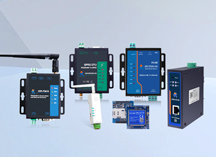
For a single device in an ordinary environment, the USR-TCP232-410s is a solid choice: dual RS232+RS485 ports that work simultaneously, baud rate 600 to 230.4K, TCP/UDP/MQTT/HTTP protocol support, and a built-in Modbus gateway; metal housing, dual watchdog, wide-input power, and an industrial -40℃ to +85℃ rating, with CE, FCC, ROHS, WEEE, and RCM certifications.
For tight spaces — for example, inside a small enclosure right next to the device — the USR-DR132/134 are lipstick-sized single-port device servers, available with RS232 or RS485. They use push-in, pluggable terminals that need no screwdriver, add a dual watchdog plus automatic reconnection, and support the same -40℃ to +85℃ range.
To bring multiple serial devices in a cabinet onto the network at once, the USR-N540 offers four ports, with RS232/485/422 and all-RS485 versions available, a wide DC 5–36V input, and Modbus multi-host polling.
Breaking serial-to-Ethernet into its parts — where the latency comes from, who does the forwarding, how real-time the application really needs to be — answers the three questions that make the selection straightforward.