Embedded Single Board Computer Pre-integrated Function Module Library: A Hardware Acceleration Solution That Shortens AGV Development Cycles
Lao Chen, if you're reading this article right now, I guess you're in the exact same state I was in three years ago—
It's 2 AM. You're staring at the 37th compilation error on your screen. The coffee next to you has gone cold. Your team just took on an AGV project. The client wants delivery in three months. You did the math: motion control algorithm, at least 6 weeks. Navigation module integration, at least 4 weeks. Multi-protocol communication adaptation, at least 3 weeks. HMI interface development, at least 2 weeks. System integration testing, at least 4 weeks. That adds up to 19 weeks. Three months is nowhere near enough.
But you don't dare tell the client "we can't do it." You grit your teeth and take it on. Then you spend 6 months, burn through 2 million, and deliver something that barely runs. The client isn't satisfied. You're not satisfied either.
I'm not telling someone else's story. This is my own story.
Three years ago, I led a team of 8 to build an AGV dispatch system for an auto parts factory. We made every mistake a rookie makes—we spent 80% of our time on "stitching modules together," not on "making the AGV run better."
The motion control algorithm had to be written from scratch because the industrial PC's SDK didn't support our motor driver protocol. The navigation module had to be tuned manually because the LiDAR's data format didn't match the board we chose. CAN bus communication had to be coded frame by frame because there was no ready-made driver library. The HMI interface had to be drawn from scratch because the touchscreen SDK wasn't compatible with our development environment.
We weren't building an AGV. We were doing manual labor—"soldering a bunch of incompatible parts together."
It took me a long time to understand: the biggest bottleneck in AGV development is never that the algorithm isn't smart enough. It's that hardware integration is too slow. No matter how brilliant your algorithm is, if it takes 3 months just to get the low-level drivers working, the algorithm itself is just decoration.
Today's article isn't about algorithms. It's not about navigation. It's not about dispatch. It's about one thing only: how to use a pre-integrated function module library and hardware acceleration to compress the AGV development cycle from 6 months to 6 weeks.
People who develop AGVs say one thing more than any other: "The algorithm is the core. Hardware is just the carrier."
That's right. And it's also wrong.
It's right because the algorithm truly determines how fast and how accurately the AGV runs. It's wrong because if you haven't even built the carrier, where does the algorithm run?
I've broken AGV development pain points into three layers. Compare them against your own situation and see where you're stuck:
How many devices are on an AGV? LiDAR, IMU, encoders, motor drivers, servos, various sensors… Each one has its own communication protocol. Modbus, CAN, RS485, TCP/IP, UDP… Your industrial PC has to "shake hands" with every single device, and every handshake requires you to write code yourself.
Based on practical experience in industrial control system design, the data acquisition phase alone requires solving at least 8 technical challenges: multiple devices sharing a serial port, some devices with extremely long response times, packet sticking, automatic reconnection after link dropout… These aren't algorithm problems. They're engineering problems. But they eat up 60% of your development time.
A friend who builds AGVs once said something to me that I still remember: "I'm not an engineer. I'm a cable jockey."
An AGV running at 0.8 m/s with 100 milliseconds of control delay means it has already lunged forward 8 centimeters. In a narrow aisle, 8 centimeters is enough to knock over an entire row of shelves.
Traditional MCU-based motor control solutions typically have a current loop response time exceeding 100 microseconds, and communication delay in multi-motor synchronous control can accumulate to 10–50 milliseconds. Measured data from an industrial motor control study shows: traditional MCU solutions have a control cycle of 100–200 μs with current tracking error greater than 5%. FPGA-based hardware acceleration solutions compress the control cycle to 1–5 μs and reduce current tracking error to below 1%.
This isn't a "a little faster" issue. This is a "will it survive" issue.
But here's the problem: you can't learn FPGA development just for one AGV project. What you need is a platform that's already done all that hardware acceleration for you.
Motion control, navigation and positioning, task dispatch, HMI interface, communication protocols, safety monitoring… Each module is an independent system. You have to stitch them into a whole—align the interfaces, make the data flow, handle the exceptions.
Practice from a manufacturing logistics AGV vehicle control software shows: core logic = RCS 3.0 configuration + JS/C# glue code. But without configuration tools, you have to write everything from scratch in C++, and module coupling makes independent testing impossible. Test efficiency plummets, and pinpointing the root cause of problems becomes a nightmare.
You think you're doing systems engineering. In reality, you're doing "patchwork engineering"—sewing a bunch of mismatched parts together and praying they don't fall apart.
I eventually figured something out: the essence of AGV development is not a software problem. It's an integration problem. What you need is not a faster CPU. It's a hardware platform that's already done the dirtiest, hardest work for you.
This is the core logic of "pre-integrated function module library + hardware acceleration."
Simply put: someone else has already written the drivers, adapted the interfaces, and debugged the communication protocols for you. You just plug and play.
Take the Siemens S7-200 SMART series as an example. It provides 15 common pre-compiled library files covering function block libraries (FB), system function block libraries (SFB), communication libraries, calculation and conversion libraries, safety libraries, analog libraries, network libraries, alarm and event handling libraries, and more. Function blocks can be called multiple times, allowing the same logic to be used in different parts of a program without rewriting code. SFBs are standardized library function blocks pre-loaded in the PLC for direct user calls, offering significant advantages in execution speed and stability.
Apply this same thinking to an AGV embedded single board computer, and the logic is identical: the most commonly used functions—CAN communication, Modbus adaptation, PID control, data acquisition, safety monitoring—are all pre-integrated at the hardware layer. Developers only need to call them. No rewriting required.
The core principle of hardware acceleration is: offload compute-intensive tasks that the CPU can't handle efficiently onto dedicated hardware. There are three specific mechanisms:
In AGV scenarios, hardware acceleration has two critical applications:
First, motion control acceleration.
FPGA-based FOC (Field-Oriented Control) solutions have compressed current loop response time from 100–200 μs down to 1–5 μs, and multi-motor synchronization delay from 10–50 ms down to under 1 ms. An engineer at a new energy factory used this solution to complete an entire production line retrofit, saving 230,000 RMB in equipment procurement costs. The line ran for 30 consecutive days in a 60°C high-temperature workshop with zero failures.
Second, AI inference acceleration.
AGV visual recognition, obstacle detection, and SLAM mapping all require real-time AI inference. If you run it on the CPU, latency is in milliseconds. If you run it on a built-in NPU, latency can be compressed to microseconds. A tested robot dog solution showed: an embedded single board computer equipped with an NPU processing SLAM navigation data improved path planning response speed by more than 10×.
Pre-integrated module library + hardware acceleration = 70% reduction in development cycle.
This isn't me talking out of thin air. A case study from an auto parts factory developing AGVs in-house: through self-development, small logistics AGV R&D costs were reduced by over 25% compared to direct procurement, saving 15,000 RMB per unit. More importantly—they were no longer held hostage by equipment vendors' technical barriers, and ongoing maintenance costs dropped significantly.
The reason is simple: when the low-level drivers and hardware acceleration are already pre-integrated, your team only needs to focus on algorithms and business logic. What 8 people did in 6 months, 3 people can do in 6 weeks.
By now, you might be asking: I get the logic, but where do I find a platform like this?
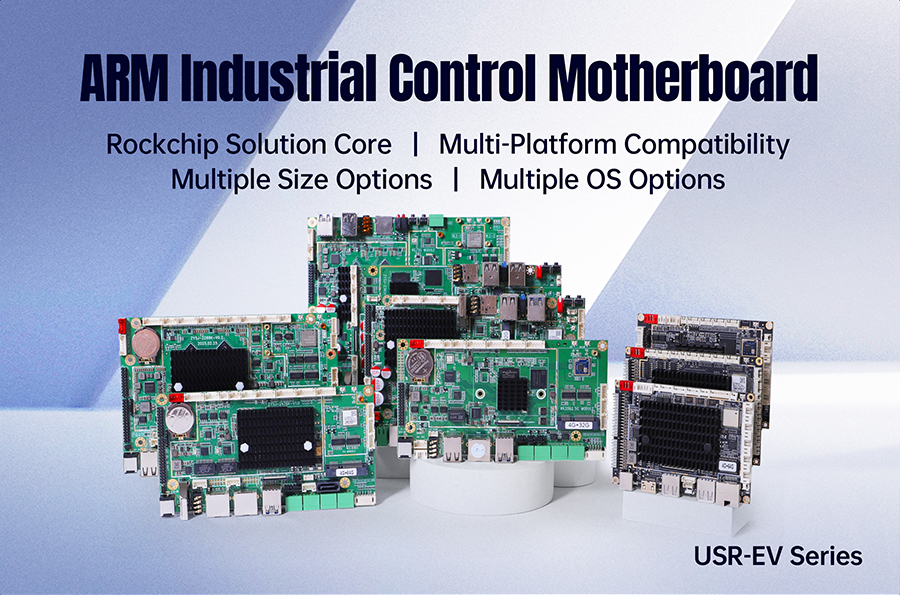
I won't keep you in suspense. What I've been using myself for the past two years, and what I recommend to friends who build AGVs, is USR IoT's USR-EV series ARM embedded single board computer.
Why this one? Three reasons:
The EV series is built on the Rockchip RK platform, with pre-integrated multi-channel CAN, RS485, IO, and other industrial interfaces, supporting 100+ industrial protocols including Modbus and MQTT. You don't need to write drivers. Plug it in and it talks to your AGV's motors, servos, LiDAR, and sensors right out of the box. The CAN interface offers strong anti-interference and low-latency data transmission, precisely ensuring stable path planning and motion control.
Powered by mainstream chips like the RK3562/3568/3576/3588, with a built-in NPU delivering 1.0 TOPS of computing power, supporting 4G–16G memory. SLAM navigation, visual recognition, AI inference—all run locally. No cloud needed. A tested solution showed: an edge AI-based quality inspection solution achieved 99.2% product defect recognition accuracy, a 15× improvement over traditional methods.
Supports Ubuntu, Android, Debian, and other mainstream operating systems, with full secondary development permissions open. You can write your own navigation algorithms, tune your own task dispatch, integrate with MES/ERP systems on your own terms. An engineer completed an entire production line AGV dispatch system upgrade in two weeks, saving 236,000 RMB in equipment procurement costs.
You don't need to reinvent the wheel. You just need to stand on a road someone else has already paved—and run your own algorithms.
It's 2026. The AGV industry has moved from "can we do it?" to "who ships first?"
Your algorithm might be 10% better than your competitor's. But if your development cycle is 3 months longer, that 10% advantage is a joke. Clients won't wait for you. The market won't wait for you.
What really creates the gap isn't who has the smartest algorithm. It's who can deliver a stable, reliable AGV system in less time and at lower cost.
The pre-integrated function module library solves the "integration" problem. Hardware acceleration solves the "real-time" problem. Once those two are solved, your team can put 100% of its energy into what truly creates value—algorithms, scenarios, user experience.
Stop being a cable jockey. Go be an engineer.
The road has already been paved. You just need to start running.