Anti-contamination Design of AGV Fanless Industrial PC under GMP Certification: A Breakthrough from Compliance Anxiety to Efficiency Leap
1. The "Invisible Shackles" of GMP Certification: Compliance Anxiety and Efficiency Dilemma in Pharmaceutical Enterprises
In the pharmaceutical industry, GMP certification is like a sword of Damocles hanging overhead. A medium-sized pharmaceutical company once faced production suspension and rectification by the drug regulatory authority due to product microbial over-limit caused by lubricant leakage from AGV trolleys in the clean area, resulting in direct losses exceeding RMB 10 million. Another company had to reconstruct its production line for half a year and invest several million yuan as the AGV navigation system generated static electricity that attracted dust, causing the cleanliness of the sterile preparation workshop to fall short of standards. These cases reveal a harsh reality: under the strict scrutiny of GMP certification, any minor contamination risk can become a "fatal blow" to a company's survival. The anxiety of pharmaceutical companies stems from three deep-seated pain points:
High Compliance Costs: GMP requires "full-process controllability and full-data traceability." Any oversight in any link, from equipment materials to operation records, can lead to certification failure. Traditional AGV fanless industrial PC often face "one-vote veto" by auditors due to a lack of anti-contamination design, such as lubricant leakage, static electricity attraction, and cleaning dead spots.
Dichotomy Between Efficiency and Compliance: To meet GMP requirements, companies often have to sacrifice efficiency. For example, one company reduced the AGV operating speed from 1m/s to 0.5m/s to avoid cross-contamination, resulting in a 40% decrease in logistics efficiency. Another company had to manually wipe and clean AGVs due to their inability to withstand disinfectant corrosion, causing 15 minutes of downtime per hour.
Lagging Technological Iteration: Traditional fanless industrial PCs mostly adopt industrial-grade designs without optimization for pharmaceutical scenarios. For example, the shell gaps of a fanless industrial PC used by one company were as wide as 0.5mm, becoming a "hotbed" for dust accumulation. Another company's fanless industrial PC had unsealed interfaces, allowing disinfectant to penetrate the motherboard and causing system crashes. Behind these pain points lies the deep-seated demand of pharmaceutical companies for AGV fanless industrial PCs: to achieve a balance between efficiency, cost, and reliability while meeting GMP compliance.
2. The "Four-Layer Defense" of Anti-contamination Design: A Systematic Solution from Physical Isolation to Intelligent Control
The anti-contamination requirements of GMP certification for AGV fanless industrial PC essentially involve constructing a "physical-chemical-biological-data" four-layer defense. The following analyzes key design points based on industry practices:
2.1 Physical Isolation: "Dust-Free Genes" from Structure to Material
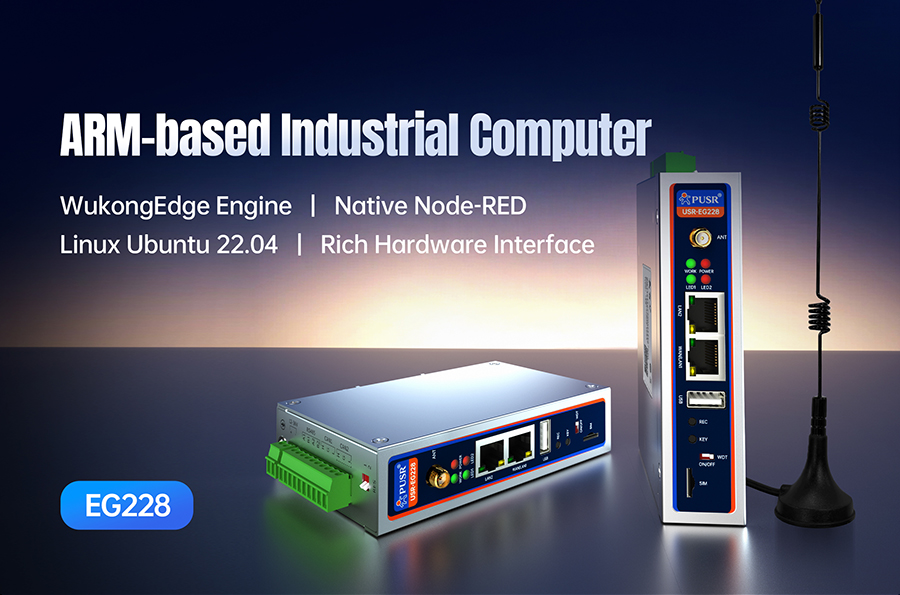
Sealed Design: The shell of the fanless industrial PC should adopt seamless integrated molding technology, with gap widths ≤0.1mm (far below the GMP requirement of 0.5mm). For example, the USR-EG228 fanless industrial PC used by one company achieves full sealing through laser welding technology, withstanding high-pressure water jet flushing and preventing dust intrusion.
Material Selection: Parts in contact with drugs should be made of 316L stainless steel or medical-grade polycarbonate (PC), with a surface roughness Ra ≤0.4μm (in line with ISO 14644-1 standards). One biopharmaceutical company reduced cleaning time from 30 minutes per unit to 10 minutes per unit by changing the shell material of the fanless industrial PC to 316L stainless steel.
Anti-static Treatment: The shell should control surface resistance within 10⁶-10⁹Ω (in line with IEC 61340-5-1 standards) through conductive coatings or carbon fiber embedding technology. One company reduced the amount of dust attracted by static electricity by 90% by adding a conductive coating to the shell of the fanless industrial PC, avoiding microbial contamination risks.
2.2 Chemical Protection: A "Corrosion-Free Commitment" from Lubrication to Cleaning
Lubrication System: Food-grade lubricants (such as NSF H1 grade) should be used, and a fully sealed lubrication chamber should be designed to avoid leakage contamination. One company reduced the risk of product microbial over-limit by 80% by changing the lubricant in the AGV gearbox to food-grade lubricant.
Cleaning Compatibility: The shell should withstand common disinfectants such as 75% alcohol, hydrogen peroxide, and quaternary ammonium salts without swelling, deformation, or performance degradation. The USR-EG228 fanless industrial PC can withstand immersion in these disinfectants for 72 hours without any changes by adopting a polycarbonate + glass fiber composite material.
Interface Protection: All interfaces (such as USB, RS485, CAN) should be equipped with dust covers or self-sealing designs to prevent disinfectant penetration. One company reduced the interface failure rate from 3 times per month to 0 times by adding self-sealing silicone plugs to the interfaces of the fanless industrial PC.
2.3 Biological Prevention and Control: "Full-link Traceability" from Environment to Data
Microbial Control: UV disinfection modules or plasma generators should be integrated to support timed automatic disinfection. One company reduced the number of environmental microorganisms by 99% by installing UV lamps in the AGV parking area and combining them with the timed disinfection function of the fanless industrial PC.
Data Integrity: It should comply with FDA 21 CFR Part 11 requirements, record all operation logs (such as temperature, humidity, disinfection time), and ensure data is tamper-proof. The USR-EG228 fanless industrial PC achieves encrypted storage and timestamp verification of operation logs through a built-in blockchain module, meeting audit trail requirements.
Batch Management: It should support RFID or QR code scanning to record key information such as drug batch numbers and transportation times. One company reduced the loss of near-expiry drugs by 20% by integrating an RFID module into the fanless industrial PC to achieve full-process traceability of drugs from production to warehousing.
2.4 Intelligent Control: An "Efficiency Revolution" from Passive Response to Active Prevention
Environmental Monitoring: Sensors such as temperature and humidity, differential pressure, and particle counters should be integrated to monitor environmental parameters in clean areas in real time. One company achieved real-time alarming of abnormal cleanliness by adding a particle counter to the fanless industrial PC, avoiding batch product contamination.
Predictive Maintenance: AI algorithms should be used to analyze equipment operation data (such as vibration and temperature) to predict fault risks. The USR-EG228 fanless industrial PC can analyze AGV motor vibration data in real time through a built-in edge computing engine, providing a 3-day advance warning of bearing wear and reducing unplanned downtime by 80%.
Path Optimization: It should support dynamic path planning to avoid AGVs staying in high-contamination risk areas. One company reduced the risk of cross-contamination by 30% by integrating a SLAM navigation algorithm into the fanless industrial PC to enable AGVs to automatically avoid densely populated areas.
3. USR-EG228: A "Benchmark Practice" of Anti-contamination Design and Industry Value
In the field of anti-contamination design, the USR-EG228 industrial computer provides a solution that optimizes "compliance-efficiency-cost" for pharmaceutical companies. Its core advantages are reflected in three scenarios:
3.1 Sterile Preparation Workshop: A Leap from "Manual Cleaning" to "Automatic Disinfection"
A sterile preparation company once faced product contamination due to cleaning dead spots in the AGV fanless industrial PC and was forced to adopt a dual cleaning mode of "manual wiping + UV disinfection," resulting in 15 minutes of downtime per hour. After introducing the USR-EG228, its integrated sealed design eliminated cleaning dead spots, and it supported 75% alcohol spray disinfection. Combined with a built-in UV module, it achieved full-process automation of "cleaning-disinfection," improving AGV operating efficiency by 40%.
3.2 Cold Chain Transportation of Biopharmaceuticals: A Breakthrough from "Temperature Fluctuations" to "Precise Temperature Control"
Biopharmaceuticals are extremely sensitive to temperature fluctuations (e.g., vaccines need to be controlled at 2-8°C). One company once suffered from damaged vaccine activity due to insufficient precision (±1°C) of the AGV fanless industrial PC's temperature control system. The USR-EG228 controls temperature fluctuations within ±0.5°C by incorporating a high-precision temperature sensor (precision ±0.1°C) and an intelligent temperature control algorithm. It also supports multi-level alarms and automatic path adjustments, improving the vaccine transportation qualification rate from 92% to 99.5%.
3.3 Solid Preparation Production Line: An Upgrade from "Batch Confusion" to "Full-process Traceability"
Solid preparation production is prone to quality accidents due to material confusion. One company once faced penalties from the drug regulatory authority due to the lack of batch management functions in the AGV fanless industrial PC, resulting in the mixing of different batches of drugs. The USR-EG228 achieves full-process traceability of drugs from ingredient feeding to packaging and supports the generation of electronic batch records by integrating an RFID module and blockchain technology, reducing the risk of batch confusion to zero.
4. Future Outlook: How Will Anti-contamination Design Reshape Pharmaceutical Production Logic?
As GMP certification standards continue to upgrade (e.g., new cleanliness requirements in ISO 14644-1:2015), the anti-contamination design of AGV fanless industrial PCs will evolve towards "intelligence, integration, and modularity":
Intelligence: AI algorithms will be used to achieve real-time prediction and active intervention of contamination risks (e.g., automatically adjusting AGV operating speeds to reduce dust.
Integration: Functions such as environmental monitoring, equipment control, and data management will be integrated into a single fanless industrial PC to reduce system complexity and contamination risks.
Modularity: It will support the rapid replacement of anti-contamination modules (such as sealed shells and food-grade lubrication systems) to adapt to different pharmaceutical scenarios. For pharmaceutical companies, choosing AGV fanless industrial PCs with anti-contamination design is not only a "must-have" to meet GMP compliance but also a "strategic investment" to improve efficiency, reduce costs, and enhance competitiveness. As one company executive said, "Anti-contamination design is not a shackle but the key to unlocking the future of pharmaceutical factories."
Industrial loT Gateways Ranked First in China by Online Sales for Seven Consecutive Years **Data from China's Industrial IoT Gateways Market Research in 2023 by Frost & Sullivan
We use cookies to ensure that we give you the best
experience on our website. If you continue to use this site we will assume that you are happy with it.