A New Paradigm for Cost Reduction and Efficiency Enhancement in Manufacturing: A Practical Guide to Liberating AGVs from "Wired Constraints" with Arm-based Computers and 5G Modules
In the wave of transformation and upgrading in the manufacturing industry, automation and intelligence have become irreversible trends. As the core equipment of intelligent logistics systems, Automated Guided Vehicles (AGVs) are rapidly evolving from "automated handling tools" to "intelligent logistics nodes." However, traditional AGV systems face numerous challenges in complex industrial environments, particularly the issue of "wired constraints," which severely limits their flexibility, efficiency, and reliability. This article will delve into the three major technological bottlenecks of AGVs in manufacturing applications and explore how the integration of arm-based computers and 5G modules can grant AGVs "wireless freedom," assisting the manufacturing industry in achieving a new paradigm for cost reduction and efficiency enhancement.
In manufacturing, AGVs often need to collaborate with various equipment (such as PLCs, robots, sensors, etc.). However, industrial equipment from different brands and generations employs varying communication protocols, leading to difficulties in data interoperability and forming "data islands." For instance, traditional AGVs predominantly use wireless communication methods like Wi-Fi or Bluetooth, but these protocols struggle to meet the stability, interference resistance, and real-time requirements in industrial environments. Simultaneously, the conversion and adaptation between different protocols increase the complexity and cost of system integration, becoming a "stumbling block" for large-scale AGV deployment.
In large factories or logistics centers, AGVs typically operate in clusters, with numbers reaching dozens or even hundreds. Traditional Wi-Fi solutions face severe challenges in high-density AGV clusters: signal interference results in packet loss rates exceeding 15%, roaming handover interruption times surpassing 100ms, and even "network disconnections." These issues directly lead to AGV scheduling delays, frequent path conflicts, and, in severe cases, collision accidents, seriously affecting logistics efficiency and production safety.
The manufacturing industry's demand for AGV collaboration capabilities is increasingly high, especially in flexible production and multi-variety, small-batch production modes, where AGVs need to achieve dynamic path planning, multi-vehicle collaborative obstacle avoidance, and dynamic task allocation. However, traditional AGV systems, limited by communication delays and bandwidth, struggle to support real-time collaborative scheduling of large-scale AGVs. For example, in an automobile manufacturing assembly plant, AGV scheduling delays may lead to material delivery bottlenecks, with production line stoppage losses reaching tens of thousands of yuan per minute.
With its characteristics of ultra-low latency (<10ms), ultra-high reliability (99.999%), and massive connections (millions per square kilometer), 5G technology has become the "golden key" to unlocking AGV communication bottlenecks. By deploying 5G Standalone (SA) mode, setting up 5G base stations (gNBs) and edge UPFs within the factory area, and constructing enterprise-level 5G private network slices, exclusive wireless resources are allocated for AGV control instructions, isolating public service interference and ensuring communication determinacy. For instance, ZTE's Nanjing Binjiang Base achieved AGV scheduling delays below 50ms, a 30% increase in warehousing operation efficiency, and a 27% reduction in labor costs through a 5G private network.
As the core control unit of AGVs, arm-based computers need to possess powerful computing capabilities, real-time performance, and reliability. Traditional arm-based computers predominantly use wired communication methods, limiting AGV mobility and flexibility. In contrast, arm-based computers integrated with 5G modules (such as USR-EG228) enable real-time data interaction with cloud and edge computing nodes through 5G networks, supporting multi-protocol fusion (such as OPC UA, MQTT, Modbus, etc.), and bridging the gap in heterogeneous communication. Simultaneously, the high bandwidth of 5G modules supports AGVs equipped with laser radars, 3D vision sensors, and other devices, achieving high-precision positioning and navigation and enhancing AGV adaptability and stability in complex environments.
In the 5G + arm-based computer architecture, edge computing nodes (MECs) play a crucial role. By locally processing real-time AGV data (such as laser radar point clouds, motor status, task instructions, etc.), edge computing reduces response delays from over 100ms in cloud processing to within 10ms, supporting AGVs in achieving millisecond-level collaborative obstacle avoidance, dynamic path planning, and dynamic task allocation. For example, Jingsong Intelligent's 5G AGV solution achieved millisecond-level collaboration among over 200 AGVs through edge computing, increasing aisle utilization by 50% and reducing path conflict probabilities from 5% to 0.03%.
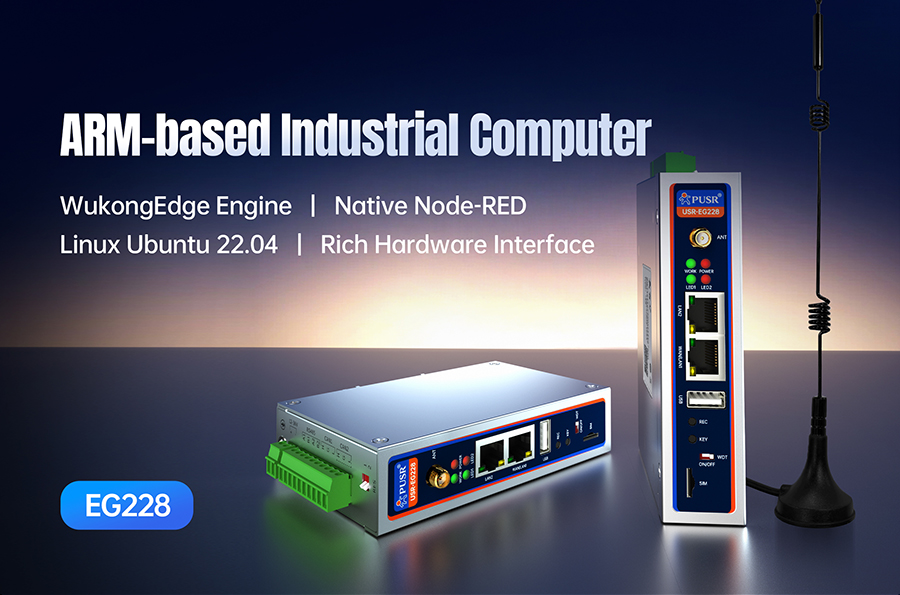
In an intelligent warehousing project for a global beverage giant, traditional manual forklifts faced significant efficiency bottlenecks, with immense peak transshipment pressure during busy seasons. By deploying Jingsong Intelligent's 5G dual-fork balance heavy-duty FMR robots equipped with USR-EG228 arm-based computers and 5G modules, real-time interaction with the WMS system and dynamic path planning were achieved. The project yielded remarkable results: a 70% increase in comprehensive circulation efficiency, a nearly fourfold increase in labor efficiency, over six repeat purchases, and a shortened investment payback period to 1.8 years.
In cold chain warehousing scenarios, traditional manual handling faces multiple challenges such as battery degradation in low-temperature environments, equipment frosting, and personnel safety. A cold chain logistics enterprise achieved continuous and stable operation at -30°C by deploying 5G cold-resistant AGVs equipped with USR-EG228 arm-based computers and cold-resistant electrolyte batteries. Project benefits were quantified: a 70% reduction in labor substitution costs, a decrease in cargo damage rates from 3% to 0.1%, annual loss reductions of 15 million yuan, a 20% optimization in energy consumption, and annual electricity cost savings of 800,000 yuan.
In electronic manufacturing clean rooms (Class 1000 or above), traditional manual handling introduces contamination risks and imposes stringent requirements for high-precision docking. An electronic manufacturing enterprise achieved ±0.5mm high-precision docking, meeting the precise handling needs of chip trays, by deploying 5G AGVs equipped with USR-EG228 arm-based computers and visual secondary positioning systems. Project value: a reduction in assembly error rates from 2.5% to 0.8%, annual rework cost reductions of 8 million yuan, a 60% reduction in line-side warehouse area, and a 30% increase in inventory turnover rates.
In 5G + arm-based computer AGV solutions, the USR-EG228 arm-based computer has become the "ideal choice" for many enterprises due to its high performance, high reliability, and flexibility. This product offers the following core advantages:
High-Performance Computing: Equipped with a high-performance processor, it supports multi-task parallel processing, meeting the real-time control and decision-making needs of AGVs.
5G Module Integration: Built-in 5G communication module supporting NSA/SA dual-mode, compatible with global mainstream operator frequency bands, enabling high-speed, low-latency, and highly reliable wireless communication.
Multi-Protocol Fusion: Supports various industrial protocols such as OPC UA, MQTT, and Modbus, bridging the gap in heterogeneous communication and achieving seamless device integration.
High-Reliability Design: Adopts a fanless cooling design, supports a wide temperature range of -20°C to 60°C, and has an IP65 protection rating, adapting to harsh industrial environments.
Flexible Expansion: Provides abundant I/O interfaces and expansion slots, supporting the integration of peripherals such as laser radars and 3D vision sensors, meeting the personalized customization needs of AGVs.
In the tide of manufacturing industry transformation and upgrading, AGVs, as the core equipment of intelligent logistics systems, are rapidly evolving from "wired constraints" to "wireless freedom." Through the integration of arm-based computers and 5G modules, AGVs can overcome traditional communication bottlenecks, achieving high-precision positioning, real-time collaborative obstacle avoidance, dynamic path planning, and dynamic task allocation, bringing a new paradigm for cost reduction and efficiency enhancement to the manufacturing industry. The USR-EG228 arm-based computer, with its high performance, high reliability, and flexibility, has become the "ideal choice" for 5G + AGV solutions, assisting enterprises in building efficient, flexible, and intelligent logistics systems and gaining the initiative in future competition.