Intelligent Upgrade of Textile Machinery: How Industrial 4G LTE Router Solve the Dilemma of Equipment Group Control and Energy Consumption Optimization
In the production workshop of a textile enterprise in Zhejiang, a jet loom worth 2 million yuan suddenly stopped due to abnormal motor temperature, causing the entire production line to be paralyzed for 6 hours and direct losses exceeding 300,000 yuan. What was even more challenging was that due to the lack of real-time data recording, it took technicians 48 hours to locate the root cause of the failure—insufficient bearing lubrication. This scenario is a typical microcosm of the intelligent transformation process in China's textile industry: equipment silos, energy consumption black holes, and delayed responses have become the three core pain points restricting the high-quality development of the industry.
Textile production involves multiple processes such as spinning, weaving, and printing and dyeing, with strong interconnections between equipment. However, under traditional management models:
Monitoring blind spots: According to statistics from an enterprise, faults such as yarn breakage in spinning machines and warp breakage in looms take an average of 2 hours to be manually detected, leading to an increase in the defective rate.
Inefficient maintenance: Without the support of historical equipment data, maintenance personnel need to repeatedly troubleshoot. The average fault repair time in a printing and dyeing enterprise is as long as 5.8 hours, which is three times that of industry benchmarks.
Difficult collaboration: The equipment status between production lines is opaque. In a weaving factory, the idle running of subsequent production lines due to equipment failures in the previous process results in annual electricity waste exceeding 1 million yuan.
The textile industry is a typical high-energy-consuming industry, with the proportion of energy costs in total production costs continuing to rise:
Peak-valley load imbalance: Equipment such as setting machines and dryers in the printing and dyeing process have high power, resulting in a peak-valley load difference of 3:1 in the park. The proportion of electricity costs during peak hours exceeds 60%.
Severe hidden losses: The leakage rate of steam pipelines generally exceeds 20%. An enterprise loses more than 5 million yuan in thermal value annually. The water measurement error in the dyeing process reaches 15%, leading to cost accounting disputes.
Unclear technological transformation direction: The energy consumption dispersion of similar equipment reaches 30%. Due to the lack of energy efficiency baseline data, enterprises find it difficult to formulate precise energy-saving transformation plans.
Textile enterprise owners generally face three major psychological barriers when promoting intelligent transformation:
Short-term cost sensitivity: They believe that equipment such as industrial 4G LTE routers have high investments and long payback periods. A small and medium-sized enterprise owner bluntly said, "The price of a set of systems is equivalent to half of a production line."
Lack of technological trust: They are concerned about system stability. The CIO of an enterprise said, "If the monitoring system goes down, it is even more terrible than equipment failures."
Limited value perception: They only regard industrial 4G LTE routers as "network equipment" and fail to recognize their strategic value as a "data hub."
Industrial 4G LTE routers achieve comprehensive perception of equipment status through three major technologies:
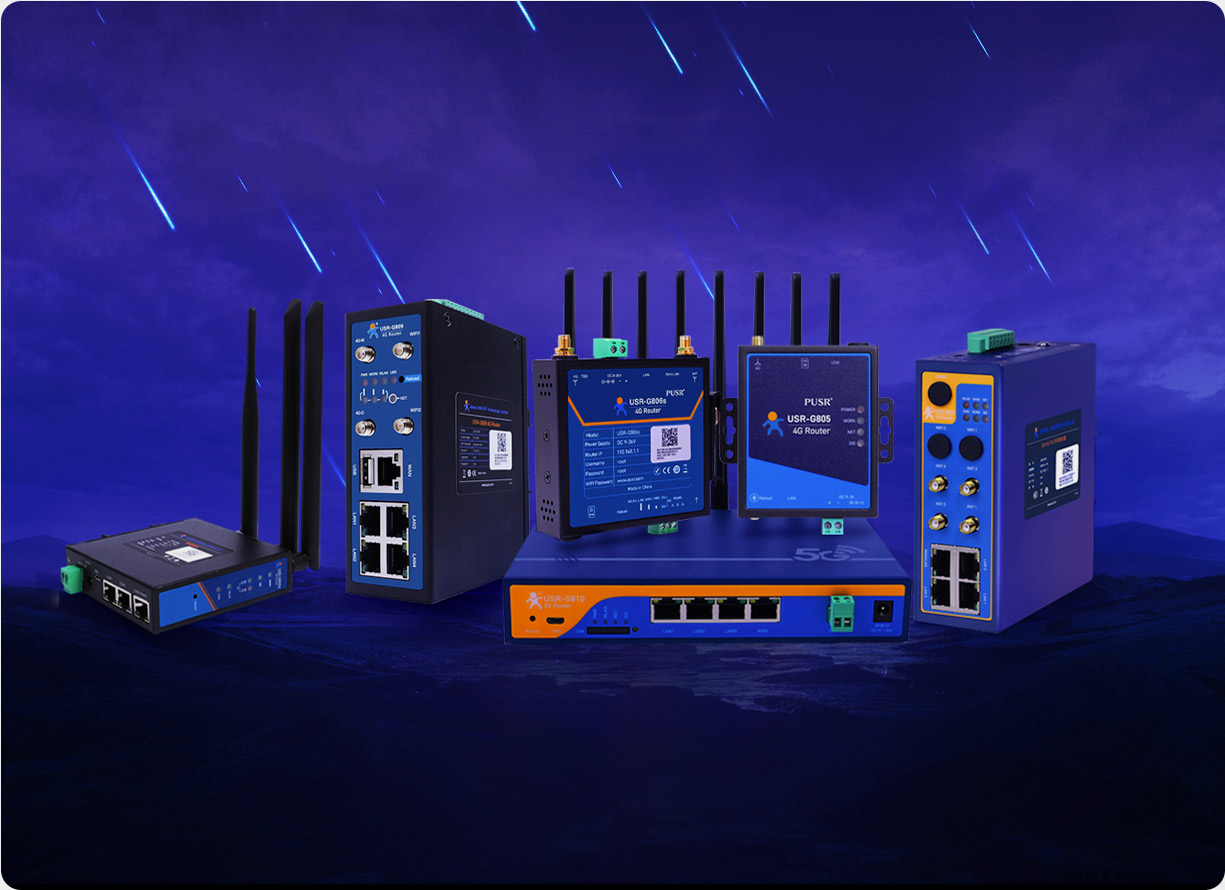
Multi-protocol conversion: They support more than 20 industrial protocols such as Modbus, Profinet, and OPC UA. An enterprise uses the USR-G809s industrial 4G LTE router to unify the protocols of spinning machines and looms of different brands into MQTT, achieving standardized data collection.
Edge computing: With built-in quad-core processors, they can complete data cleaning, anomaly detection, and other preprocessing at the router end. An enterprise uses the edge computing function to compare yarn breakage data from spinning machines with historical models, providing early warnings of equipment failures 1 hour in advance.
5G/WiFi6 dual-mode transmission: They support 5G SA standalone networking with an air interface delay as low as 1ms. In the aseptic weaving workshop of an enterprise, a 5G router reduces the image transmission delay of the visual inspection system from 200ms to 30ms, increasing the defect detection rate by 15%.
Industrial 4G LTE routers achieve a "data closed loop" in energy consumption management through three major mechanisms:
Real-time monitoring: They connect to intelligent electricity meters, steam flow meters, and other equipment to collect energy consumption data in real time. An enterprise associates steam consumption data in the dyeing process with production batches through the router and finds that the steam consumption of a certain batch of products exceeds the standard by 30%, locating a steam valve leakage problem.
Peak-valley scheduling: They support time-of-use electricity price strategies. A park charges energy storage equipment during low-price periods through the router and releases energy for power supply during peak periods, saving more than 10 million yuan in electricity costs annually.
Energy efficiency benchmarking: They establish equipment energy efficiency health indices to eliminate backward production capacity. An enterprise uses data such as motor current and speed collected by the router to identify 142 inefficient motors below IE2 level, saving more than 2 million kWh of electricity annually.
The value of industrial 4G LTE routers can be quantified through three major indicators:
Reduced downtime: After deployment, an enterprise reduces equipment failure downtime from an average of 48 hours per year to 12 hours, saving more than 2 million yuan in costs annually.
Lower energy consumption costs: A park reduces the steam pipeline loss rate from 20% to 8% through router optimization, saving more than 5 million yuan in thermal costs annually.
Decreased quality costs: An enterprise reduces the fabric defect rate from 3.5% to 1.2% by real-time monitoring of loom tension parameters, reducing quality losses by more than 3 million yuan annually.
Among many industrial 4G LTE routers, the USR-G809s has become the preferred choice for textile enterprises due to three major characteristics:
Industrial-grade design: It has an operating temperature range of -35°C to 75°C and an IP67 protection rating, adapting to the high-temperature, high-humidity, and dusty environment of textile workshops. An enterprise deploys it in the printing and dyeing workshop, and the equipment failure rate is zero.
Protocol compatibility: It has a built-in library of more than 20 industrial protocols and supports direct connection to equipment such as PLCs and sensors. A composite textile enterprise uses the USR-G809s to uniformly access data from 12 reactors of different brands into the system.
Security protection: It supports functions such as IPsec VPN, firewalls, and access control and has passed the Level 3 certification of the Cybersecurity Classification Protection 2.0. An export-oriented enterprise meets the data security requirements of the EU BRC food safety standard through secure channels.
Objective: Achieve real-time collection of equipment status, production parameters, and environmental data.
Implementation: Deploy industrial 4G LTE routers, connect to equipment such as PLCs and sensors, and establish a data collection layer.
Case: An enterprise uses the USR-G809s to upload data such as the speed and yarn breakage rate of spinning machines to the MES system in real time, achieving precise control of process parameters.
Objective: Build an integrated energy management system for "sources-networks-loads-storage."
Implementation: Connect industrial 4G LTE routers to systems such as ERP and WMS and establish a data mid-platform.
Case: A park integrates data from the power grid, photovoltaics, and energy storage through routers, achieving peak-valley electricity price arbitrage and saving more than 10 million yuan in electricity costs annually.
Objective: Achieve intelligent decision-making such as equipment failure prediction and process optimization through AI algorithms.
Implementation: Use industrial 4G LTE routers as edge nodes to collaborate with cloud platforms in training models.
Case: An enterprise uses vibration data from looms collected by the USR-G809s, combined with AI algorithms, to predict bearing wear and replace components in advance, avoiding equipment burnout.
Today, with rising labor costs and increasing environmental pressure, the intelligent transformation of the textile industry is no longer a multiple-choice question but a must-answer question. As the "digital nerves" connecting equipment and data, industrial 4G LTE routers are redefining the boundaries of production monitoring and energy consumption management. When the vibration data of a spinning machine can trigger real-time warnings, when the energy consumption fluctuations of a production line can be accurately traced back to a single motor, and when the energy costs of an enterprise can be reduced by 15% through peak-valley scheduling, the textile industry can truly achieve a leap from "scale manufacturing" to "value creation." This is not only a victory of technology but also a solemn commitment to "Made in China"—empowering traditional industries with digital technology and making every meter of fabric carry the warmth of technology.