In-depth Analysis of Pain Points in the Operation and Maintenance of Photovoltaic Power Plants: How Can Industrial 4G LTE Router Solve Network Coverage Challenges in Remote Areas?
Driven by the "dual carbon" goals, China's installed photovoltaic capacity continues to rise. By November 2025, the number of distributed photovoltaic power plants nationwide will have exceeded 5 million. However, while the industry focuses on improving power generation efficiency, "invisible killers" in the operation and maintenance (O&M) process are silently eroding profits. Insufficient network coverage in remote areas, isolated data islands, and inefficient fault location have become core pain points restricting the full lifecycle management of photovoltaic power plants. This article will delve into how industrial 4G LTE router, through technological innovation, can build a "fully covered, highly reliable, and intelligent" communication network for photovoltaic O&M. It will also recommend a solution specifically designed for industrial scenarios—the USR-G806w industrial 4G LTE router.
Photovoltaic power plants are mostly distributed in remote areas such as mountains, deserts, and plateaus, where wired network infrastructure is often lacking, and public network signal coverage is weak. For example, a photovoltaic power plant in northwest China, located more than 8 kilometers from the nearest base station, had a 4G signal strength of only -115 dBm. This resulted in an average of 12 daily disconnections of the monitoring system, with monthly power generation losses due to data loss exceeding 50,000 kWh, directly causing economic losses of RMB 30,000. More severely, traditional routers have a failure rate of up to 40% in extreme environments, further exacerbating the instability of data transmission.
Photovoltaic power plants typically use inverters and sensors from multiple brands such as Huawei, Sungrow, and GoodWe. The incompatible data formats across manufacturers' monitoring platforms require managers to switch between 5-8 systems for operations. A case study of a large-scale ground-mounted power plant showed that O&M personnel had to spend 2 hours daily integrating data. Due to data synchronization delays, a hot spot failure in the modules went undetected, posing a fire risk and nearly causing losses in the millions of yuan.
When the monitoring system alerts to "abnormal power generation in a certain area," locating the specific fault point (such as cracked modules or burned MC4 connectors) requires significant manpower. Traditional methods require O&M personnel to carry equipment such as infrared thermal imagers and IV curve testers for on-site investigations. On average, it takes 4 hours to handle a single fault, with annual O&M costs accounting for up to 35% of total operating expenses. A distributed power plant failed to promptly address bird droppings blocking the modules, resulting in an 18% drop in monthly power generation and losses exceeding RMB 200,000.
Industrial 4G LTE routers build a "wired + wireless" dual-link backup network by integrating multiple communication modules such as 4G/5G, Wi-Fi, wired Ethernet, and LoRa. For example, when the 4G signal is interrupted, the router can automatically switch to the LoRa low-power wide-area network (with a coverage radius of up to 5 kilometers) to ensure no data is lost. After adopting a multi-network integration solution, a plateau photovoltaic power plant saw its data transmission success rate increase from 78% to 99.9%, with annual data loss losses reduced to less than RMB 5,000.
USR-G806w Solution:
The USR-G806w supports 4G LTE for all networks and can be optionally equipped with a LoRa module, covering a radius of up to 5 kilometers to meet monitoring needs in remote areas. Its "dual-SIM dual-standby" function supports simultaneous access to two operators' networks. When the primary network signal strength drops below -100 dBm, it automatically switches to the backup network in just 2 seconds, ensuring business continuity.
Industrial 4G LTE routers adopt industrial-grade designs with features such as an IP67 protection rating (dustproof and waterproof), a wide operating temperature range (-40°C to 85°C), and electromagnetic interference resistance (EMC Level 4). For example, a desert photovoltaic power plant adopted routers with self-cleaning functions, using high-pressure air pumps to regularly blow dust out of the equipment. This extended the equipment's lifespan from 2 years to 5 years, with an annual failure rate reduced to below 5%.
USR-G806w Solution:
The USR-G806w features a fully metal casing with an IP30 protection rating (customizable to IP67), built-in hardware watchdog and ESD electrostatic protection, and stable operation in environments from -20°C to 70°C. Its "lightning protection design" supports 8 kV surge protection, effectively withstanding lightning strikes and ensuring continuous operation in extreme weather conditions such as heavy rain and sandstorms.
Industrial 4G LTE routers support industrial protocols such as Modbus, OPC UA, and MQTT, enabling seamless integration with various types of sensors. Meanwhile, built-in edge computing modules can process data locally (such as data cleaning and anomaly detection), reducing cloud transmission volume and latency. For example, a photovoltaic power plant in a river basin achieved "real-time alarm for module temperature exceedance" through edge computing, shortening response times from minutes to seconds and reducing annual false alarm rates to below 0.1%.
USR-G806w Solution:
The USR-G806w supports RS232/RS485 serial port transparent transmission, allowing direct connection to inverters, environmental monitors, and other devices. Its edge computing function supports Python secondary development, enabling users to customize algorithms (such as power generation forecasting models) for intelligent decision-making. Additionally, through the USR Cloud platform, managers can view key indicators such as power plant power generation, cumulative revenue, and CO2 emission reductions in real-time, building a "global digital cockpit."
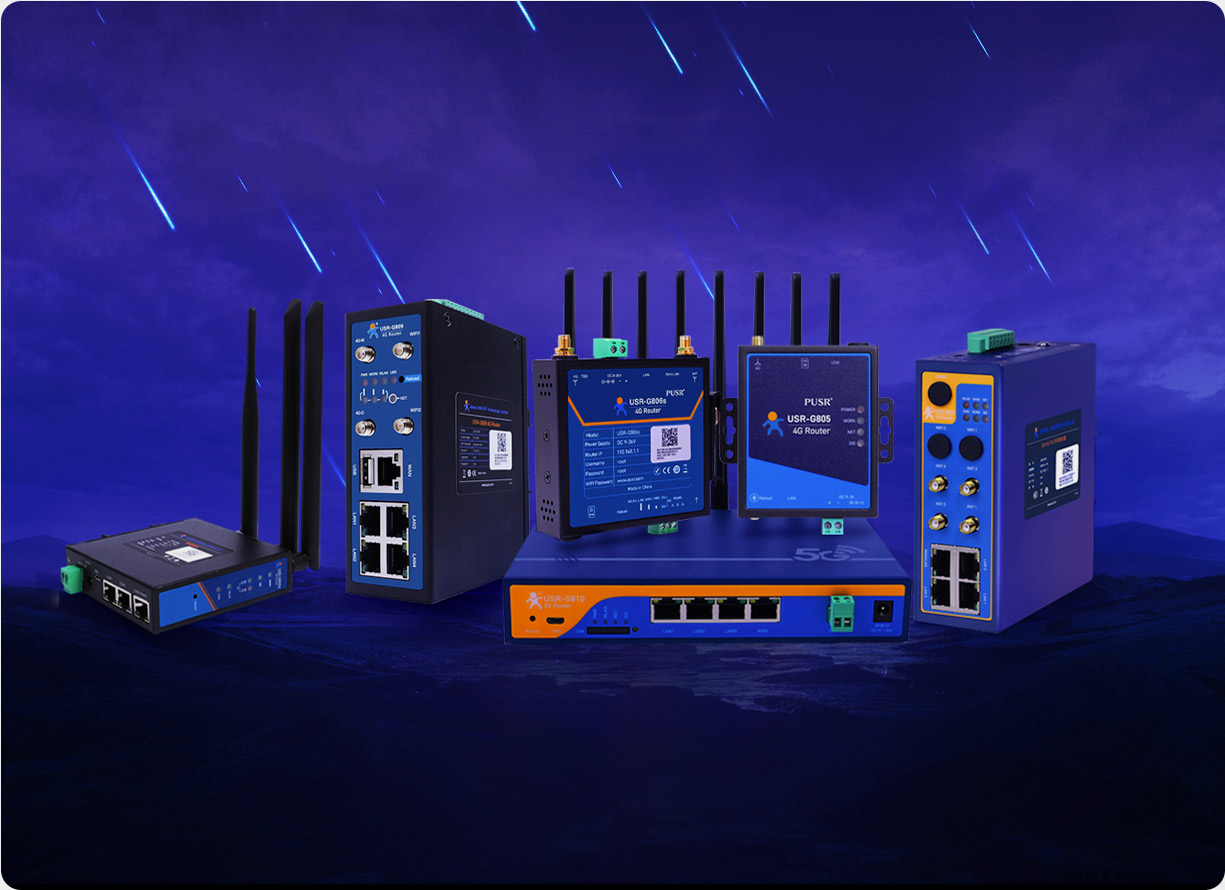
The USR-G806w is a 4G/5G industrial 4G LTE router specifically designed for industrial scenarios, integrating data collection, transmission, and edge computing to perfectly meet the O&M needs of photovoltaic power plants.
Multi-network Integrated Communication: Supports 4G LTE, dual-band Wi-Fi (2.4GHz/5GHz), dual Gigabit Ethernet ports (1 WAN + 2 LAN), and built-in telecom eSIM card for quick internet access without card insertion. Its "Cloud Eagle Card" function supports automatic switching among three major operators, ensuring access via the optimal operator even in areas with poor network signals.
Extreme Environment Adaptability: Fully metal casing with an IP30 protection rating (customizable to IP67), operation in temperatures from -20°C to 70°C, and 8 kV surge protection, adapting to harsh environments such as deserts, plateaus, and coastal areas.
Intelligent Networking and Edge Computing: Supports USR DM remote networking function for cross-regional device interconnection without public IP addresses; built-in Python development environment for custom algorithms, enabling intelligent applications such as fault prediction and power generation optimization.
Security Protection System: Supports five VPN protocols (PPTP, L2TP, IPSec, OpenVPN, GRE), with IP blacklist/whitelist, port forwarding, NAT/DMZ, and other firewall functions to ensure secure data transmission.
Remote O&M Management: Through the USR Cloud platform, real-time monitoring of device status, remote parameter configuration, and firmware upgrades can be performed, reducing O&M costs by over 50%.
Ground-mounted Photovoltaic Power Plants: Achieves real-time data backhaul in remote areas through 4G + LoRa dual-link backup, combined with edge computing for "module-level fault warning," improving power generation efficiency by over 10%.
Distributed Rooftop Photovoltaic: Expands coverage range using Wi-Fi relay function and centrally manages scattered sites through the USR Cloud platform, reducing O&M labor costs by 30%.
Agricultural-Photovoltaic Complementary Projects: Operates stably in high-temperature and high-humidity environments, monitoring parameters such as module temperature and humidity to prevent power generation losses due to environmental factors.
A ground-mounted power plant in northwest China, covering an area of over 50 square kilometers, had a data loss rate of 22% due to weak signals in its traditional monitoring system, requiring O&M personnel to conduct 8-hour daily inspections. In 2025, the plant introduced the USR-G806w industrial 4G LTE router and achieved upgrades through the following solution:
Network Optimization: Adopted "4G + LoRa" dual-link backup, expanding signal coverage radius to 5 kilometers and increasing data transmission success rate to 99.9%.
Intelligent Warning: Achieved "real-time alarm for module temperature exceedance" through edge computing, shortening response time to 3 seconds and reducing annual false alarm occurrences from 120 to 1.
O&M Cost Reduction: Remotely managed devices through the USR Cloud platform, reducing annual O&M costs by 60% and decreasing personnel inspection frequency from daily to weekly.
As the photovoltaic industry transitions from "scale expansion" to "benefit competition," O&M capabilities have become a core competitiveness of power plants. The USR-G806w industrial 4G LTE router, with its four core capabilities of "multi-network integration, extreme environment adaptability, intelligent networking, and security protection," builds a stable, efficient, and intelligent communication network for photovoltaic power plants, helping customers transform from "cost centers" to "profit centers."