Transformation of Smart Factory Production Lines: How Can Industrial Switches Solve the Packet Loss Dilemma in PLC-Robot Communication?
At the production line transformation site of an auto parts factory in the Yangtze River Delta, engineers are fretting over the jumping numbers on the control screen—the packet loss rate between the PLC and the six-axis robot is as high as 15%, leading to frequent interruptions in the welding process and a loss of over 200 units of production capacity per hour. This scenario is not an isolated case. According to industry research, over 60% of smart factories encounter unstable equipment communication during production line upgrades, with packet loss in PLC-robot communication becoming an "invisible killer" that restricts the efficiency of automated production lines.
When the robotic arm on the production line suddenly stalls, the operator's first reaction is to check the equipment itself, often overlooking the "time bomb" hidden in the communication network. The losses caused by packet loss in communication are concealed:
Direct losses: A home appliance company suffered over 500,000 yuan in losses from a single incident due to communication interruptions that caused an injection molding machine to idle;
Hidden costs: Frequent equipment restarts shortened the PLC lifespan by 30% and increased maintenance costs by 45%;
Quality risks: Communication delays led to deviations in the robot's motion trajectory, causing the product defect rate at a precision machining factory to rise by 2 percentage points.
Behind these pain points lies the customers' deep-seated need for "certainty"—they require not just equipment connectivity but also stable communication guarantees with millisecond-level response times.
Traditional industrial network architectures struggle to meet the demands of modern production lines:
Protocol fragmentation: The coexistence of multiple protocols such as Modbus, Profinet, and EtherCAT results in "language barriers" between devices;
Poor environmental adaptability: Ordinary switches experience startup difficulties in environments below -10°C, with communication failure rates surging by 300% in winter at a factory in northern China;
Weak anti-interference capabilities: Electromagnetic interference from devices such as frequency converters and welding machines can increase the communication error rate by 10 times.
An engineering machinery company once attempted to solve signal attenuation issues by adding repeaters, only to experience system crashes due to accumulated network delays, exposing the limitations of traditional "patchwork" solutions.
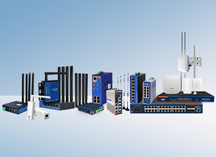
Taking the USR-ISG series industrial switch as an example, they build stable communication links through three core technologies:
Deterministic transmission guarantees:
Store-and-forward technology ensures packet forwarding delays are stable within 5μs, meeting the real-time control requirements of robots;
Support for IEEE 802.1Qbb priority marking ensures the priority transmission of critical control instructions;
Ring network redundancy design (ERPS protocol) achieves 50ms-level fault self-healing, with a photovoltaic company improving network availability to 99.999% after application.
Industrial-grade environmental adaptability:
Wide temperature operation capability from -40°C to 85°C, with stable operation for over 3 years in outdoor environments at -35°C in Inner Mongolia;
IP40 protection rating combined with a full metal casing effectively resists dust, moisture, and electromagnetic interference;
Dual power redundancy design (9.6-60V wide voltage input), with a substation project maintaining power supply for 2.3 hours during mains power outages.
Intelligent operation and maintenance system:
Built-in watchdog module automatically restarts faulty ports, reducing manual intervention;
Support for SNMP protocol enables real-time monitoring of 12 key indicators such as port traffic and temperature;
Port mirroring function aids in fault location, with an auto factory reducing troubleshooting time from 4 hours to 20 minutes through traffic analysis.
The USR-ISG series has developed differentiated solutions tailored to the characteristics of different industries:
Automotive manufacturing: Five gigabit electrical ports simultaneously transmit control instructions for welding robots and 4K video streams from vision systems, with a backplane bandwidth of 10Gbps;
3C electronics: Eight-port PoE power supply design directly powers cameras and sensors on AGV carts, reducing wiring costs by 40%;
Food processing: Anti-corrosion coating combined with an IP67 protection rating reduces the failure rate by 75% in humid environments;
Energy and power: 6kV lightning protection design, certified by IEC61000-4-5 standard, effectively resists lightning surges.
A case study of production line transformation at a semiconductor company shows that after adopting USR-ISG switches:
The packet loss rate in PLC-robot communication dropped from 12% to 0.02%;
Overall equipment effectiveness (OEE) increased by 18%;
Annual maintenance costs decreased by 650,000 yuan.
Customers often fall into the "parameter competition" trap when selecting models and need to focus on:
Backplane bandwidth: Non-managed switches should be ≥1.5 times the sum of all port speeds;
Packet forwarding rate: Line-speed forwarding requires ≥ (number of ports × port speed × 2) / 8 (Mbps);
MTBF: Industrial-grade equipment should be ≥100,000 hours, with a certain brand achieving 350,000 hours in actual tests;
Electromagnetic compatibility: Must pass the IEC61000-4-6 radio frequency field immunity test (10V/m).
Differentiated recommendations based on production line scale:
Production Line Type Recommended Model Port Configuration Special Features
Small production lines (<20 axes) USR-ISG1005 5 gigabit electrical ports + 2 optical ports Plug-and-play, supports VLAN division
Medium production lines (20-50 axes) USR-ISG1008 8 gigabit electrical ports + 2 optical ports Port speed limiting, QoS priority
Large production lines (>50 axes) USR-ISG1016 16 gigabit electrical ports + 4 optical ports Ring network redundancy, ERPS protocol
With the maturity of TSN (Time-Sensitive Networking) technology, industrial switch are evolving from single communication devices to intelligent hubs for production lines:
Time synchronization accuracy: New-generation products support microsecond-level clock synchronization to meet motion control requirements;
Edge computing capabilities: Built-in ARM Cortex-A72 processors can run lightweight AI models for real-time data analysis;
Predictive maintenance: Through vibration sensor interfaces and machine learning algorithms, equipment failures can be predicted 30 days in advance.
A robot manufacturer has integrated USR-ISG switching modules into its new-generation products, achieving:
A 60% reduction in communication delay;
A 0.02mm improvement in motion trajectory accuracy;
A reduction in production line changeover time from 2 hours to 15 minutes.
In the era of Industry 4.0, the stability of communication networks has become a core indicator for measuring the maturity of smart factories. When a photovoltaic company reduced the packet loss rate in its production line communication to 0.001% using USR-ISG switches, its chairman remarked, "The emergency plans we prepared for communication failures in the past have now saved us an equivalent amount in unplanned downtime costs." This perhaps echoes the common sentiment of all manufacturing customers—they do not need more complex equipment but a more reliable communication foundation.
Choosing industrial switches is essentially choosing certainty. When PLC instructions can reach robot joints in milliseconds and visual system data can be transmitted losslessly to the control hub, the "digital nerves" of smart factories can truly operate unimpeded. And this is precisely the industrial transformation story that the USR-ISG series industrial switches are writing.