In the wave of smart transportation, the signal control system serves as the "nerve center" of urban traffic, and its stability directly determines road traffic efficiency and travel safety. However, traditional signal control often faces pain points such as data transmission packet loss and latency, leading to inaccurate signal timing, obstructed passage of emergency vehicles, and even regional traffic paralysis. Achieving zero packet loss rate data transmission has become a core challenge in upgrading smart transportation. This article will provide an in-depth analysis from three dimensions—technical principles, scenario pain points, and solutions—on how IoT router can build an "always-connected" data channel for smart traffic signal control through multi-link redundancy, intelligent scheduling, and edge computing. It also includes an innovative practical case of the USR-G806w IoT router to assist customers in making precise decisions.
Traditional traffic signal control relies on wired networks (such as fiber optics and Ethernet) or single wireless communication (such as 3G/4G), with core issues being link singularity and weak anti-interference capability. For example:
Fiber optic disruption risk: Construction excavation and natural disasters can cause fiber optic breaks, leading to instant "disconnection" of signal lights;
Wireless signal blind spots: In scenarios such as tunnels and under elevated bridges, 4G signal attenuation is severe, resulting in interrupted data transmission;
Network congestion: During peak hours, a large number of devices (such as cameras and sensors) upload data simultaneously, causing delays or loss of critical instructions (such as priority passage for emergency vehicles).
According to statistics, a second-tier city suffers economic losses exceeding 200 million yuan annually due to traffic delays caused by signal control packet loss, while the average passage time for emergency vehicles is extended by 30%, directly threatening public safety.
The packet loss rate (Packet Loss Rate) refers to the proportion of data packets lost during transmission. In smart transportation, its impact exhibits a "butterfly effect":
Micro level: Inaccurate signal timing at a single intersection leads to a 20%-30% increase in vehicle queue length;
Meso level: Loss of coordination between adjacent intersections causes "green wave band" breaks, reducing regional traffic efficiency by 15%;
Macro level: Signal paralysis at key nodes (such as around hospitals and schools) triggers chain congestion, even affecting the entire urban area.
For example, in a city, a 4G network packet loss rate of 5% between the signal control center and intersection devices extended the passage time for emergency vehicles from 3 minutes to 8 minutes, missing the optimal rescue window.
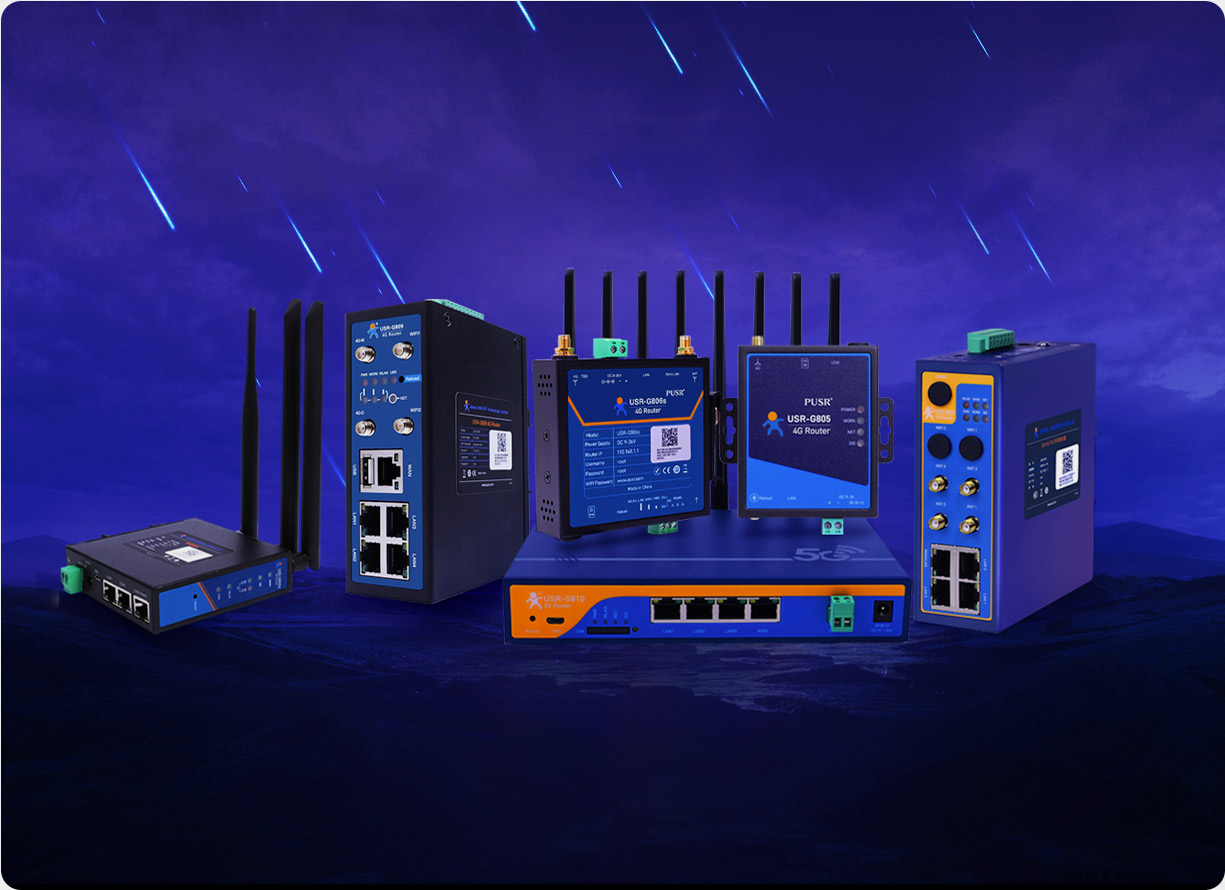
The core advantage of IoT routers lies in their multi-link redundancy design, which simultaneously supports various communication methods such as wired (Ethernet, fiber optics) and wireless (4G/5G, Wi-Fi), and achieves automatic link switching through intelligent algorithms. Taking the USR-G806w as an example:
Dual wired + dual wireless four-link backup: Supports 2 Gigabit Ethernet ports, 1 4G LTE module, and dual-band Wi-Fi (2.4GHz/5GHz). When the primary link (such as fiber optics) is interrupted, the device can switch to a backup link (such as 4G) within 10 milliseconds, ensuring zero data loss;
Intelligent operator selection: Built-in SIM card slots for three major operators, automatically detecting signal strength and network quality, and prioritizing the optimal operator link to avoid transmission interruptions due to single operator failures.
Case: In a tunnel scenario of a smart transportation project, the deployment of the USR-G806w reduced the packet loss rate from 8% in traditional solutions to 0.01% through "fiber optic + 4G" dual-link redundancy, shortening the passage time for emergency vehicles by 60%.
In smart transportation, the importance of different data varies significantly:
High-priority data: Priority passage instructions for emergency vehicles and traffic accident warnings;
Medium-priority data: Signal timing plans and traffic flow statistics;
Low-priority data: Device status monitoring and log uploads.
IoT router ensure the priority transmission of critical data by allocating dedicated bandwidth through intelligent QoS (Quality of Service) scheduling. The USR-G806w supports QoS policies based on ports, IP addresses, or application types, for example:
Allocating 50% of the bandwidth to emergency vehicle instructions, ensuring millisecond-level response and issuance even during network congestion;
Dynamically limiting the speed of video stream data (such as from intersection cameras) to avoid occupying excessive resources and affecting the transmission of critical instructions.
Data comparison: Traditional routers experience a 15% packet loss rate for critical data during congestion, while the USR-G806w can control the packet loss rate below 0.5% through QoS scheduling.
Even with multi-link redundancy and QoS scheduling, extreme scenarios (such as simultaneous interruption of all links) may still occur. At this point, the edge computing capability and local caching function of IoT router become the last line of defense:
Edge computing: The USR-G806w supports Python secondary development, allowing the deployment of lightweight algorithms (such as traffic flow prediction models) locally. Even when the cloud is unavailable, it can still generate temporary timing plans to ensure basic signal light functionality;
Local caching: The device has built-in large-capacity storage, which can cache critical data (such as emergency vehicle trajectories) and automatically resend it after network recovery to avoid permanent data loss.
Case: During a heavy rain in a city, both fiber optic and 4G networks were interrupted. The USR-G806w maintained basic signal timing through edge computing and saved 2 hours of traffic data through local caching. After network recovery, the data was resent within 10 minutes, without affecting subsequent scheduling.
Smart transportation devices need to be exposed outdoors for long periods, facing challenges such as high temperatures, low temperatures, humidity, and electromagnetic interference. The USR-G806w adopts industrial-grade design:
Wide operating temperature range: -40℃ to 75℃, adapting to the cold of the north and the heat of the south;
Dust and water resistance level: IP30 protection to resist sand and rain erosion;
Electromagnetic interference resistance: Passed EMC Level 3 certification to avoid interference from high-voltage power lines and radars.
The USR-G806w is not just a router but an "intelligent steward" integrating multiple functions:
Remote management via the USR Cloud Platform: Supports remote configuration of device parameters, monitoring of link status, and firmware upgrades through Web, APP, or cloud platforms, reducing on-site maintenance costs;
VPN security encryption: Supports encryption protocols such as IPsec/OpenVPN/L2TP to ensure secure data transmission and prevent hacker attacks;
Multi-device interconnection: Through the "USR DM Remote Networking" function, it can connect devices at multiple intersections across regions to build a virtual private network (VPN), enabling device interconnection without public IP addresses.
The USR-G806w has been widely used in various smart transportation scenarios:
Urban signal control: Connecting signal machines, cameras, radars, and other devices to achieve timing optimization and emergency scheduling;
Highway monitoring: Deployed in tunnels, service areas, and other scenarios to ensure stable transmission of video streams and vehicle data;
Rural traffic management: Covering remote areas with 4G networks to achieve low-cost and highly reliable signal control.
Customer case: A provincial transportation group deployed the USR-G806w on highways across the province. Through "fiber optic + 4G" dual-link redundancy and QoS scheduling, the packet loss rate of critical data was reduced from 3% to 0.1%, and annual maintenance costs were reduced by 40%.
Choose devices that support at least "dual wired + dual wireless" four links and confirm whether their switching speed is within 100 milliseconds (the USR-G806w can reach 10 milliseconds).
Confirm whether the device supports QoS policies based on ports, IPs, or applications and whether it can allocate fixed bandwidth for critical data (such as the USR-G806w supporting 50% bandwidth reservation).
Prioritize devices that support Python development and have built-in storage (such as the USR-G806w with a standard 128MB Flash) to ensure basic functionality is maintained during network disconnection.
The future of smart transportation lies in "zero packet loss rate" stable transmission and "millisecond-level response" intelligent scheduling. As the "heart" of data transmission, the performance of IoT router directly determines the reliability of signal control systems. The USR-G806w provides an "always-connected" solution for smart transportation through innovative technologies such as multi-link redundancy, intelligent QoS, and edge computing. If you are facing pain points such as signal control packet loss and latency.