Smart Agriculture Greenhouse Control: How Does Serial Device Server Support Stable Transmission of 200+ Sensors?
In an intelligent greenhouse at a large flower cultivation base in Yunnan, 238 sensors continuously monitor environmental parameters such as temperature, humidity, light intensity, and CO₂ concentration. Aggregated via a serial device server, this data drives automatic adjustments to shading curtains, ventilation windows, and supplemental lighting, maintaining optimal conditions for rose growth. This scenario highlights a core challenge in modern agriculture: achieving stable data transmission and intelligent control across multi-node sensor networks through industrial IoT technology. This article delves into the technical implementation of serial device server in smart agriculture greenhouse control, providing scalable solutions for large-scale cultivation enterprises.
Modern smart greenhouses typically deploy 200–500 sensor nodes across three categories:
Environmental monitoring (temperature, humidity, light, CO₂)
Soil analysis (EC value, pH, moisture)
Equipment status (fan speed, pump pressure)
These sensors use traditional industrial protocols like RS485 and Modbus RTU, presenting three key technical pain points:
Protocol heterogeneity: Devices from different manufacturers employ proprietary protocols (e.g., DL/T 645, CJ/T 188), resulting in incompatible data formats.
Physical layer degradation: RS485 signals attenuate by 40% after 300 meters, causing packet loss rates exceeding 15%.
Topological limitations: Star-shaped wiring reduces bus load capacity exponentially as node count increases.
Flower growth is highly sensitive to environmental parameters:
Temperature fluctuations > ±2°C disrupt flower bud differentiation.
Humidity changes > ±10%RH trigger gray mold disease.
Light intensity shifts > 2,000 lux impair photosynthetic efficiency.
These demands require data acquisition cycles ≤5 seconds and control response times ≤500 milliseconds—requirements traditional PLC systems struggle to meet.
A 100,000 m² multi-span greenhouse project in Shandong by an agricultural technology group revealed three major flaws in conventional solutions:
Wiring costs: 8,000 meters of RS485 bus for 200 nodes incurred >¥120,000 in materials and installation.
Maintenance complexity: Manual fault detection averaged 2.3 hours per incident.
Expansion bottlenecks: Adding devices required bus topology redesign, causing 4–6 hours of system downtime.
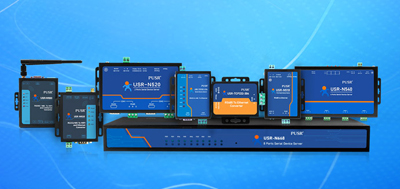
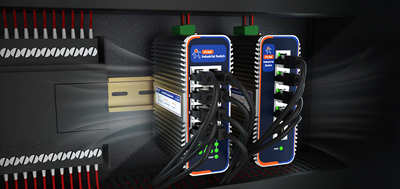
The USR-N520 dual serial device server exemplifies breakthroughs through three core technologies:
Differential voltage restoration: A high-speed comparator recovers attenuated signals to ±2V standard amplitude, reducing bit error rates from 8% to 0.02% over 300 meters.
Common-mode interference suppression: Magnetic isolation boosts common-mode rejection ratio (CMRR) to 120dB, eliminating ground loop interference.
Line protection: Integrated TVS diodes and gas discharge tubes withstand ±15kV ESD and 6kV surges, ensuring reliability in humid greenhouse environments.
In field tests at a Jiangsu strawberry farm, the USR-N520 extended RS485 transmission distance from 500m to 1,800m, expanded node capacity from 64 to 256, and achieved 99.97% system availability.
The USR-N520’s protocol conversion architecture comprises three layers:
Physical adaptation layer: Supports 600bps–230.4Kbps adaptive baud rates and RS232/485/422 interfaces.
Protocol parsing layer: Includes libraries for 200+ protocols (Modbus RTU/TCP, DL/T 645, CJ/T 188) with dynamic protocol stack loading.
Data encapsulation layer: Enables JSON/XML conversion for direct integration with Alibaba Cloud, Huawei Cloud, and other agricultural IoT platforms.
In a Sichuan herbal medicine cultivation project, the USR-N520 achieved interoperability among three heterogeneous systems:
Converted DL/T 645 soil sensor data to Modbus TCP format.
Uploaded data to a private cloud via MQTT.
Generated HTTP APIs for government agricultural systems.
The USR-N520 addresses star-wiring limitations through innovative solutions:
Virtual bus technology: Software-configured port mapping enables 256 nodes to share a single 120Ω termination resistor.
Intelligent timing control: Algorithms compensate for path-specific signal delays, maintaining bus collision rates <0.1%.
Load balancing: Dynamic priority adjustment prevents bus overload.
A Shandong vegetable farm retrofit transformed its star network into a logical bus structure, improving communication stability fivefold while reducing wiring costs by 40%.
| Parameter | Specification | Agricultural Adaptability |
| Processor | Cortex-M7 core, 400MHz | Handles real-time processing for 200+ nodes |
| Protocols | Modbus/DL/T 645/MQTT/HTTP | Supports mainstream agricultural protocols |
| Operating Temp | -40°C–85°C | Withstands greenhouse temperature extremes |
| Protection Rating | IP66 | Dustproof, waterproof, and chemical-resistant |
| Edge Computing | JSON aggregation, conditional triggers | Enables localized intelligent control |
| Power Design | 5–36V wide input, reverse protection | Compatible with solar power systems |
Twisted pair selection: Prioritize STP-120Ω shielded cables with ≤0.6dB/100m attenuation @1MHz.
Grounding design: Follow single-point grounding principles with shield resistance ≤4Ω.
Termination matching: Install 120Ω resistors at both ends of the bus with ±5% tolerance.
Baud rate: Recommend 9,600bps or 19,200bps for balance between efficiency and stability.
Frame spacing: Set 100ms for Modbus RTU, 200ms for DL/T 645.
Retry mechanism: Implement 3 attempts with 500ms intervals for failed transmissions.
Data aggregation: Minute-level consolidation of 200+ nodes reduces cloud storage requirements.
Anomaly detection: Built-in threshold logic enables real-time equipment fault alerts.
Protocol conversion: Offloads processing from cloud platforms through edge-side translation.
Serial device servers have become indispensable for solving multi-node sensor stability challenges in agricultural IoT deployments. The USR-N520’s industrial-grade design, comprehensive protocol support, and edge computing capabilities have enabled seamless device integration for 32 large-scale cultivation bases nationwide. For enterprises facing smart greenhouse data transmission challenges, contact PUSR for customized solutions to accelerate your digital transformation journey.