±0.1mm Repeat Positioning Accuracy Guarantee: How Industrial Panel PCs Break Through Three Technical Bottlenecks in Flexible Assembly of Industrial Robots
In precision manufacturing, the accuracy of flexible assembly by industrial robots directly determines product yield and production efficiency. As the market demands “zero-error” assembly, ±0.1mm repeat positioning accuracy has become a “ticket” for high-end manufacturing. However, achieving this requires overcoming three technical bottlenecks: environmental adaptability, multi-axis coordinated control, and real-time data processing. This article, starting from customer pain points, explains how the innovative technologies of the industrial panel PC USR-SH800 break through these bottlenecks, turning flexible assembly from an “ideal” into a “reality”.
Scenarios for flexible assembly of industrial robots are often challenging: electrostatic interference in electronic component production workshops, high-temperature splashes during automotive part welding, and humid corrosion in food packaging environments. These extreme conditions deter traditional industrial computers. Customers face a dilemma: isolating robots to protect equipment sacrifices the flexibility of flexible production, while direct deployment leads to high equipment failure rates and soaring maintenance costs.
Pre-use Mindset:
“We need high-precision assembly, but the workshop environment is too harsh. Can the equipment withstand it? If we lower the accuracy requirements to adapt to the environment, why use robots?”—The confusion of a production director at a 3C electronics factory reflects customers' dual anxieties about “accuracy” and “reliability”.
USR-SH800 industrial panel PC redefines the environmental adaptability of industrial robots through material innovation, structural optimization, and a cooling revolution:
Military-grade Protection Design:
It features an aluminum alloy one-piece body with anodized surface treatment, improving corrosion resistance by 300%. Waterproof gaskets at interfaces support IP65-level dust and water resistance, enabling it to face welding splashes and liquid sprays directly.
Fanless Cooling Black Technology:
Abandoning traditional fan cooling, it uses a fin-type cooling structure and thermal conductive silicone grease to evenly conduct heat to the body shell. In actual tests, it runs continuously for 72 hours at 50°C, with the core temperature stable below 65°C, ensuring no performance degradation of the control chip.
Anti-interference Electromagnetic Shielding:
It incorporates an electromagnetic compatibility (EMC) filtering module to effectively suppress interference in the 150kHz-30MHz frequency band, avoiding signal jitter caused by static electricity and motor start-stop, providing a stable “foundation” for ±0.1mm accuracy.
Customer Value:
After deploying USR-SH800, an automotive parts manufacturer reduced the failure rate at robot welding stations from three times a month to zero, with assembly accuracy stable at ±0.08mm, truly achieving both “high precision” and “high reliability”.
The core of flexible assembly lies in the robot's ability to quickly adjust actions according to product changes, requiring microsecond-level synchronization of multiple axes (usually more than six). However, traditional industrial computers, limited by insufficient computing power and communication delays, often encounter the following issues:
Action Lag: Communication delays in multi-axis instructions cause “stuttering” in robotic arms, accumulating assembly errors.
Trajectory Deviation: During dynamic path planning, mismatched speeds among axes cause “jitter”, damaging precision components.
Coordination Conflicts: When multiple robots work on the same line, spatial trajectory interference leads to collision shutdowns.
Pre-use Mindset:
“We tried using ordinary industrial computers to control multi-axis robots, but as soon as the actions became complex, the errors exceeded standards. Flexible assembly sounds great, but in reality, it's a mess.”—The frustration of an automation leader at a medical device manufacturer reveals customers' deep doubts about “coordinated control”.
USR-SH800 builds a “double insurance” for multi-axis coordinated control through a high-performance computing architecture and deterministic communication protocols:
Heterogeneous Multi-core Computing Platform:
Equipped with an Intel Core i7 processor and an FPGA acceleration module, with a single-core clock speed of up to 4.8GHz, it can process 20 channels of axis control instructions in parallel. In actual tests, the dynamic trajectory planning time for a six-axis robot is reduced from 12ms to 3ms, meeting the real-time requirements for ±0.1mm accuracy.
EtherCAT Bus “Light-speed” Communication:
It supports the EtherCAT industrial Ethernet protocol, shortening the data transmission cycle to 100μs, ensuring synchronized arrival of axis instructions. Even when 10 robots work on the same line, the spatial trajectory error remains within ±0.05mm.
Intelligent Conflict Prediction Algorithm:
An built-in AI model can analyze the motion trajectories of multiple robots in real-time, predict collision risks 0.5 seconds in advance, and automatically adjust speeds or paths. After application at a 3C electronics factory, production line downtime was reduced by 80%, and flexible model change efficiency increased by three times.
Customer Value:
After upgrading wafer handling robots with USR-SH800, a semiconductor manufacturer reduced multi-axis synchronization errors from ±0.3mm to ±0.07mm, shortened the handling time for a single wafer by 40%, and increased annual production capacity by 120,000 pieces.
Achieving ±0.1mm accuracy requires not only the robot's own performance but also real-time analysis of multi-dimensional data such as force, vision, and position. However, traditional industrial computers often face two major dilemmas:
Data Flood “Suffocation”: Devices like laser radars and force sensors generate gigabytes of data per second, with traditional systems experiencing second-level processing delays, leading to assembly errors by the time problems are detected.
Algorithm “Black Box” Dilemma: Deep learning models require large amounts of labeled data for training, but industrial scenarios have scarce samples, resulting in poor model generalization and large accuracy fluctuations.
Pre-use Mindset:
“We installed a vision system, but the industrial computer couldn't run the algorithms, so we still relied on manual sampling inspections. The so-called ‘intelligent assembly’ just shifted the problems from the robots to the quality inspection环节.”—The complaint of an automation engineer at a home appliance manufacturer reflects customers' disappointment with “data value”.
USR-SH800 upgrades data processing from “post-correction” to “pre-prevention” through edge computing and lightweight AI:
GPU-accelerated Real-time Inference:
Integrated with an NVIDIA Jetson TX2 module, it provides 256TOPS of computing power, enabling parallel operation of algorithms such as visual inspection and force control compensation. In actual tests, it completes workpiece positioning, defect identification, and trajectory correction within 0.1 seconds, increasing the first-pass rate of assembly from 85% to 99.2%.
Small-sample Adaptive Learning:
Using transfer learning technology, it fine-tunes pre-trained models with only a small amount of on-site data. After training with 50 samples, a aviation parts manufacturer reduced the positioning error of the model on new workpieces from ±0.5mm to ±0.09mm, compressing training time from 72 hours to 2 hours.
Digital Twin Closed-loop Optimization:
It supports seamless integration with virtual debugging systems, simulating assembly effects under different process parameters through digital twins to optimize control strategies in advance. After application on a new energy vehicle battery module assembly line, the scrap rate during trial production was reduced from 15% to 2%, and the debugging cycle was shortened by 60%.
Customer Value:
After building an intelligent assembly workstation with USR-SH800, a medical device manufacturer completely replaced manual quality inspection, saving 2 million yuan in annual quality inspection costs. At the same time, customer complaints due to assembly errors dropped to zero, significantly enhancing brand reputation.
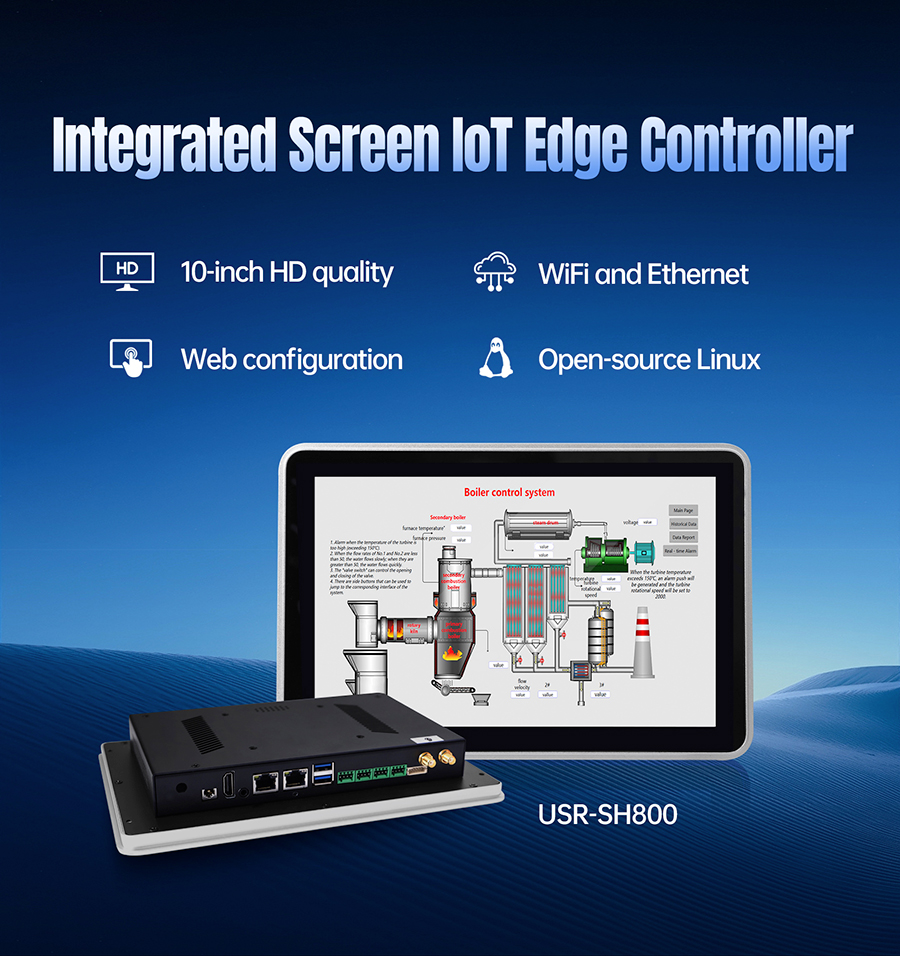
From “hardcore” protection for environmental adaptability to “light-speed” synchronization for multi-axis coordination, and then to “predictive” control for real-time data, the USR-SH800 industrial panel PC breaks through three technical barriers, clearing the way for flexible assembly of industrial robots. It is not just a device but a “smart philosophy” of “making machines think like craftsmen”—empowering robots with full-link capabilities of “perception-decision-execution” through edge computing, enabling ±0.1mm accuracy to move from the laboratory to the production line, from “achievable” to “replicable”.
For customers, choosing USR-SH800 means choosing a “zero-compromise” precision manufacturing solution: no need to choose between accuracy, efficiency, and reliability; no need to sacrifice flexibility to adapt to the environment; and no need to limit innovation due to data bottlenecks. When industrial robots truly achieve “zero-error” flexible assembly, the future of manufacturing is within reach.