The Secret Behind Zero-Downtime Production Lines: How Industrial Routers Enable Millisecond-Level Handshakes Between PLC and MES Systems
In the wave of intelligent transformation in automotive manufacturing, a zero-downtime production line is the dream of all enterprises. As welding robots' precisely positioned mechanical arms continue to dance, as sensor data from the painting workshop converges in real-time like a stream, and as AGV trolleys shuttle effortlessly between production lines—behind these scenes lies an often-overlooked "invisible guardian": the industrial router. It is not just a bridge for data transmission but also the key to solving the challenge of millisecond-level handshakes between PLC and MES systems.
In traditional automotive manufacturing production lines, the collaboration between MES systems and PLCs often falls into a "disconnection" dilemma:
Instruction delays: Production plan adjustment instructions issued by the MES system require manual entry into the PLC, taking hours or even days, leading to delayed production scheduling.
Data silos: Key data such as equipment status and process parameters rely on manual statistics, with high error rates and inability to provide real-time feedback, affecting quality traceability.
Collaboration failures: Heterogeneous equipment such as welding robots, painting equipment, and AGV trolleys do not communicate with each other, unable to achieve collaborative scenarios like "automatic call for handling after processing completion," relying on manual intervention.
The case of an automotive parts enterprise is highly representative: Its stamping line produced 5,000 defective parts over three consecutive days due to data asynchronization between the PLC and MES system, resulting in direct losses exceeding one million yuan. The pain points of this "experience-driven" model essentially stem from the deep disconnection between IT (Information Technology) and OT (Operational Technology).
PLC and MES systems belong to the domains of industrial control and enterprise management, respectively, with vastly different communication protocols such as Modbus, Profinet, and OPC UA, making data interaction akin to "chickens talking to ducks." For example, a certain automaker's welding workshop uses Siemens S7-1500 PLCs, while its MES system is developed based on the "Athena" platform by Digiwin, with incompatible native protocols. Data transmission requires conversion through an intermediate server, resulting in delays of up to 2 seconds, unable to meet real-time control requirements.
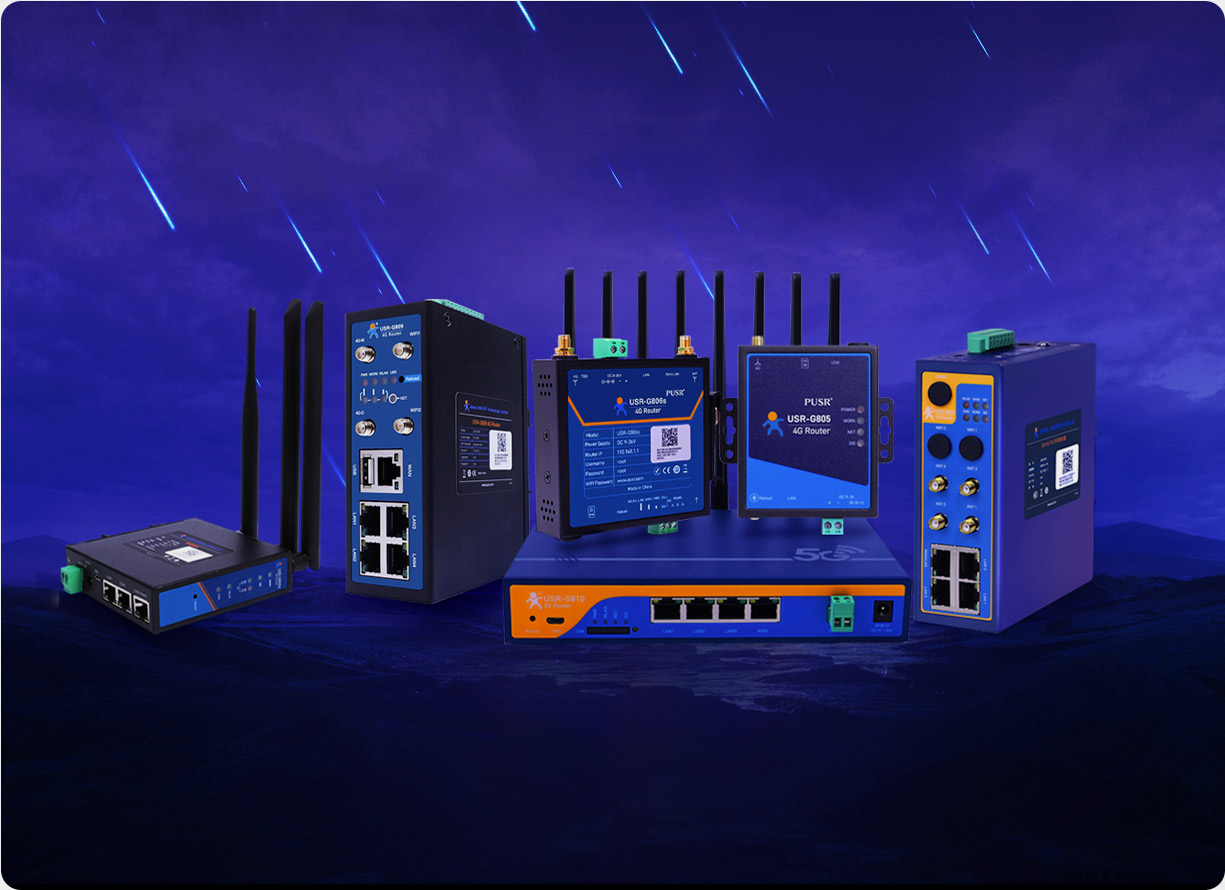
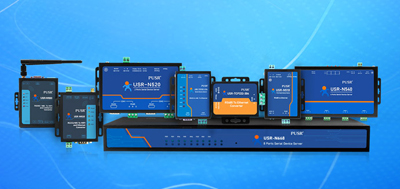
The industrial router USR-G806w, through its built-in protocol conversion engine, supports over 20 industrial protocols such as Modbus RTU/TCP, OPC UA, and MQTT, automatically adapting to the communication languages of different devices. For example:
Scenario 1: In the painting workshop, the USR-G806w converts Modbus TCP protocol data from the PLC into the OPC UA format required by the MES system, enabling real-time upload of equipment status and coating flow data.
Scenario 2: On the final assembly line, the USR-G806w pushes positioning data from AGV trolleys to the MES system via the MQTT protocol, triggering collaborative instructions like "automatic call for handling of empty material frames."
This "millisecond-level protocol conversion" capability compresses the handshake delay between PLC and MES systems from seconds to milliseconds, laying the foundation for real-time control.
Automotive manufacturing production lines are a "disaster zone" for electromagnetic interference:
High-frequency welding: Transient electromagnetic pulses generated by resistance welding can reach thousands of volts per meter, causing signal interruptions in ordinary routers.
Metal reflection: The fully metal-enclosed production line environment creates multipath effects, resulting in a packet loss rate exceeding 30%.
Extreme temperatures: The temperature near the baking oven in the painting workshop reaches 85°C, while workshop temperatures in northern regions can drop to -30°C in winter, requiring equipment to operate stably within a wide temperature range of -20°C to 70°C.
Test data from a certain new energy automaker shows that the signal strength of ordinary commercial routers in the welding workshop drops sharply from -60 dBm to -110 dBm, with connection stability below 30% and a packet loss rate as high as 40%, leading to frequent errors in the MES system.
The USR-G806w overcomes industrial environment challenges through three major technological breakthroughs:
Electromagnetic shielding design: Adopting a fully metal casing and conductive sealing ring to form a Faraday cage effect, with shielding effectiveness exceeding 60 dB, capable of withstanding electromagnetic pulses from high-frequency welding.
Wide-temperature operation capability: Equipped with industrial-grade chips, the operating temperature range covers -20°C to 70°C, and heat pipe cooling technology reduces chip temperature by 20°C in high-temperature scenarios.
Anti-interference antenna: Supports external 5dBi high-gain directional antennas, penetrating metal obstacles through beamforming technology and tripling the signal coverage distance.
In a test conducted by a heavy truck enterprise in Heihe, Heilongjiang, the USR-G806w operated continuously for 72 hours without failure at -35°C, while competing routers experienced three crashes due to capacitor failures.
As the interconnection between PLC and MES systems deepens, security risks grow exponentially:
Data leakage: The theft of sensitive data such as production plans and process parameters could lead to the loss of a company's core competitiveness.
Cyberattacks: Unisolated industrial networks may be subject to APT attacks, causing production line paralysis.
Permission mismanagement: Manual operation permission management is prone to oversights, leading to equipment misoperations.
A certain joint venture automaker once suffered a ransomware attack due to its PLC network being exposed to the public internet, resulting in a 12-hour plant shutdown and direct losses exceeding ten million yuan.
The USR-G806w builds a comprehensive security system from transmission to storage:
Transmission encryption: Supports five layers of VPN encryption such as IPSec and OpenVPN, encapsulating data into encrypted tunnels during public internet transmission to prevent theft.
Access control: Strictly limits device access permissions through IP blacklists/whitelists, port forwarding, and NAT/DMZ functions, for example, only allowing authorized IP MES servers to access PLC data.
Local storage security: Incorporates details such as SIM card PIN locks and Wi-Fi hidden SSIDs to prevent unauthorized access to physical devices.
Additionally, the USR-G806w supports remote management via the "USR Cloud" platform, allowing operations and maintenance personnel to monitor equipment status in real-time through a web interface or app and set up automatic alerts for abnormal behavior, such as triggering security audits when data traffic surges.
The three technological breakthroughs of the industrial router USR-G806w bring customers a triple upgrade in value:
Operational efficiency improvement: At a certain automotive final assembly plant, after the USR-G806w enabled millisecond-level handshakes between the PLC and MES system, the overall equipment effectiveness (OEE) increased by 15%, saving over 2 million yuan in annual downtime costs.
Experience transformation: Through real-time data feedback, the MES system can dynamically adjust production plans, for example, automatically optimizing material delivery rhythms based on AGV trolley capacity, improving production line rhythm matching by 40%.
Management upgrade: At a certain parts enterprise, the remote networking function of the USR-G806w supports unified management of CNC machine tools across 10 factories nationwide, allowing operations and maintenance personnel to remotely issue control instructions via VPN, saving 60% in on-site maintenance costs.
As welding robots' mechanical arms once again position precisely, as sensor data from the painting workshop converges in real-time like a stream, and as AGV trolleys shuttle effortlessly between production lines—behind these scenes stands the USR-G806w industrial router, silently supporting them all. With the wisdom of a "protocol translator," the resilience of an "electromagnetic shield," and the reliability of "three layers of security," it breaks through the three major technological bottlenecks of millisecond-level handshakes between PLC and MES systems, turning the dream of zero-downtime production lines into reality.
For enterprises still on the sidelines, choosing the USR-G806w is not just selecting a device but also choosing a digital transformation path that "drives efficiency with stability and empowers innovation with security." In the fierce competition of automotive manufacturing, this "invisible" reliability may well be the key to determining victory or defeat.