Essential for Smart Factory Transformation: How Industrial Router Enable Wireless Scheduling of AGV Trolleys?
In today's world where the wave of intelligent manufacturing is sweeping across the globe, the transformation of smart factories has become a core strategy for enterprises to enhance their competitiveness. Among them, AGVs (Automated Guided Vehicles), as key equipment for logistics automation, have their scheduling efficiency directly determining the production line collaboration capability and overall production capacity. However, traditional AGV scheduling systems generally face pain points such as high communication latency, unstable networks, data security risks, and high operation and maintenance costs, which seriously restrict the effectiveness of smart factory implementation. With their characteristics of high speed, low latency, strong anti-interference, and reliable security, industrial router have become the core hub for solving the problem of wireless AGV scheduling. This article will deeply analyze how industrial router, through technological innovation and scenario adaptation, provide end-to-end wireless AGV scheduling solutions for smart factories.
Traditional AGVs mostly use Wi-Fi or Bluetooth communication, but these technologies have inherent drawbacks. Wi-Fi is prone to channel congestion when multiple devices are connected, leading to instruction transmission delays. Bluetooth, on the other hand, is limited by its transmission distance (usually ≤ 10 meters) and cannot meet the coverage requirements of large factories. For example, a certain automobile manufacturing plant once experienced Wi-Fi signal interference, causing an AGV to collide during a turn due to instruction delays, resulting in a production line shutdown for 2 hours and direct losses exceeding 500,000 yuan.
The factory environment is complex, and factors such as metal equipment, electromagnetic interference, and obstacle obstruction can significantly weaken wireless signal strength. After introducing AGVs, a certain electronics factory found that due to the dense metal shelves in the workshop, the Wi-Fi signal attenuation was severe, and the AGVs frequently lost connection during operation, with a task completion rate of less than 60%. Manual intervention was required for restarts, leading to a sharp increase in operation and maintenance costs.
AGV scheduling involves core data such as production line formulas and process parameters. Traditional communication methods lack encryption mechanisms and are vulnerable to interception or tampering by hackers. A certain chemical enterprise once suffered an attack on its AGV control system, resulting in incorrect raw material ratios, triggering a product quality accident and losses exceeding 2 million yuan.
Traditional AGV scheduling systems require the deployment of a large number of wired network nodes, with long wiring cycles and high costs. Moreover, later expansions require re-planning of the wiring. A certain logistics warehouse needed to increase the number of AGVs due to business expansion, but the existing wired network could not support the new equipment. As a result, production had to be suspended for transformation, taking 3 months and costing over 10 million yuan.
By integrating technologies such as 5G/4G, Wi-Fi 6, VPN encryption, and edge computing, industrial routers build a wireless scheduling network that covers the entire lifecycle of AGVs, fundamentally solving the pain points of traditional systems.
Industrial routers support 5G networks (latency ≤ 10ms) or Wi-Fi 6 (latency ≤ 20ms), ensuring real-time instruction delivery to AGVs. For example, the WR51G industrial 5G router from Shenzhen Xunji Technology achieves millisecond-level communication between AGVs and the control center through a 5G network, enabling AGVs to accurately perform actions such as turning and obstacle avoidance while moving at high speeds, with a task completion rate increased to 99.5%.
Industrial routers adopt technologies such as dual-band Wi-Fi, MIMO antennas, and spectrum sensing to automatically avoid interference channels and ensure signal stability. For example, the F-NR130-02 industrial Wi-Fi device from Four-Faith achieves seamless AP switching for AGVs in the workshop through its unique fast roaming technology, with a roaming latency ≤ 50ms and a packet loss rate close to zero, ensuring stable operation even when passing through areas with dense metal shelves.
Industrial routers support multiple encryption protocols such as IPSec, OpenVPN, and GRE, enabling end-to-end encryption of sensitive information such as AGV control instructions, status data, and video streams. For example, the USR-G817 industrial router is equipped with a built-in hardware encryption chip and uses the AES-256 encryption algorithm to ensure the security of data transmission and prevent hacker attacks and data leakage.
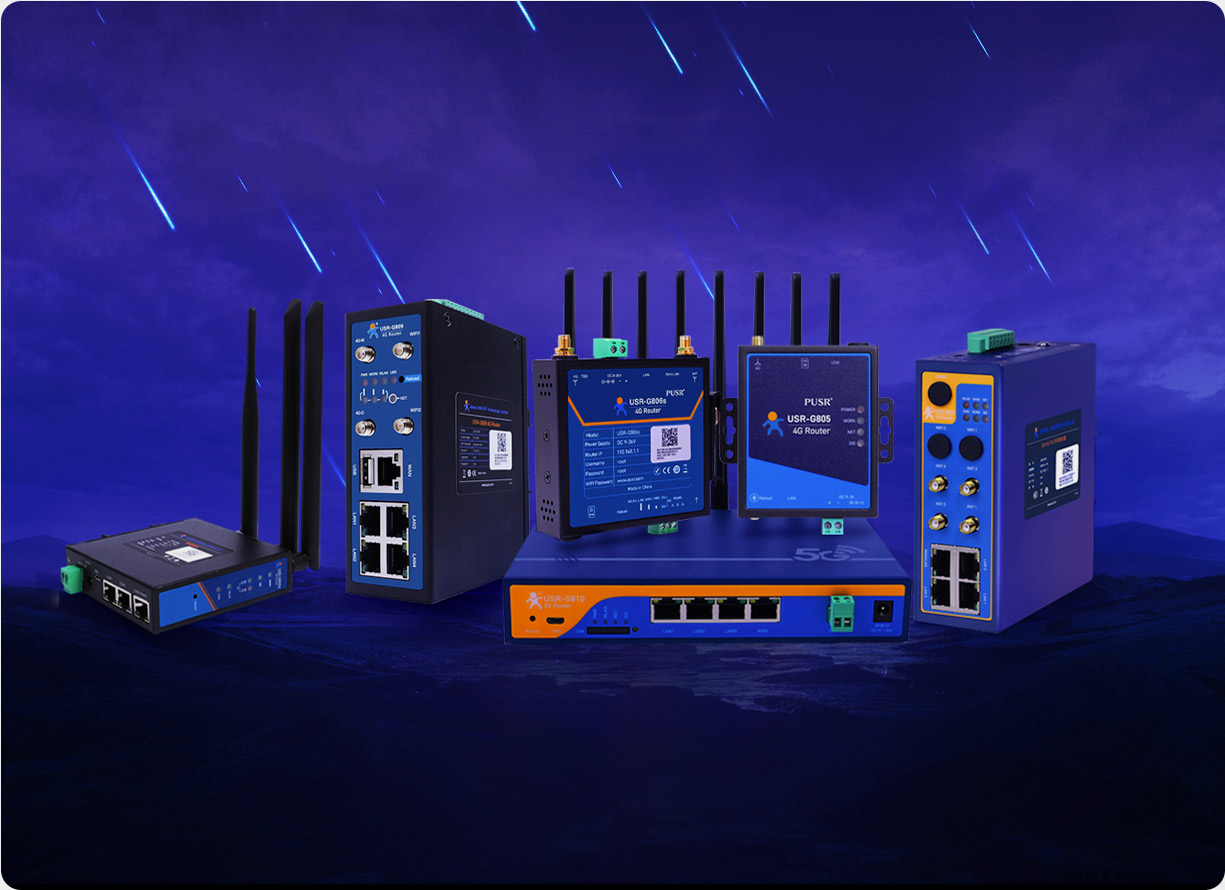
Industrial routers support 5G/4G full Netcom, dual SIM card dual standby, and load balancing, freeing them from the constraints of wired networks and enabling "plug and play". For example, after adopting the USR-G809s industrial router, a certain home appliance factory was able to quickly deploy the AGV system without wiring. When adding new equipment later, only router nodes needed to be increased, shortening the expansion cycle from 3 months to 1 week and reducing operation and maintenance costs by 70%.
As a communication bridge between AGVs and the control center, industrial routers can transmit real-time instructions such as start, stop, turn, and accelerate. For example, on an automobile assembly line, AGVs need to precisely deliver parts according to the production line rhythm. Industrial routers deliver control center instructions to AGVs in real time through a 5G network, ensuring the timeliness and accuracy of deliveries and avoiding production line shutdowns.
Industrial routers can collect data such as AGV battery levels, operating speeds, and fault codes and transmit them to the monitoring platform via VPN. For example, a certain food factory uses the USR-G817 router to monitor AGV battery status in real time. When the battery level drops below 20%, a charging task is automatically triggered to avoid task interruptions due to insufficient battery power.
Industrial routers support data interaction between AGVs, enabling collaborative operations among multiple vehicles. For example, in a warehousing and logistics scenario, multiple AGVs need to work together to complete cargo handling tasks. Industrial routers optimize path planning by sharing real-time information such as positions and task progress among AGVs, avoiding collisions and congestion and improving overall handling efficiency by 40%.
Industrial routers support functions such as remote access, firmware upgrades, and fault diagnosis, allowing operation and maintenance personnel to complete equipment maintenance without going to the site. For example, a certain chemical enterprise remotely repaired a navigation algorithm vulnerability in an AGV through the USR-G809s router, completing the upgrade in just 10 minutes and avoiding the drawbacks of traditional methods that require production shutdowns for inspections.
Among numerous industrial routers, the USR-G809s has become an ideal choice for AGV scheduling in smart factories due to its high cost-effectiveness, easy deployment, and strong compatibility.
High-speed and stable communication: Supports 5G/4G full Netcom with a downlink rate of up to 700Mbps, ensuring real-time delivery of AGV instructions.
Rich interface expansion: Integrates RS232/RS485, Ethernet, Wi-Fi, and other interfaces, allowing connection to AGV controllers, sensors, cameras, and other equipment.
Secure and reliable: Supports IPSec VPN encryption to ensure data transmission security; industrial-grade design, resistant to high temperatures, dust, and electromagnetic interference, adapting to harsh factory environments.
Easy operation and maintenance: Supports remote management and firmware upgrades, reducing operation and maintenance costs; rail-mounted installation saves space.
For example, after introducing the USR-G809s, a certain small and medium-sized manufacturing enterprise completed the deployment of the AGV system in just 3 days, achieving production line logistics automation, reducing labor costs by 50%, and increasing the task completion rate to 98%.
The transformation of smart factories essentially aims to achieve efficient collaboration of production factors through technological empowerment. As the core hub for wireless AGV scheduling, industrial routers, with their characteristics of high speed, low latency, strong security, and easy scalability, have completely solved the pain points of traditional systems and provided stable, efficient, and secure communication guarantees for smart factories. Whether for large manufacturing enterprises or small and medium-sized factories, choosing an appropriate industrial router, such as the USR-G809s, can quickly achieve intelligent upgrades in AGV scheduling and gain a competitive edge in the fierce market competition.