Smart Energy Photovoltaic Power Plants: How Industrial Switches Break the Dilemma of Data Silos in Inverters?
In the monitoring center of a photovoltaic power plant in northwest China, engineer Li Ming frowned as he stared at the jumping numbers on the screen. The power generation efficiency of inverter A07 was 12% lower than that of adjacent equipment, but the fault alarm system showed everything was normal. There was a 30-minute delay between the state-of-charge (SOC) data of the energy storage battery pack and the power output of the inverter. More challenging was that when a sudden grid failure occurred, 17 out of 200 inverters scattered across a 5-square-kilometer area failed to execute the islanding protection command in time due to communication interruptions.
This scenario is constantly playing out in 32,000 photovoltaic power plants across the country. According to statistics from the National Energy Administration, by 2025, China's installed photovoltaic power generation capacity will exceed 800 GW, but the annual power generation loss caused by data silos will reach as high as 4.5 billion kilowatt-hours—equivalent to the annual power generation of a Three Gorges power station. As the industry shifts from scale expansion to lean operation, data silos have become the core pain point restricting the intelligent upgrading of photovoltaic power plants.
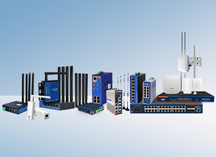
In a 200 MW photovoltaic power plant in Golmud, Qinghai, a communication network based on USR-ISG industrial switches is rewriting the rules of the game. This ring network system composed of 16 gigabit switches has improved the data collection efficiency of inverters, combiner boxes, weather stations, energy storage devices, and other equipment by 300%, and compressed the fault location time from hours to seconds.
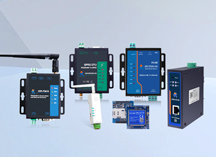
The core value of industrial switches lies in their built-in "protocol conversion engine." Taking the USR-ISG series as an example, it supports the simultaneous parsing of 8 mainstream industrial protocols such as Modbus TCP/RTU, IEC 61850, and Profinet, acting as a real-time translator for devices speaking different languages. When an inverter sends data via Modbus RTU, the switch can automatically convert it into the IEC 61850 standard format for seamless connection to the power plant monitoring system.
Practical Case: After adopting the USR-ISG-8-port switch in a distributed photovoltaic project, the data streams of 3 brands of inverters, 2 types of energy storage systems, and 1 intelligent operation and maintenance platform were successfully integrated. The project debugging cycle was shortened by 60%, and the data collection completeness rate increased from 78% to 99.2%.
In a desert photovoltaic power plant in Inner Mongolia, where the surface temperature can reach 70°C in summer and sandstorms are frequent, the industrial-grade design of the USR-ISG demonstrates remarkable adaptability:
When a sudden grid failure occurs, industrial switches need to complete islanding detection and cut off communication within 2 ms. The "triple protection mechanism" of the USR-ISG:
As photovoltaic power plants enter the new era of "photovoltaic-storage-direct-flexible," industrial switches are evolving from simple communication devices to intelligent edge nodes. The three evolutionary directions demonstrated by the USR-ISG series are redefining the value boundaries of photovoltaic communication networks:
The new generation of USR-ISG is equipped with an ARM Cortex-A55 quad-core processor, enabling the local operation of lightweight AI algorithms. In a photovoltaic power plant in Shandong, the switch predicted IGBT module failures 3 days in advance by analyzing historical inverter data, avoiding unplanned downtime losses exceeding 500,000 yuan.
Through the OPC UA information model, the USR-ISG can map inverter operation data to a digital twin system in real time. Operation and maintenance personnel can complete equipment inspections, parameter tuning, and other operations in virtual space without going to the site, increasing the operation and maintenance efficiency of a single person by 5 times.
In photovoltaic-storage-charging integrated scenarios, the USR-ISG can achieve microgrid energy routing based on the IEEE 2030.5 standard. When there is excess photovoltaic output, the switch automatically coordinates inverters to reduce power while initiating energy storage charging and V2G (vehicle-to-grid) discharging, increasing energy utilization to 92%.
Faced with a wide range of industrial switch products on the market, photovoltaic power plant operators need to grasp three core principles:
As photovoltaic power plants enter the era of "unmanned operation," industrial switches are becoming the nerve centers connecting the physical and digital worlds. In the "zero-carbon photovoltaic solution" jointly developed by Huawei Digital Energy and USR IOT, the USR-ISG industrial switch is deeply integrated with 5G modules and AI operation and maintenance platforms, achieving:
At this critical turning point where the photovoltaic industry shifts from scale expansion to quality development, industrial switches are no longer simple communication devices but infrastructure driving the energy revolution. Choosing the right industrial switch is equivalent to installing a "smart brain" for the photovoltaic power plant, enabling every ray of sunlight to be converted into maximum value. As the first ray of sunlight in the morning shines on the photovoltaic array, an efficient, secure, and intelligent energy new era is unfolding through the connections of industrial switches.