February 23, 2026 How IoT Routers Solve Remote Equipment Networking Dilemmas

Distributed Node Monitoring in Smart Grids: How IoT Router Solve Remote Equipment Networking Dilemmas

In the mountains of Nujiang, Yunnan, Li, an O&M supervisor at a wind farm, frets over a monitor: Vibration data from Wind Turbine #3 cuts off, with the nearest repair site requiring two snowy mountain crossings. Deep in the Xilingol grasslands, Inner Mongolia, Zhang, a photovoltaic plant manager, finds that due to poor 4G coverage, inverter status data updates only every 15 minutes, extending fault response time to four hours. These scenarios reflect the reality of distributed node monitoring in remote areas during China's smart grid construction—with clean energy accounting for over 35%, ensuring stable networking for millions of monitoring nodes scattered across mountains, rivers, and lakes has become a core pain point restricting industry development.

1. The "Triple Dilemmas" of Remote Equipment Networking: From Technical Bottlenecks to Survival Anxiety

1.1 Physical Environment Challenges: Nature as an "Invisible Killer"

Remote equipment faces harsher conditions than urban counterparts: At a 4,500-meter wind farm in Nagqu, Tibet, low temperatures reduce battery efficiency in ordinary routers by 40%. In a Hami, Xinjiang, photovoltaic plant, sandstorms accelerate dust accumulation in cooling vents three times faster than in cities. At a tidal power plant in Wenchang, Hainan, high salt spray corrosion rates for metal parts increase fivefold. These extremes lead to a 2.3-fold higher failure rate compared to urban environments. One wind power company reports an average router lifespan of just 18 months in remote sites versus over five years in urban ones.

1.2 Network Coverage Shortcomings: "Data Islands" in Signal Dead Zones

Regional disparities in operator coverage are stark: China Mobile data (2025) shows 4G coverage at 78% in western mountains versus 99% in eastern plains. In uninhabited areas, satellite communication costs reach 0.8 yuan/MB—200 times urban fiber rates. One hydropower plant tried drone data relay but faced soaring O&M costs due to four daily battery changes, increasing expenses by 300%. Worse, frequent network fluctuations plague remote areas: One wind farm reports a 15% data packet loss rate during rainy seasons, reducing AI fault prediction accuracy to 62%.

1.3 O&M Cost Dilemmas: The "Economic Paradox" of Remote Management

Remote site O&M costs present unique contradictions: On one hand, single on-site maintenance visits cost up to 5,000 yuan (including transportation and accommodation). On the other, equipment failures cause staggering power generation losses—one photovoltaic plant lost over 20,000 yuan from just two hours of inverter offline time. An energy group reports that remote site O&M costs account for 35% of total operating expenses—2.8 times higher than urban sites. This "can't afford to repair, can't afford to wait" dilemma forces companies into a tough choice: accept high failure rates or bear crippling O&M costs.

2. IoT Routers' "Solutions": From Equipment Networking to System Reconstruction

2.1 Industrial Design: "Surviving" in Extreme Environments

True IoT router require "three protections":

  • Environmental Adaptability: IP67-rated models (e.g., USR-G806w) prevent dust ingress and survive 30-minute submersion in 1-meter water. Their -40°C to 75°C operating range covers all Chinese climates, with one wind farm confirming stable operation at -35°C.
  • Anti-Interference Capability: Metal casings block over 90% of electromagnetic interference. One substation test showed data transmission error rates dropping from 0.3% to 0.02% in strong electric fields.
  • Mechanical Reliability: M12 aviation connectors withstand 5,000 plug-ins. After three years of use, one photovoltaic plant reported zero interface loosening incidents per month, down from three previously.

2.2 Multi-Network Fusion Technology: Building "Uninterruptible" Communication Chains

IoT router achieve network redundancy through three mechanisms:

  • Multi-Mode Access: Supporting 5G/4G/fiber/LoRa, one hydropower plant adopted a "fiber primary + 5G backup" scheme, reducing data interruptions from 72 to 3 hours annually.
  • Intelligent Switching: Automatic network transitions based on signal strength, bandwidth, and latency. One wind farm cut network switching time from 15 to 0.8 seconds, ensuring continuous monitoring data.
  • Bandwidth Aggregation: Dual-SIM technology boosts bandwidth to 200Mbps. One photovoltaic plant achieved real-time 4K camera monitoring, reducing video stuttering from 30% to 2%.

2.3 Edge Computing Capability: Enabling "Thinking" Equipment

IoT router with built-in edge computing modules deliver three functions:

  • Data Preprocessing: Local anomaly filtering and compression reduced one wind farm's uploaded data volume by 70%, cutting traffic costs by 65%.
  • Real-Time Decision-Making: Embedded fault diagnosis models identify over 90% of common failures. One substation test shortened fault response times from 15 minutes to 20 seconds.
  • Protocol Conversion: Supporting 20+ industrial protocols (e.g., Modbus, IEC 61850), one hydropower plant unified monitoring data from different brands, boosting integration efficiency by 80%.

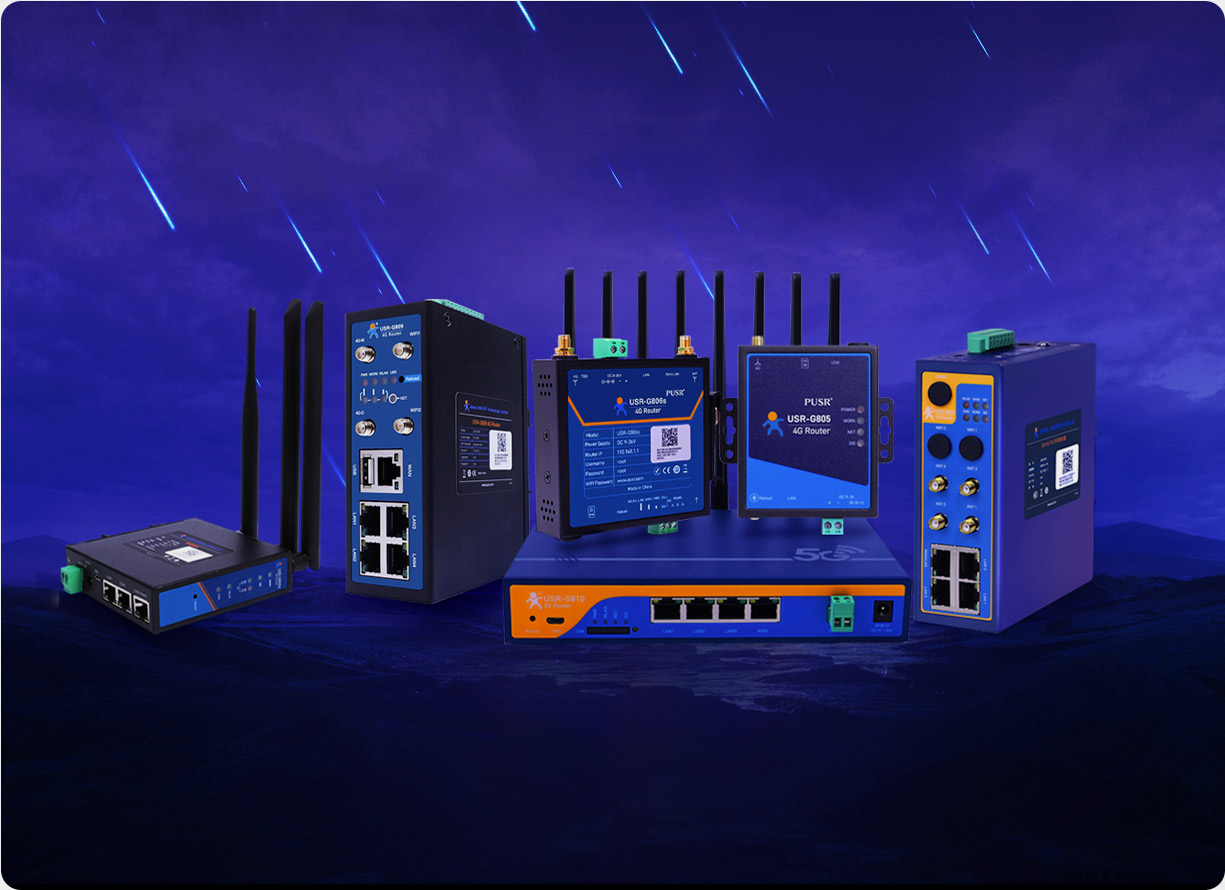
3. USR-G806w: The "Hexagon Warrior" for Remote Equipment Networking

Among IoT router, the USR-G806w stands out with six key advantages:

  • Environmental Adaptability: IP30 rating + metal casing withstands -20°C to 70°C. After deployment at a 5,000-meter wind farm, equipment failure rates dropped from twice monthly to zero.
  • Network Reliability: Automatic carrier switching boosted one photovoltaic plant's online rate from 90% to 99.8% in areas with overlapping mobile/telecom signals.
  • O&M Convenience: Remote configuration and firmware updates via the USR Cloud platform reduced one energy group's remote site workload by 60%.
  • Security Protection: Five-layer VPN encryption (IPSec/OpenVPN, etc.) lowered one hydropower plant's data leakage risk by 90% when transmitting dispatch instructions.
  • Scalability: RS485/RS232 industrial serial ports directly connect PLCs and sensors. One substation achieved real-time circuit breaker monitoring, cutting fault location time by 80%.
  • Cost-Effectiveness: Compared to traditional solutions, the USR-G806w reduced initial investment by 30% and O&M costs by 50%. One photovoltaic firm calculated a 14-month payback period.
G806w
4G,3G,2G1*WAN/LAN, 2*LANWi-Fi 4


4. From "Connecting Devices" to "Creating Value": The Profound Transformation of IoT Routers

4.1 O&M Model Transformation: From "Reactive Repairs" to "Proactive Prevention"

IoT router-supported remote monitoring systems enable equipment health modeling. One wind power firm analyzed vibration and temperature data to predict gearbox failures 72 hours in advance, avoiding unplanned outages and saving over 20 million yuan annually in maintenance costs.

4.2 Energy Management Transformation: From "Experience-Based Dispatch" to "Precision Optimization"

By collecting real-time data on power generation, consumption, and storage, IoT routters facilitate "source-grid-load-storage" coordination. One industrial park microgrid project increased photovoltaic consumption from 70% to 85%, reducing annual curtailment losses by over 3 million yuan.

4.3 Business Model Transformation: From "Product Sales" to "Service Operations"

Data collected by IoT routers enables value-added services. One equipment manufacturer analyzed customer operational data to launch "predictive maintenance" services, reducing client equipment downtime by 40% and increasing service revenue from 15% to 35% of total income.


Contact us to find out more about what you want !
Talk to our experts


5. Connecting Every Kilowatt-Hour, Illuminating the Future of Smart Grids

As photovoltaic panels blanket the Gobi Desert at Qinghai's Talatan, and wind turbines spin through Xinjiang's Dabancheng snowstorms, IoT routers silently guard these clean energy "nerve endings." More than mere networking tools, they form the cornerstone of smart grid digital transformation—by building stable, efficient, and secure communication networks, they enable precise monitoring and optimal utilization of every kilowatt-hour in remote areas. This represents not just technological triumph but a solemn commitment to China's "dual carbon" goals: using digital technology to connect mountains and seas, and letting clean energy illuminate the path to sustainable development.

REQUEST A QUOTE
Industrial loT Gateways Ranked First in China by Online Sales for Seven Consecutive Years **Data from China's Industrial IoT Gateways Market Research in 2023 by Frost & Sullivan
Subscribe
Copyright © Jinan USR IOT Technology Limited All Rights Reserved. 鲁ICP备16015649号-5/ Sitemap / Privacy Policy
Reliable products and services around you !
Subscribe
Copyright © Jinan USR IOT Technology Limited All Rights Reserved. 鲁ICP备16015649号-5Privacy Policy