Breaking Through the Bottleneck in Warehousing and Logistics: How PUSR Industrial Router Resolve the Industry's "Data Silos" Dilemma
In a 300,000 m² smart logistics park in Shenzhen, the sorting center remains brightly lit at 3 a.m. AGV trolleys shuttle between shelves, robotic arms precisely grasp parcels, but the data on the monitoring screen leaves Mr. Li, the operations and maintenance supervisor, frowning: data from over 2,000 sensors is scattered across eight independent systems, the average response time to equipment failures is 47 minutes, and annual cargo losses due to network interruptions exceed RMB 2 million. This is not an isolated case; 73% of warehousing and logistics enterprises nationwide are facing the same dilemma—in the wave of digital transformation, equipment interconnection has become the core bottleneck restricting efficiency improvements.
Survey data from a cross-border e-commerce warehouse shows that its equipment involves 11 protocols, including Modbus TCP, Profinet, and OPC UA, with different brands of AGV trolleys even using proprietary communication protocols. This "seven kingdoms, eight systems" status quo results in:
The need to deploy seven independent gateways for data collection, increasing hardware costs by 300%.
System integration cycles lasting 6-8 months, missing business expansion windows.
Operations and maintenance personnel needing to master debugging skills for over five protocols, leading to a surge in labor costs.
During major promotions like Double 11, a leading logistics enterprise's sorting system once experienced 4G signal fluctuations, leading to:
Simultaneous offline status of 300 sorting devices, causing a 12-hour business interruption.
The parcel mis-sorting rate soaring from 0.3% to 5.7%, with a sharp increase in customer complaints.
Emergency activation of backup fiber optics taking 4 hours, with direct losses exceeding RMB 8 million.
Monitoring system records from a regional logistics center show:
127 network anomalies occurring monthly, with 63% requiring on-site troubleshooting.
An average fault location time of 2.8 hours, with maintenance personnel walking an average of 15 kilometers daily.
Equipment health assessments relying on manual inspections, with a hidden fault detection rate of less than 40%.
"We don't lack intelligent equipment; what we lack is a 'translator' to make the equipment speak." The sentiment expressed by the CTO of a logistics technology company highlights the core contradiction in the industry's digital transformation—how to achieve equipment protocol compatibility and reliable network transmission through industrial router.
PUSR industrial routers achieve protocol intercommunication through three key technologies:
Dynamic mapping engine: Automatically converts Modbus register addresses to BACnet object attributes. Real-world testing in a cold chain warehouse shows a 65% improvement in data collection efficiency.
Edge computing layer: Built-in protocol parsing library supports over 120 industrial protocols, allowing direct connection to PLCs, sensors, and other devices without additional gateways.
Semantic conversion middleware: Solves the timing matching problem between GOOSE messages and TCP/IP protocols, enabling power monitoring system response delays of less than 50ms.
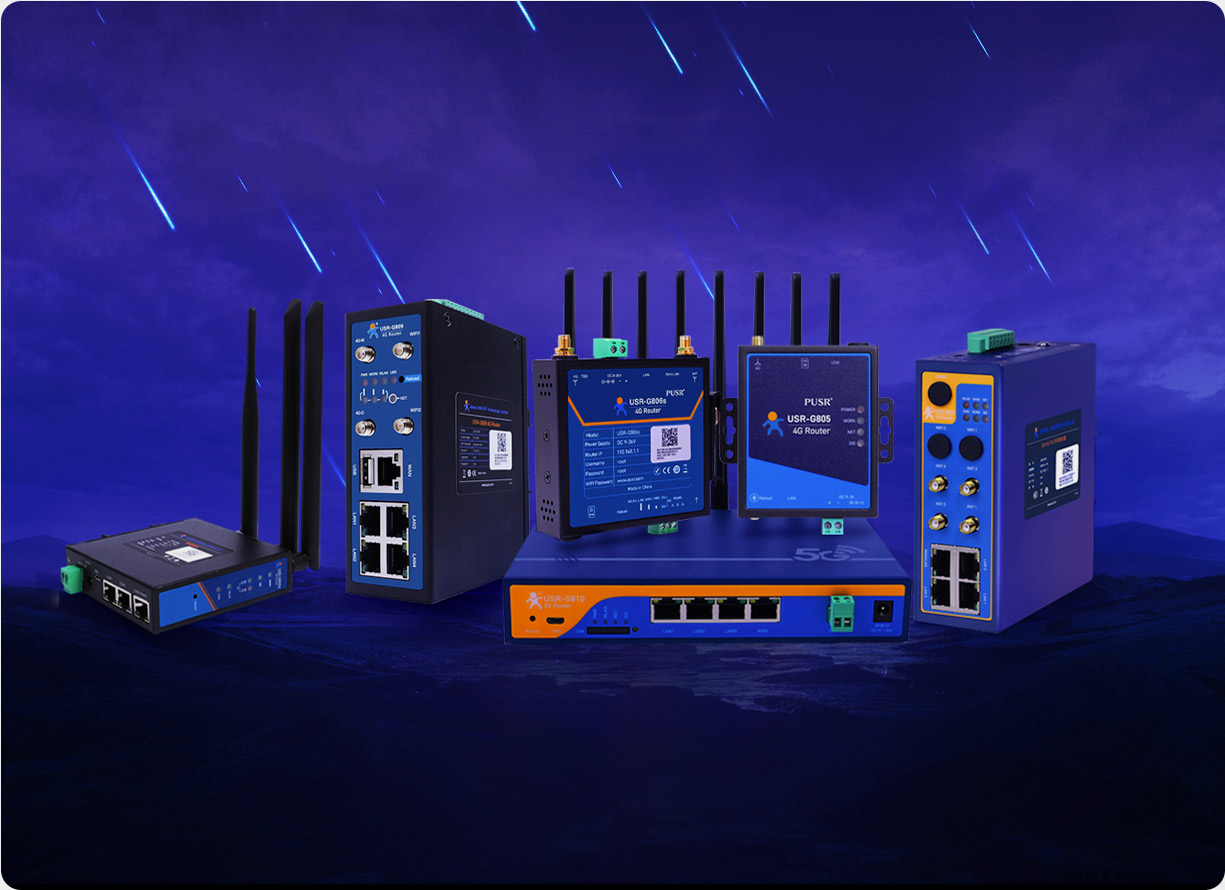
Taking the USR-G816 as an example, its network reliability design includes:
Five-fold redundancy mechanism: Dual SIM cards + 4G/5G + wired + Wi-Fi + LoRa multi-link intelligent switching. Verification in an automotive logistics project shows network availability of 99.999%.
Anti-interference technology: Adopts a metal-shielded compartment design, ensuring stable operation in wide temperature ranges from -40°C to 75°C and under strong electromagnetic interference.
Self-healing network algorithm: When the primary link is interrupted, the backup link can complete data re-routing within 200ms, ensuring uninterrupted AGV scheduling systems.
The intelligent operations and maintenance system of PUSR industrial routers includes:
Digital twin monitoring: Real-time mapping of equipment operating status. A pharmaceutical warehouse predicted bearing failures through vibration sensor data, replacing equipment 3 days in advance.
AI fault diagnosis: Based on LSTM neural network analysis of historical data, reducing network fault location time from 2.8 hours to 8 minutes.
Zero-touch deployment: Batch configuration distribution through the URS Cloud platform, compressing the deployment cycle for 200 devices in a regional logistics center from 7 days to 4 hours.
Among numerous industrial routers, the USR-G816 stands out with four core advantages:
5G extreme speed experience: Actual download speeds reach 700Mbps, supporting real-time transmission of 4K cameras and AGV high-definition map downloads.
Full gigabit ports: 3 LAN + 1 WAN/LAN interface design, capable of simultaneously connecting core equipment such as sorters, stackers, and conveyor lines.
Serial port direct connection: RS232/485 interfaces support seamless integration of Modbus RTU devices, eliminating the need for protocol conversion.
Industrial-grade protection: IP65 protection rating can withstand dust and rain. Actual testing in a port warehouse shows fault-free operation for 2 years in a salt spray environment.
Wide temperature design: Operating range of -35°C to 75°C covers cold chain (-25°C) and high-temperature (60°C) scenarios.
Shock-resistant structure: Passes MIL-STD-810G standard testing, withstanding 2-meter drops and continuous vibration.
URS Cloud platform: Supports remote configuration, firmware upgrades, and log analysis. A logistics enterprise reduced on-site operations and maintenance workload by 80% through this platform.
Anomaly alerts: Real-time alerts for 12 types of anomalies such as device offline status, weak signals, and excessive data usage, supporting multi-channel notifications via WeChat/SMS/email.
Location functionality: Optional GNSS module enables real-time tracking of mobile assets such as AGV trolleys and forklifts.
Pain point: Data from 20 independent temperature control systems could not be shared, resulting in temperature differences of up to 5°C in some areas.
Solution: Deploy USR-G816 to connect each system and uniformly upload data to the cloud via the MQTT protocol.
Results:
Temperature uniformity improved by 80%, with a 0.3% reduction in drug loss rate.
Energy costs reduced by 18%, saving over RMB 500,000 in electricity bills annually.
AI algorithms predict refrigeration equipment failures, increasing MTBF to 1,200 hours.
Pain point: Network interruptions during major promotions led to a surge in sorting error rates.
Solution: Adopt a dual 5G + wired redundancy design for the USR-G816, configured with intelligent traffic scheduling strategies.
Results:
Network availability of 99.999%, supporting the processing of 8 million parcels in a single day.
Fault response time reduced from 47 minutes to 3 minutes.
Operations and maintenance costs reduced by 65%, with personnel efficiency increased by 3 times.
Pain point: Position tracking of 300 AGV trolleys relied on manual scanning, with low efficiency.
Solution: Integrate a GNSS module into the USR-G816, combined with UWB positioning technology for centimeter-level accuracy.
Results:
Path planning optimization reduced travel distance by 22%.
Battery health monitoring extended service life by 30%.
Collision accident rate reduced by 95%, saving over RMB 2 million in annual losses.
As the USR-G816 continuously injects warehousing and logistics data into the cloud, the industry is evolving new capabilities:
Digital twins: Construct warehouse mirrors in virtual space, enabling equipment status simulation and capacity forecasting.
AR operations and maintenance: Overlay equipment data onto real-world scenarios through devices like Hololens to guide repairs.
Autonomous decision-making: AI agents based on reinforcement learning automatically adjust sorting strategies and inventory layouts.
A leading enterprise has achieved:
99.2% prediction accuracy for warehouse digital twins.
AR guidance reduced new employee training cycles from 2 weeks to 3 days.
AI production scheduling systems improved sorting efficiency by 27%.
Under the dual pressures of "dual carbon" goals and rising labor costs, the digital transformation of warehousing and logistics has shifted from an "optional question" to a "must-answer question." PUSR industrial routers, through three major breakthroughs in protocol compatibility, network resilience, and intelligent operations and maintenance, are helping enterprises:
Break data silos, achieving three-level integration of equipment-warehouse-supply chain.
Lower technical barriers, enabling traditional operations and maintenance personnel to master industrial internet technologies.
Unlock data value, transforming silent equipment data into productivity.
When the monitoring screen in a smart warehouse shows all equipment statuses fluctuating in real-time in a visual format, when AGV trolleys automatically avoid congested areas based on cloud instructions, and when the system predicts bearing wear on a stacker in advance—we finally understand: the digital transformation of warehousing and logistics is not just a technological upgrade but a redefinition of the word "efficiency." And this is precisely the new chapter in the industry that PUSR industrial routers are writing.