February 1, 2026
How RS232 to Ethernet Converter Breaks the Inverter Data Island Dilemma?
Smart Energy PV Power Plants: How RS232 to Ethernet Converter Breaks the Inverter Data Island Dilemma?
Driven by global energy transition and carbon neutrality goals, PV power plants, as core carriers of clean energy, are accelerating towards intelligence and digitization. However, the large number of inverters in PV power plants, due to inconsistent communication protocols and diverse interface types, have long formed "data islands," leading to issues like low plant operation and maintenance (O&M) efficiency, difficulty in tracing power generation losses, and delayed fault responses. This article deeply analyzes the technical value of RS232 to Ethernet converter in PV power plants, revealing how they break the inverter data island dilemma through protocol conversion and data interconnection. It also recommends a lightweight product designed specifically for energy scenarios—USR-TCP232-302—to help power plants achieve a leap from "passive O&M" to "proactive intelligence."
1. The "Data Island" Dilemma in PV Power Plants: Why Do Inverters Become Information Islands?
1.1 Three Core Pain Points of Inverter Data Islands
Inverters are the "heart" of PV power plants, responsible for converting direct current (DC) into alternating current (AC) and monitoring key parameters such as power generation, voltage, and current in real time. However, due to differences in equipment manufacturers, models, and communication protocols, inverter data collection faces the following challenges:
Protocol Fragmentation: Inverters from different manufacturers use proprietary protocols (e.g., SMA's SunSpec, Huawei's Modbus TCP, Sungrow's CAN bus), preventing data interoperability.
Inconsistent Interfaces: Older inverters only support serial ports (RS232/RS485), while newer devices mostly use Ethernet or wireless communication, resulting in a mix of interface types.
Low Data Utilization: Collected data is only used for local display and not uploaded to monitoring platforms, making it impossible to support advanced applications like power generation analysis and fault prediction.
Case Study: A large ground-mounted PV power plant with 500 inverters from 3 brands and 5 protocols required operators to check data on different terminals. Fault location took over 2 hours, and annual power generation losses due to data delays reached 3%.
1.2 The Deep Impact of Data Islands on Plant Operations
High O&M Costs: Manual inspections rely on experience and fail to detect potential faults in advance, leading to increased unplanned downtime.
Low Power Generation Efficiency: The inability to monitor inverter efficiency degradation in real time prevents timely adjustments to operation strategies, affecting overall power generation.
Lack of Data-Driven Decision-Making: Data scattered across multiple systems makes it difficult to generate comprehensive analysis reports, impacting investment return assessments.
2. RS232 to Ethernet Converter: The "Protocol Translator" Breaking Data Islands
2.1 Technical Principles: Full Link Connectivity from Physical to Application Layers
An RS232 to Ethernet converter is an industrial device that converts serial communication (RS232/RS485) into TCP/IP network protocols. Its core functions include:
Protocol Conversion: Supports over 200 industrial protocols such as Modbus RTU/TCP, SunSpec, and CAN bus, ensuring compatibility with mainstream inverter brands.
Transparent Transmission: No need to modify the inverter's original communication protocol, ensuring data integrity and real-time performance.
Multi-Device Access: A single device can connect to 4-8 inverters, reducing system complexity and costs.
Edge Computing: Supports data preprocessing (e.g., filtering, aggregation) to reduce cloud computing load.
Taking USR-TCP232-302 as an example, its working logic is as follows:
Data Collection: Connects to inverters via serial ports to read parameters like power generation, temperature, and fault codes in real time.
Protocol Parsing: Converts proprietary protocol data into standard Modbus TCP or HTTP formats.
Data Encapsulation: Adds metadata such as timestamps and device IDs to generate structured data packets.
Data Transmission: Uploads data to monitoring platforms or cloud servers via Ethernet or 4G/5G networks.
Reverse Control: Receives platform commands to adjust inverter operation parameters (e.g., power limiting, device restart).
2.2 Application Scenarios: From Single-Machine Monitoring to Global Optimization
RS232 to Ethernet converters have wide-ranging applications in PV power plants, covering core areas such as O&M management, power generation optimization, and safety monitoring:
Real-Time Monitoring: Displays inverter status (operating/fault/offline), power generation, and daily output through visual dashboards.
Fault Prediction: Uses historical data and AI algorithms to predict capacitor aging, IGBT module failures, etc., triggering maintenance work orders in advance.
Power Generation Analysis: Correlates meteorological data (light intensity, temperature) with inverter efficiency to optimize component cleaning cycles and tilt angle adjustment strategies.
Safety Protection: Monitors abnormal DC-side voltage and current in inverters to prevent fires caused by DC arcing.
Case Study: A distributed PV power plant achieved unified monitoring of 100 inverters by deploying USR-TCP232-302. After system launch, fault response time was reduced from 2 hours to 10 minutes, and annual power generation increased by 2.5%. Predictive maintenance reduced inverter replacement costs by 40%.
3. USR-TCP232-302: A Lightweight RS232 to Ethernet Converter Designed Specifically for PV Scenarios
3.1 Product Highlights: Low Power, High Integration, Easy Deployment
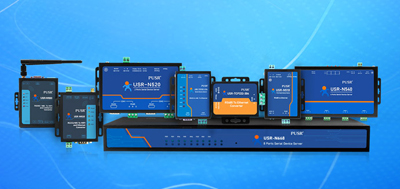
USR-TCP232-302 is a new-generation RS232 to Ethernet converter launched by USR IOT for energy scenarios. Its core advantages include:
Ultra-Low Power Design: Typical power consumption <2W, supporting long-term stable operation in solar-powered systems and adapting to remote mountainous areas, deserts, and other off-grid scenarios.
High Integration: A single device supports 4 serial ports (RS485/RS232) and 1 Ethernet port, enabling simultaneous connection to 4 inverters and reducing equipment quantity and wiring costs.
Intelligent Anti-Interference: Built-in electromagnetic isolation and surge protection to adapt to the strong electromagnetic environment of inverters and ensure stable data transmission.
Cloud Platform Integration: Seamlessly connects to the USR Cloud platform, providing device management, data storage, and alarm notification functions, and supporting remote monitoring via mobile apps.
Lightweight Deployment: Supports DIN rail and wall-mount installation, with a compact size (95mm×65mm×25mm) to save cabinet space.
3.2 Typical Application: Practice in a Commercial and Industrial PV Power Plant
A commercial and industrial PV power plant originally had 50 inverters monitored by 3 different systems due to protocol inconsistencies, resulting in low O&M efficiency. After deploying USR-TCP232-302:
Protocol Adaptation: Quickly matched the communication protocols of different inverters using configuration tools, completing device networking within 2 days.
Data Collection: Real-time collection of 15 key parameters such as power generation, efficiency, and fault codes, with a data accuracy rate of 99.8%.
Platform Integration: Pushed collected data to the plant monitoring platform via the MQTT protocol, enabling automatic power generation statistics and fault alarms.
Cost Savings: Reduced procurement costs for 1 monitoring system and saved 120,000 yuan in annual O&M labor costs. Fault warnings reduced unplanned downtime by 60%.
4. How to Choose an RS232 to Ethernet Converter for PV Power Plants? Five Core Indicators
4.1 Protocol Compatibility
Select devices that support mainstream inverter protocols (e.g., SunSpec, Modbus TCP, CAN bus) to avoid collection failures due to protocol mismatches.
4.2 Anti-Interference Capability
Choose products with electromagnetic isolation and surge protection to ensure stable data transmission in complex PV power plant environments.
4.3 Power Supply Design
Prioritize devices that support wide voltage input (DC 9-36V) to be compatible with the DC-side power supply of inverters and reduce power conversion steps.
4.4 Scalability
Support external sensors such as temperature and humidity sensors and smoke detectors to meet future environmental monitoring needs.
4.5 Ease of Use
Select products that provide configuration tools and API interfaces to lower deployment thresholds and shorten project cycles.
5. From Data Islands to Intelligent O&M: A Leap Forward
In the wave of intelligent transformation of PV power plants, breaking the inverter data island dilemma has become key to improving power generation efficiency and reducing O&M costs. As a "bridge" connecting inverters and monitoring platforms, the low power consumption, high reliability, and strong protocol compatibility of RS232 to Ethernet converters directly determine the efficiency and value of data collection. With its industrial-grade design, intelligent anti-interference, and lightweight deployment, USR-TCP232-302 has become the preferred solution for many PV power plants.
Industrial loT Gateways Ranked First in China by Online Sales for Seven Consecutive Years **Data from China's Industrial IoT Gateways Market Research in 2023 by Frost & Sullivan
We use cookies to ensure that we give you the best
experience on our website. If you continue to use this site we will assume that you are happy with it.