Smart Logistics AGV Scheduling: How Serial Device Server Enable Multi-Vehicle Wireless Serial Communication?
In smart logistics, AGVs are reshaping material handling with efficiency and intelligence. However, stable, efficient, and low-latency wireless serial communication for multi-AGV collaboration is a key bottleneck. This article explores serial device servers' technical principles, applications, and solutions for AGV communication, offering actionable insights for enterprises.
AGVs operate in manufacturing plants and warehouses with metal shelves, large equipment, and electromagnetic interference, causing signal degradation and data loss in traditional wireless communication (e.g., Wi-Fi, ZigBee). For example, electromagnetic interference once delayed path planning commands in an automotive factory's AGV system, leading to collisions.
In e-commerce sorting centers, AGVs must respond within milliseconds for order allocation, path planning, and obstacle avoidance. Delays over 100ms disrupt task prioritization, increasing congestion and idle rates. Statistics show that every 50ms increase in latency can reduce AGV fleet efficiency by 15%-20%.
AGV controllers, sensors, and host computers often use different protocols (e.g., Modbus RTU, CAN bus, TCP/IP), requiring custom interfaces in traditional solutions, which increases complexity and maintenance costs. For instance, a pharmaceutical warehouse's AGV system needed additional protocol conversion gateways, extending deployment by 30%.
Serial device server convert serial data into network data, enabling seamless integration of devices with different protocols. Their core value in AGV communication includes:
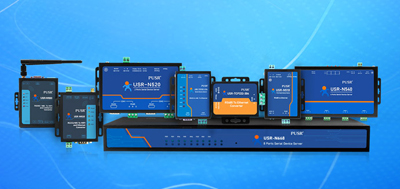
Supporting multiple protocols (e.g., Modbus RTU/TCP, BACnet, CAN bus), serial device server convert AGV controller data into standard TCP/IP for direct communication with host computers and cloud platforms. For example, the USR-N520 dual serial device server supports Modbus RTU to Modbus TCP conversion, connecting two AGV controllers simultaneously for data transparency and protocol unification.
Integrated with Wi-Fi, 4G/5G, and LoRa modules, serial device servers enable remote multi-AGV communication over wireless networks. For example, in outdoor logistics parks, AGVs can use the USR-N520's 4G module to connect to operator networks, interacting with cloud scheduling systems over kilometers.
Advanced serial device servers (e.g., USR-N520) feature edge computing for local data preprocessing (e.g., filtering, aggregation), reducing unnecessary data transmission and cloud load. For instance, AGV sensor data can be analyzed locally, with only critical information (e.g., obstacle positions) uploaded, improving response speed by over 50%.
Among serial device servers, the USR-N520 stands out with its industrial design, high performance, and flexibility, making it ideal for multi-AGV communication. Key advantages include:
The USR-N520 has dual RS232/485 ports, allowing simultaneous connection to two AGV controllers with independent operation to avoid data conflicts. For example, in a home appliance factory, one USR-N520 managed path planning and task allocation for two AGVs, reducing system complexity by 40%.
Powered by a Cortex-M7 core (400MHz) and an optimized TCP/IP stack, the USR-N520 achieves data transmission delays below 10ms and packet loss rates under 0.1%. Its watchdog mechanism and heartbeat detection ensure continuous communication in electromagnetic interference-prone environments.
The USR-N520 supports TCP Client/Server, UDP, Httpd Client, and WebSocket modes, adapting to various communication needs. For example:
TCP Server mode: The serial device server listens for host computer connections, suitable for AGV status reporting.
UDP mode: Broadcast packets enable multi-vehicle synchronization for rapid emergency obstacle avoidance commands.
WebSocket mode: Web-based real-time monitoring of AGV positions and status improves operational efficiency.
The USR-N520 meets IP40 standards, operates from -40°C to +85°C, and resists vibration, dust, and humidity. In cold chain warehouses, its wide temperature range ensures stable operation at -20°C, preventing communication interruptions.
In automotive plants, the USR-N520 connects AGV controllers to host computers for automated body part delivery. Modbus RTU to Modbus TCP conversion enables real-time tracking of AGV positions, battery levels, and task status, optimizing path planning and reducing congestion. For example, a Tesla factory saw a 25% efficiency gain and 18% reduction in idle rates after deploying USR-N520.
In e-commerce warehouses, the USR-N520 integrates AGVs with shelves and conveyors. WebSocket mode allows web-based real-time monitoring of AGV positions, combined with RFID for precise inventory management. For example, JD.com's Asia No.1 warehouse achieved a 3x increase in order processing efficiency and 99.99% inventory accuracy with USR-N520.
In large logistics parks, the USR-N520's 4G module enables cross-regional remote scheduling of AGVs. For example, a port container terminal achieved unmanned transportation over kilometers using USR-N520 to connect AGVs to cloud scheduling systems, reducing labor costs by 70% and improving operational efficiency by 40%.
For large AGV fleets (over 10 vehicles), choose a serial device server with a ≥400MHz CPU (e.g., USR-N520) to ensure low latency in concurrent communication.
Prioritize devices supporting multiple protocols (e.g., Modbus, BACnet, CAN bus) to avoid future compatibility issues during equipment upgrades.
Select IP65 or higher devices for high-temperature, high-humidity, or dusty environments. For low-temperature settings (e.g., cold chain warehouses), confirm wide-temperature operation support.
Choose serial device servers with edge computing for local AGV sensor data analysis (e.g., filtering, aggregation) to reduce cloud load and communication traffic.
In smart logistics, multi-AGV collaboration is vital for efficiency. Serial device servers offer stable, efficient, and low-latency communication through protocol conversion, wireless expansion, and edge computing. The USR-N520, with its high performance, multi-mode support, and industrial protection, is driving logistics automation upgrades globally.
If you seek a reliable serial device server for multi-AGV communication, the USR-N520 is an excellent choice. Contact us today for customized solutions and embark on a new chapter in smart logistics!