When a machine vision production line needs to connect four to eight industrial cameras simultaneously, choosing an industrial computer is not about picking the "most powerful" one—it is about matching the interfaces, compute, and thermal design to your vision pipeline.
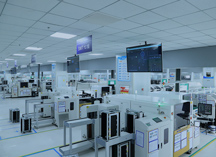
Start with a concrete scenario. An SMT soldering inspection line has one GigE camera at the front for joint inspection, one in the middle verifying component placement, and two at the back photographing the same PCB from different angles. Seven cameras working at once, each outputting roughly 5 MB of image data per second. The line cycle is 10 seconds—all images must be acquired, processed, and the result output within that 10 seconds. If the PC does not have enough network ports, you need an external switch—and each extra device adds latency and a failure point. If the AI compute is insufficient, images queue up and the cycle time stretches.
Selecting the right industrial computer is fundamentally about aligning these steps:
The two most common camera interfaces on production lines are GigE (Gigabit Ethernet) and USB3. They impose completely different requirements on the host.
GigE cameras transfer images over Ethernet. A single 5-megapixel GigE camera shooting continuously generates about 70–80 Mbps of bandwidth. Four cameras together use roughly 320 Mbps—a single Gigabit Ethernet port can barely handle it. But once the line runs, you also need PLC communication, log uploads, and a local HMI page—all competing for the same network controller. Packet loss and latency jitter will appear.
USB3 cameras have the advantage of not requiring an external switch, but the disadvantage of a USB controller bandwidth cap. A single USB3.0 controller typically supports 4–6 cameras at 1080p resolution. Beyond that, you need a separate controller. When selecting a PC, count how many independent USB controllers and how many independent network chips are on the board—this matters more than the headline number of "how many USB ports."
If the production environment requires longer cable runs (over 100 meters), consider GMSL industrial cameras. GMSL transmits data and power through coaxial cable—one cable solves both data and power delivery, ideal for applications where cameras are spread out and cabling is difficult. The EG928A Edge AI Box supports up to 8 channels of GMSL2 cameras, handling synchronized multi-camera acquisition on one controller.
The machine vision compute pipeline is: camera acquisition → image preprocessing (scaling, normalization) → AI inference → result output. These three stages demand different types of compute.
CPU handles "glue" logic: operating system, camera drivers, PLC communication, local database, application-layer scheduling. On most factory floor vision systems, the CPU does not run fully loaded—a 4-core, 8 GB RAM X86 industrial computer can comfortably run one HMI, two cameras, and data collection. The CPU only becomes a bottleneck when the vision algorithm itself is complex (e.g., 3D point cloud processing, multi-model parallel inference).
GPU handles "bursty, heavy compute": high-resolution images (e.g., 20-megapixel line-scan cameras), multiple AI models running simultaneously, or 3D reconstruction scenarios. GPU's advantage is massive parallel compute, but the cost is high power consumption (40–75 W) and challenging thermal management. In a compact cabinet with fanless cooling, GPU is not the first choice.
NPU handles "sustained inference": this is currently the most common choice for industrial edge applications. NPU is designed for low-latency, continuously running AI inference, with low power consumption (typically 10–30 W), suitable for target detection, defect classification, OCR, and other common vision tasks. The EG928A's RK3588J processor integrates a 6 TOPS NPU, supports INT4/INT8/INT16/FP16 precision levels, and can connect up to 32 network cameras for face recognition, license plate recognition, and object detection simultaneously.
How to choose?
Cabinets on production lines are hot and poorly ventilated. Many engineers overlook this, stuffing a "fanless" industrial computer into a sealed cabinet, only to watch the CPU temperature spike, performance throttle, and vision frame rates drop.
Fanless design does eliminate the fan—the most failure-prone moving part—but it also means heat can only be dissipated through the metal chassis. Larger chassis with more fin surface area can dissipate more heat.
EG528, an ARM-based industrial computer, uses a full aluminum chassis with an operating temperature range of -25°C to +75°C, suitable for installation in relatively clean cabinets. If the ambient temperature is higher (above 60°C) or AI inference power consumption exceeds 30 W, passive cooling is no longer sufficient—you need active fans or a larger chassis.
Also note the mounting orientation: installing with fins oriented vertically dissipates heat 10–15% better than horizontal installation. Do not place it in a completely sealed, unventilated tight space.
Industrial vision is not standalone image acquisition. Cameras need trigger signals (e.g., a photoelectric sensor detecting a product arrival before the camera takes a photo), and the processed results need to be sent back to a PLC or a reject mechanism.
An industrial computer capable of machine vision should have at least:
The EG928A has built-in RS485, RS232, CAN bus, and DI/DO interfaces, allowing direct connection of trigger signals and control devices without additional expansion modules. EG628 industrial gateway similarly provides 2×RS485 + 1×RS232 + CAN, suitable for small-to-medium vision stations.
Choosing hardware is only the first step—whether the software can get you up and running quickly matters just as much.
The EG928A comes pre-installed with Ubuntu 22.04, supporting mainstream AI frameworks including TensorFlow, PyTorch, and ONNX, with compatibility for Caffe and Mxnet. If your team is already training models with these frameworks, you can deploy them directly on the EG928A for inference without rewriting code.
The EG528 ARM platform comes pre-installed with Ubuntu 24.04 + Node-RED, enabling drag-and-drop data flow programming without writing low-level code. This is very practical for small-to-medium production lines that lack a dedicated visual algorithm team but need to launch quickly.
The X86 EC100/EC300/EC500 series are compatible with Windows/Linux and support legacy industrial vision software like Halcon and VisionPro. If your vision algorithm team is familiar with Halcon, an X86 industrial computer is the better fit.
Scenario 1: 2–3 cameras, rule-based algorithms, line cycle 5+ seconds
Choose EG528 or EG628. 4-core CPU, 2–3 network ports, ample serial ports, fanless design—sufficient and cost-effective. If the algorithm team needs to use Halcon or VisionPro, switch to the EC100 series.
Scenario 2: 4–8 cameras, lightweight AI models (target detection, defect classification), line cycle 3–5 seconds
Choose EG928A. 6 TOPS NPU + multi-port GbE + support for up to 32 network cameras + digital IO + serial ports. One device handles acquisition, inference, and control.
Scenario 3: 8+ cameras, high-resolution line-scan cameras, multi-model parallel inference, line cycle 1–3 seconds
Choose EC300/EC500 series with optional PCIe expansion cards (GPU or frame grabber). X86 platforms offer more slots and larger memory capacity (up to 128 GB), capable of handling heavy compute demands.
Scenario 4: Small vision station (1 camera, positioning + reading + presence detection)
EG528 or EG228 is sufficient. Low cost, compact size, DIN-rail mountable, ideal for embedding inside inspection equipment.
1. Can a multi-port industrial computer connect to cameras without a frame grabber?
Yes. GigE and USB cameras take images through standard interfaces—if the host has enough network ports and bandwidth, no additional frame grabber is needed. However, if the camera uses Camera Link or CoaXPress dedicated interfaces, a matching frame grabber card is still required.
2. Which is better for machine vision: NPU compute or GPU compute?
It depends on the task. NPU is suitable for continuously running lightweight inference (target detection, classification, OCR), with low power consumption and stable latency. GPU is suitable for high-resolution, multi-model parallel processing, or 3D reconstruction that demands bursty heavy compute. It is not a matter of either/or—it is about matching the scenario.
3. Can a fanless industrial computer run AI inference in high-temperature environments?
Yes, with conditions. Fanless designs have limited heat dissipation capacity, typically suitable for scenarios with TDP not exceeding 15–30 W. If the ambient temperature exceeds 60°C and inference power consumption stays above 30 W continuously, passive cooling is insufficient—you need active fans or a larger chassis.
4. Which should I choose: an embedded industrial computer or a 4U industrial computer?
If cameras connect via built-in network ports and algorithms are primarily traditional vision, embedded models offer smaller size and DC power flexibility. If multiple PCIe expansion cards or high-power discrete GPUs are needed, 4U models are more accommodating in terms of slots and thermal management.
5. How many cameras can one industrial computer support?
There is no fixed number. It depends on camera resolution, frame rate, interface type, and AI model complexity. Roughly speaking: an industrial computer with 4 GbE ports can typically stably support 4–8 cameras at 5 megapixels doing lightweight inference.
6. Is the TOPS figure important when selecting an industrial computer?
TOPS is a peak compute reference value and cannot directly replace measured frame rate. Before selecting, it is best to benchmark your actual model on the target hardware to see real frame rate, latency, and frame loss.
7. What certifications does an industrial computer for machine vision need?
Different markets have different requirements. Export to the EU typically needs CE, ROHS, WEEE; entering the Chinese market needs 3C certification; North America needs FCC. Products like EG928A, EG628, and EG528 cover these mainstream certifications—confirm the requirements for your target market when purchasing.
8. What should I watch for when selecting industrial computer software?
ARM platforms (e.g., EG928A, EG528) come pre-installed with Linux Ubuntu, suitable for TensorFlow, PyTorch, and other mainstream AI frameworks, as well as Node-RED drag-and-drop programming. X86 platforms (e.g., EC series) are compatible with Windows/Linux and can run legacy vision sof