How can AGVs achieve "zero chain breakage" transportation in biopharmaceutical cold chain logistics?
In the field of biopharmaceuticals, cold chain logistics is a critical link in ensuring the quality and safety of drugs. From vaccines to cell therapy products, and from biologics to gene drugs, these high-value, highly sensitive pharmaceuticals have nearly stringent temperature control requirements. Once the cold chain breaks, even a brief temperature fluctuation can render the drugs ineffective and even pose serious health risks. However, in traditional cold chain logistics models, issues such as manual operations, equipment limitations, and information silos have made "zero chain breakage" transportation a long-standing and elusive goal for the industry. It was not until the introduction of AGV (Automated Guided Vehicle) technology that a breakthrough solution emerged for this dilemma.
The breakage of the cold chain in biopharmaceuticals often occurs in a "silent" manner, but its consequences can be deafening. Take COVID-19 vaccines as an example; their storage temperature must be strictly controlled between 2°C and 8°C. If the temperature briefly rises to 10°C during transportation, the active ingredients of the vaccine may begin to degrade, a process invisible to the naked eye, until a decrease in protection is discovered after vaccination. An international pharmaceutical company once experienced a cold chain breakage that rendered a batch of biologics worth tens of millions of dollars ineffective, not only facing huge financial losses but also becoming embroiled in legal disputes due to health risks to patients. This "invisible loss" has instilled a deep-seated fear of cold chain breakage in biopharmaceutical companies.
Traditional cold chain logistics relies on manual operations and fixed equipment, presenting three major pain points:
Risks of manual intervention: Manual handling and loading/unloading can easily lead to temperature fluctuations, especially during transitions between cold storage and ambient environments, where issues such as condensation and prolonged door opening times frequently occur.
Equipment limitations: Traditional forklifts and conveyors struggle to adapt to extremely low-temperature environments (below -25°C), with problems such as battery performance degradation and mechanical component freeze-cracking being prominent.
Information silos: Data on temperature monitoring, equipment status, and transportation routes are scattered, making real-time synchronization difficult and leading to delayed responses to abnormalities.
In the cold storage of a biopharmaceutical company, traditional forklifts experienced a sharp reduction in battery life due to low temperatures, requiring three battery replacements per day, each necessitating a 15-minute shutdown. This accumulated to over 180 hours of annual downtime, directly threatening the continuity of the cold chain. This contradiction between efficiency and safety has left companies trapped in a dilemma where "more investment leads to higher risks."
To achieve "zero chain breakage," AGVs must first overcome the technical challenges of extremely low-temperature environments. Taking an AGV designed by a company for a -25°C cold storage as an example, its core breakthroughs include:
Low-temperature-resistant materials: Special alloys and composite materials are used to ensure that mechanical components do not deform or become brittle in environments as cold as -30°C.
Battery heating technology: Built-in heating films and intelligent temperature control systems maintain battery operating temperatures above -10°C, avoiding performance degradation. In one case, this technology extended the continuous operating time of the AGV from 2 hours to 10 hours in a -25°C environment.
Waterproof and anti-condensation design: Sealed compartments and hydrophobic coatings prevent condensation from infiltrating electronic components, with an IP65 protection rating ensuring stable operation in environments with a 50°C temperature differential.
The temperature control system of AGVs must achieve "millisecond-level" response and "full-chain" coverage:
Onboard temperature control units: Integrated semiconductor cooling and heating modules dynamically adjust the temperature of the cargo compartment according to drug requirements, with an accuracy of ±0.5°C.
Multi-sensor fusion: Temperature, humidity, vibration, and light sensors collect data in real-time, analyzing abnormal trends through edge computing to provide early warnings of potential risks.
5G + IoT communication: 5G networks enable low-latency data transmission, reducing the response time to temperature abnormalities from minutes to seconds. In one project, the AGV seamlessly integrated with the cold storage management system (WMS), automatically triggering backup refrigeration equipment and sending alarm messages to management personnel's mobile phones when the temperature deviated by 0.3°C from the set value.
The "zero chain breakage" capability of AGVs is not only reflected in individual performance but also relies on the collaboration of the entire logistics system:
Dynamic path planning: Based on laser SLAM and visual recognition technologies, AGVs can perceive environmental changes in real-time (such as obstacles and personnel movement) and dynamically adjust paths to avoid temperature fluctuations caused by congestion.
Multi-AGV collaborative scheduling: Through a central scheduling system, multiple AGVs can collaborate to complete transportation tasks across regions and temperature zones. For example, during transfers from a -25°C deep-freeze storage to a 2°C-8°C refrigerated storage, the system automatically assigns AGVs for relay transportation, reducing manual intervention and door opening times.
Integration with upstream and downstream systems: AGVs seamlessly integrate with ERP, MES, TMS, and other systems, achieving real-time synchronization of order, inventory, and transportation data. One company reduced cold chain breakage risk events by 70% and increased order fulfillment rates to 99.5% through this integration.
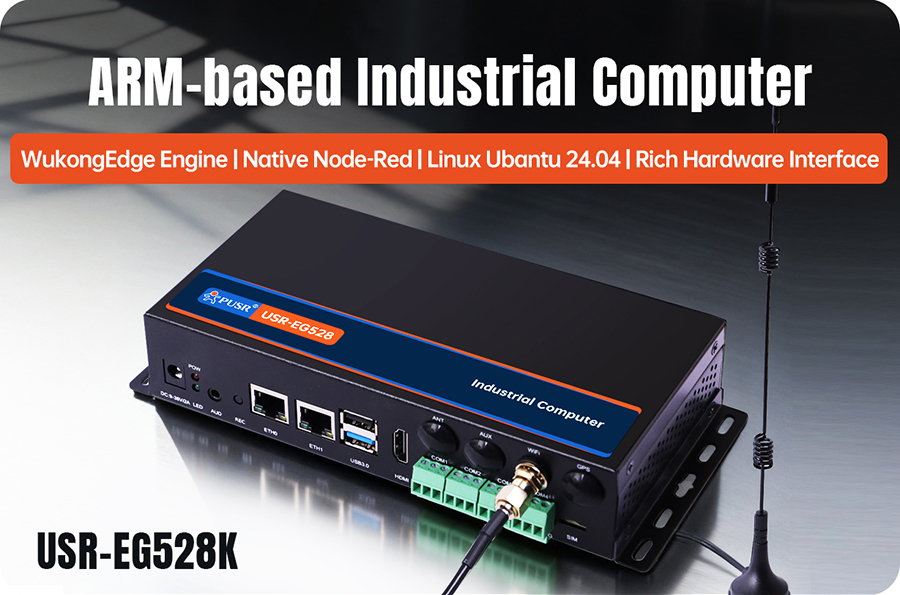
In the process of AGVs achieving "zero chain breakage" transportation, arm industrial PC play a central role. Taking Jinan UROVO's USR-EG528 as an example, its high performance, high reliability, and strong scalability provide solid technical support for AGVs:
Edge computing capabilities: Equipped with a Rockchip RK3562 quad-core processor and an embedded WukongEdge edge computing engine, it can process multi-dimensional data such as temperature, path, and equipment status in real-time, supporting local decision-making and rapid response.
Multi-network communication: Supports 4G/Wi-Fi/Ethernet, coupled with routing and firewall functions, ensuring stable connectivity for AGVs in complex network environments and avoiding cold chain breakage due to communication interruptions.
Industrial protocol compatibility: Provides rich interfaces such as 4 RS485 ports and 2 Ethernet ports, easily connecting with various sensors, PLCs, and cold storage equipment for unified management of data collection and equipment control.
Open development environment: Pre-installed with the Ubuntu system and Node-Red visual programming tools, it supports rapid customization of business logic by enterprises, reducing the difficulty and cost of AGV system integration.
This company previously relied on manual forklifts and fixed conveyor lines for its cold chain logistics, experiencing significant temperature fluctuations and low efficiency. After introducing an AGV system:
Results: Cold chain breakage events decreased from three per month to zero. The 24-hour operation of AGVs increased cold storage utilization by 40% and reduced labor costs by 35%.
Key technologies: Low-temperature-resistant AGVs and the USR-EG528 arm industrial PC were used to achieve real-time temperature monitoring, dynamic path planning, and multi-AGV collaborative scheduling.
Cell therapy products need to be stored and transported in a -196°C liquid nitrogen environment, a requirement difficult to meet with traditional methods. By integrating AGVs with automated cold storage, this company achieved:
Results: Full-chain extremely low-temperature control from production to delivery, with product survival rates increasing from 92% to 99.8%.
Key technologies: The AGVs were equipped with liquid nitrogen insulation compartments and temperature compensation systems, interacting with the cold chain monitoring platform in real-time through the USR-EG528.
With the integration of AI, digital twins, and green energy technologies, AGVs will drive biopharmaceutical cold chain logistics to evolve to a higher level:
Predictive maintenance: Machine learning analyzes AGV operating data to predict equipment failures in advance, avoiding cold chain breakage due to downtime.
Digital twin cold chains: Virtual cold chain models are constructed to simulate temperature changes under different scenarios, optimizing AGV scheduling and cold storage design.
Green cold chains: Hydrogen fuel cell AGVs and solar refrigeration systems are adopted to reduce carbon emissions and achieve sustainable "zero chain breakage" transportation.
In the biopharmaceutical industry, the cost of cold chain breakage is unbearable, and the emergence of AGV technology provides a systematic solution to this challenge. From adapting to extremely low-temperature environments to precise temperature control, and from intelligent scheduling to global collaboration, AGVs are redefining the standards for biopharmaceutical cold chains with "zero chain breakage" transportation. Empowered by core components such as the arm industrial PC USR-EG528, this technological breakthrough is moving from the laboratory to large-scale applications. In the future, with continuous technological evolution, AGVs will become the "safety lock" for biopharmaceutical cold chain logistics, safeguarding the quality and safety of every vaccine and every cell therapy product.