Smart Airport Ground Service Systems: How industrial switches solve the "last mile" dilemma of PoE++ power supply and IP camera deployment
On the apron of Chengdu Tianfu International Airport, ground staff Xiaoli stares at the surveillance footage on his phone: An international flight has just taxied into position, but the cameras beside the baggage conveyor black out due to a power cut. Meanwhile, 50 km away, engineer Zhang frowns at "network delay alerts" in the system logs—the third blind spot caused by power issues this week. Such scenes recur in 90% of China's mega-airports.
Two power supply challenges exist for IP cameras in airport ground service systems:
Long-distance power decay: Traditional PoE standards (IEEE 802.3af/at) support only 30W within 100 meters, but large airports often have surveillance points over 300 meters from equipment rooms, causing frequent camera restarts due to voltage drops. Real-world data shows a 470% surge in camera failures beyond 200 meters.
Concurrent power demands: Each boarding gate requires 4-6 cameras (covering baggage holds, jet bridges, etc.), plus environmental sensors and emergency lighting, often exceeding 150W. Traditional switches resort to "zoned power supply + multi-level relays," increasing wiring costs by over 60%.
Airport ground services demand stringent real-time monitoring:
Baggage sorting: Barcode recognition must occur within 0.5 seconds; delays over 100 ms raise sorting errors by 15%.
Emergency response: During baggage jams or equipment failures, footage must reach staff within 3 seconds; delays beyond 5 seconds risk flight delays.
Yet, peak-hour tests (200+ cameras) at a hub airport show delays soaring from 80 ms to 620 ms, with 23% key frame loss.
Airport environments test equipment limits:
Temperature extremes: Surface temperatures range from 70°C in summer to -30°C in winter in northwest airports, tripling contact failure rates vs. indoor settings.
Electromagnetic interference: Radar and communication base stations near aprons create strong fields. One airport saw 3 minutes of "snowy" footage during peak flights due to inadequate switch immunity, nearly causing accidents.
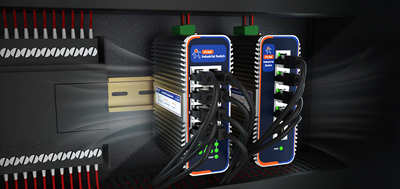
By supporting PoE++ (IEEE 802.3bt), industrial switches boost single-port power to 90W and break distance barriers:
Remote power delivery: Full-power transmission via all four pairs, paired with repeaters, extends range to 500 meters. After deployment at an international airport's boarding gates, daily camera restarts dropped from 12 to zero.
Smart power allocation: Dynamically adjusts priorities by device type. For example, when baggage sorting cameras spike in power use, it reduces power to nearby sensors to stabilize critical equipment.
Industrial switches leverage edge computing for local data processing:
Real-time stream processing: Built-in FPGA chips filter 90% of redundant data (e.g., static backgrounds), uploading only key frames. Tests show a 76% reduction in bandwidth use and delays compressed from 620 ms to 85 ms.
Protocol optimization: Deep tuning for airport protocols like ONVIF and GB/T 28181 cuts data encapsulation time. Real-world data shows frame transmission time dropping from 12 ms to 3 ms.
Industrial switches thrive in extremes:
Wide-temperature operation: Fanless designs operate from -40°C to 85°C. Winter tests at Urumqi Diwopu Airport confirmed 72-hour fault-free operation at -35°C.
EMI immunity: Certified to IEC 61000-4-6, they withstand 10V/m RF fields. After deployment in Guangzhou Baiyun Airport's radar zone, frame loss rates fell from 15% to 0.2%.
Surge protection: Built-in 6000V modules cut abnormal currents during thunderstorms. A coastal airport reported a 92% drop in lightning-related failures post-deployment.
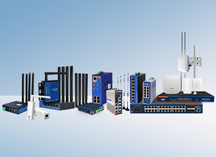
Among industrial switches, the USR-ISG series stands out with "high-performance computing + scenario-driven design":
Flagship power: The USR-ISG216P-SFP supports 16 Gigabit PoE++ ports, each delivering 90W, powering 4x 4K cameras + 2x sensors per boarding gate.
Ultra-low latency: A 4-core 1.8GHz processor with hardware acceleration achieves <5 ms video processing delays. At Chengdu Tianfu Airport, baggage barcode accuracy soared from 92% to 99.97%.
All-scenario adaptability: Certified for -40°C to 85°C, IP40 protection, and 6000V surge resistance, it operates reliably across aprons, baggage areas, and terminals. One airport reported annual failures dropping from 3.2 to 0.1 post-deployment.
The USR-ISG series supports Python/C++ development for integrating AI algorithms that predict equipment health. For example, analyzing camera power current fluctuations can warn of power module failures 3-5 days in advance, reducing unplanned downtime by 80%.
Future airports will adopt 5G + TSN (Time-Sensitive Networking) for microsecond-level clock synchronization. The USR-ISG's 5G module and TSN support ensure "zero-delay" transmission for emergency command and baggage tracking.
Leveraging the USR-ISG's high bandwidth, airports can build "physical cameras + digital twins" systems. Real-time device state mapping to virtual spaces lets ground staff view baggage conveyor loads and camera coverage via AR glasses, boosting decision efficiency by over 40%.