In factory floors, outdoor cabinets, and unattended sites, network continuity directly affects production efficiency and maintenance costs. Many teams experience smooth operations right after deployment, only to encounter intermittent disconnections, unexpected reboots, and remote connectivity failures weeks or months later. Each trip to the field adds up, and maintenance costs keep climbing.
The root cause is rarely a single device failure. More often, it is the lack of a systematic evaluation of "long-term stability" during the selection phase.
Industrial cellular routers differ fundamentally from consumer routers in physical construction, operating environment, and feature configuration. Consumer routers rely on plastic enclosures, 0°C to 40°C operating ranges, and limited thermal design — suitable for offices and homes. Industrial routers must withstand wide temperature swings from -35°C to 75°C, strong electromagnetic interference, voltage fluctuations, and continuous 24/7 operation. The selection process needs to cover multiple dimensions systematically.
The deployment environment determines hardware requirements for industrial cellular routers.
Factory floorstypically involve strong electromagnetic interference, temperature fluctuations, and frequent equipment vibration.Outdoor cabinetsmay be exposed to direct sunlight, with internal temperatures exceeding 60°C in summer, alongside rain, dust, and lightning-induced surges.Unattended sites(such as solar power stations or water monitoring points) are often located in remote areas where the cost of on-site troubleshooting far exceeds that in urban environments.
Different scenarios impose distinct hardware requirements:
Before selecting a model, inspect the actual deployment location — confirm temperature range, electromagnetic environment, power supply conditions, and available installation space — then match those to the router's specifications.
A single SIM card and a single network link are the most common single points of failure in industrial networks. Base station maintenance, carrier network congestion, SIM card expiration, or balance depletion — any one of these can break connectivity.
Dual SIM Failoveris a baseline feature for industrial cellular routers. When the primary SIM card's carrier network becomes abnormal, the router automatically switches to the backup SIM card, restoring communication. Some models support dual SIM dual standby, simultaneously connecting to two different carriers for further reliability improvement.
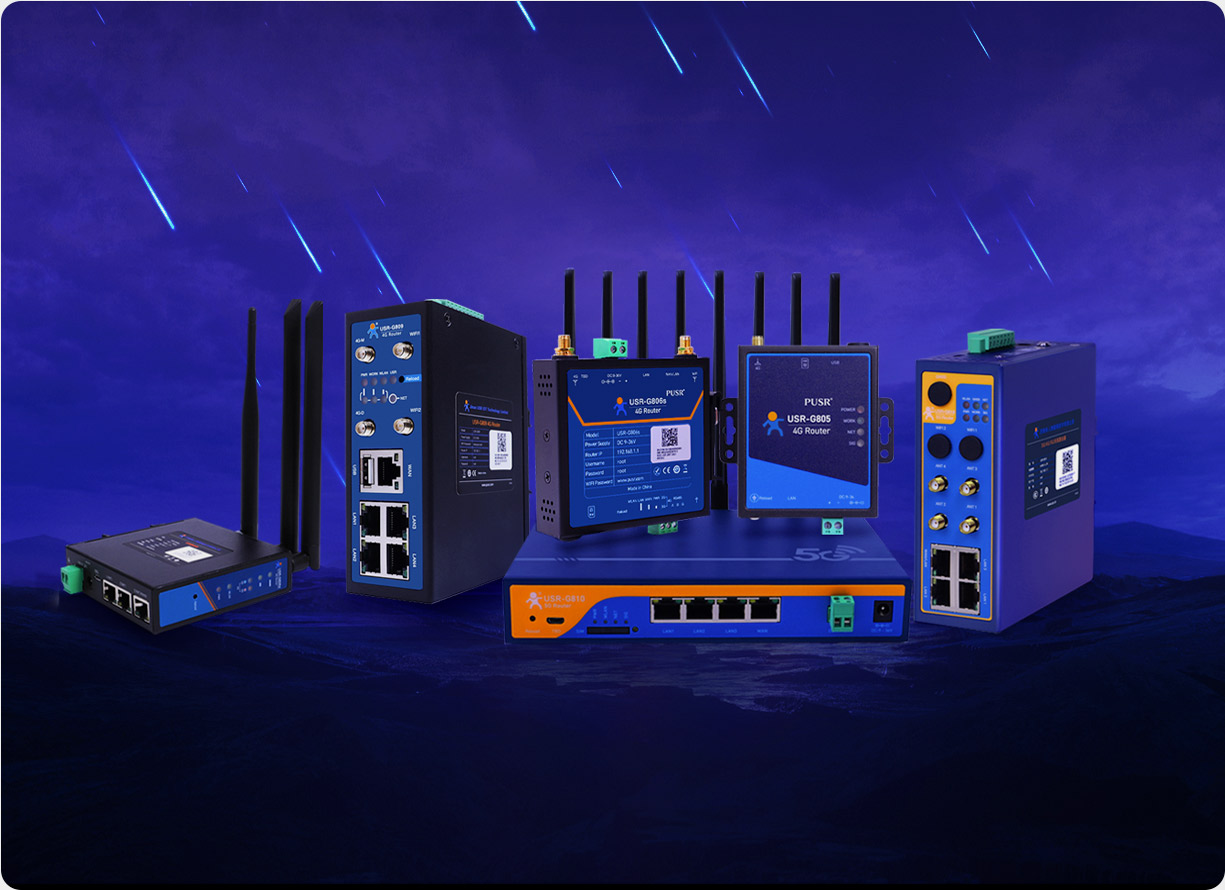
WAN Failoveris another common redundancy approach. When the primary link (such as a wired broadband connection) fails, the router switches to a backup link (such as a 4G/5G cellular connection), keeping services running. The USR-G816 supports WAN failover, enabling automatic primary-to-backup link switching.
In practice, deploy routers with at least dual SIM slots and distribute SIM cards across different carriers to mitigate the risk of single-carrier network outages.
Electromagnetic interference in industrial environments is far more complex than in office spaces. Large motor startups, lightning induction, and electrostatic discharge can generate transient current surges on circuits, damaging communication equipment.
EMC (Electromagnetic Compatibility) protectionis a core specification for industrial cellular routers. Key aspects include:
When selecting a router, verify whether the device passes EN 61000-4 series testing (surge, EFT, ESD, etc.) — this is the internationally recognized standard for measuring EMC protection capability.
When equipment is deployed across dozens or hundreds of locations, sending technicians to each site for troubleshooting is hardly feasible. Remote management capability directly determines operational efficiency.
Hardware Watchdogis a standard feature of industrial cellular routers. The USR-G806w employs both hardware and software watchdog design, ensuring 7×24-hour stable operation with automatic recovery when abnormalities occur — no manual intervention required.
Cloud management platformsprovide a unified remote operation interface. Administrators can configure parameters, restart devices, upgrade firmware, and monitor status through the cloud platform without visiting the site. PUSR's remote management platform supports remote configuration, device reboot, and firmware updates.
Abnormality alertingnotifies operations personnel the moment a fault occurs. The USR-G816 supports device offline alarms, weak signal alarms, and network traffic overrun alarms, delivered through email and SMS with repeat push capability, ensuring no alert goes unnoticed.
Data in industrial settings often involves production control and critical infrastructure. Data transmission security is a must-check item during selection.
VPN supportis the primary mechanism industrial cellular routers use to ensure data security. Common VPN protocols include:
The USR-G806w supports a complete VPN protocol stack (OpenVPN, IPsec, PPTP, L2TP, and GRE) along with multiple encryption methods, delivering financial-grade data transmission security.
Industrial sites typically contain a large number of legacy devices. Interface and protocol diversity is a factor that must be considered during selection.
Before selection, inventory the interface types and quantities of on-site equipment to ensure the chosen router has sufficient ports for support.
The following is a concise selection checklist. Confirm each item by priority:
| Item | Priority | Description |
|---|---|---|
| Operating temperature range | High | Ensure coverage of extreme temperatures at deployment site |
| Enclosure material and thermal design | High | Metal enclosure + efficient heat dissipation |
| Dual SIM redundancy | High | Avoid single point of failure |
| EMC protection level | High | Pass EN 61000-4 series testing |
| Remote management features | High | Cloud platform + watchdog + anomaly alerts |
| VPN support | High | At least IPsec or OpenVPN |
| Hardware watchdog | Medium | Automatic recovery on anomaly |
| Serial ports (RS-232/485) | Medium | Legacy device integration |
| WAN failover | Medium | Multi-link redundancy |
Selection is not about comparing parameter levels — it is about finding the right fit. Identify the core needs of your deployment scenario, verify each metric against those needs, and you will select an industrial cellular router that truly delivers long-term stability.
Industrial cellular routers are designed for harsh environments, supporting wide-temperature operation (-35°C to 75°C), metal enclosures, EMC protection, dual SIM redundancy, and remote management. Consumer routers typically operate in 0°C to 40°C environments, use plastic enclosures, and lack industrial-grade protection and remote management features.
When the primary SIM card's carrier network experiences a fault or signal degradation, the router automatically switches to the backup SIM card, restoring network connectivity. This effectively prevents communication loss caused by single-carrier network outages.
Common industrial VPN protocols include IPsec, OpenVPN, PPTP, L2TP, and GRE. IPsec is suitable for site-to-site encrypted communication, while OpenVPN offers high flexibility with bidirectional client-server connections. Choose the protocol combination based on actual security requirements.
Industrial environments contain numerous electromagnetic interference sources (motors, variable frequency drives, lightning, etc.). EMC protection prevents these interferences from causing equipment damage or communication interruptions. Selecting a router that passes EN 61000-4 series testing effectively reduces this risk.
Basic monitoring and data acquisition (SCADA) scenarios have modest bandwidth requirements — LTE Cat.4 is sufficient. Applications involving video surveillance or large-volume data transmission should consider LTE Cat.6 or 5G routers. Evaluate bandwidth based on actual business traffic to avoid over-provisioning.
Common industrial protocols include Modbus RTU, Modbus TCP, MQTT, OPC UA, and DNP3. Some routers also provide serial server functionality, converting RS-232/RS-485 data into IP data for easier cloud platform integration.
Industrial cellular routers use hardware watchdog technology to monitor device status at both hardware and software levels, automatically recovering from anomalies. Combined with wide-temperature design, EMC protection, and redundant power input, long-term stable operation is ensured.
Recommended features include: remote parameter configuration, device reboot, firmware upgrade, status monitoring, and anomaly alerts (offline status, weak signal, traffic overrun). Cloud-based unified management significantly reduces operational costs for multi-site deployments.