Manufacturers deploying equipment on site often face the same question: should the site run on a 5G cellular router, or is a solid 4g cellular router enough? With spec sheets like the G816 and G806w running long, it is easy to get lost in the details.
The first step is not comparing specs — it is breaking the site requirements into a few fixed questions. How sensitive is the business to bandwidth and latency? How do the devices connect? Can the link afford downtime? How harsh is the environment? Is remote maintenance needed? Once these are answered, the model basically picks itself.
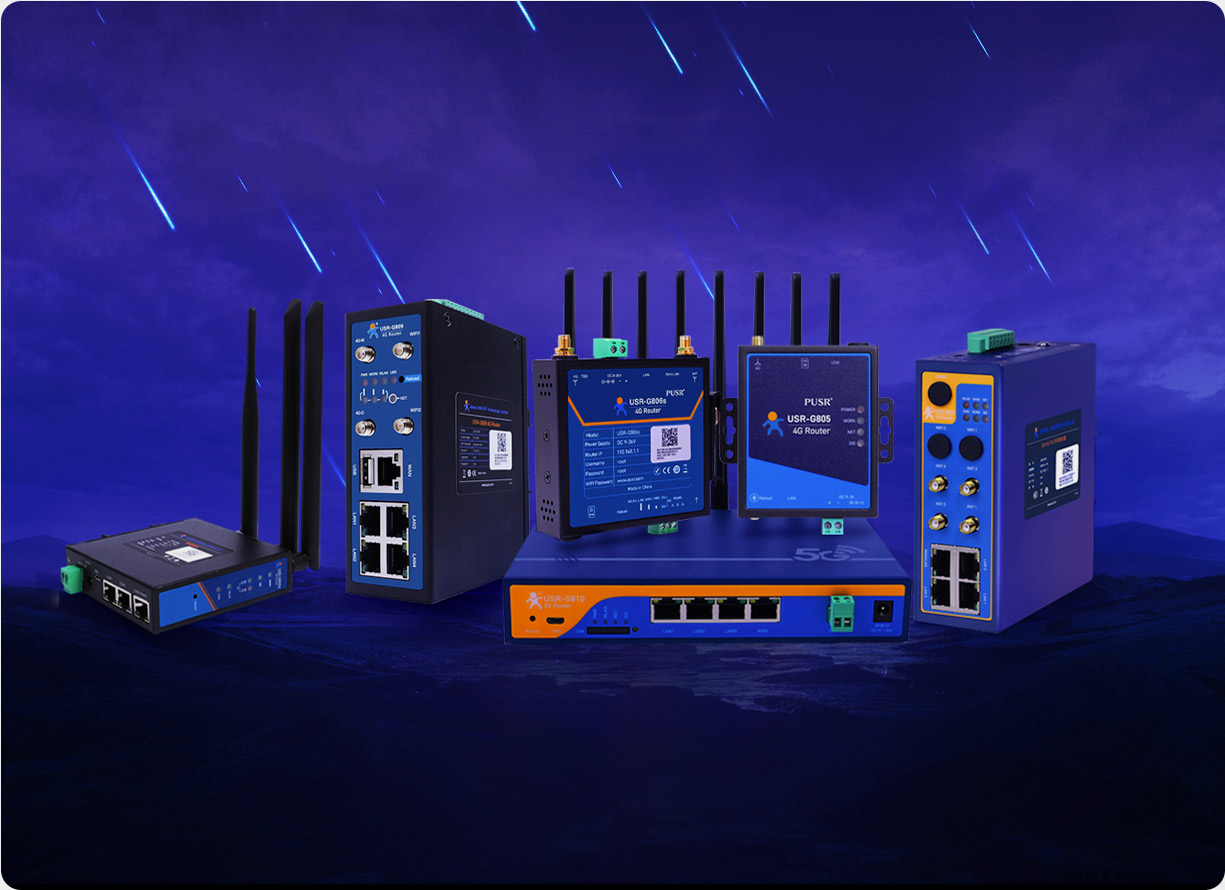
Need 5G:When the workload runs on high bandwidth and low latency — multi-stream HD video backhaul, real-time control, remote dispatch — 4G tends to become the bottleneck, so go straight for a 5g cellular router. The USR-G816 pairs a Qualcomm quad-core processor with the X62 5G modem, supports SA/NSA networking and mainstream global bands, and lets multiple devices share one high-speed cellular uplink.
Mature 4G is enough:If the job is collecting PLC data, pushing sensor readings to the cloud, or connecting standard Ethernet equipment, mature 4G coverage handles it. The USR-G806w is a Qualcomm-based 4g cellular router — a dependable pick for these projects, and its cost is easier to control than a 5G setup.
Multiple Ethernet ports:Sites often have industrial PCs, cameras and gateways online at the same time. The G816 uses a multi-port design, so several devices share one cellular egress instead of each device needing its own SIM card.
RS232/RS485 serial ports:Many PLCs, meters and sensors only have serial ports and no Ethernet. The G816 has a built-in serial port, so legacy equipment connects directly — no external serial server required.
WiFi access:Where running cable is impractical — mobile devices, self-service terminals, on-vehicle setups — the G806w comes with built-in WiFi (IEEE 802.11 b/g/n, up to 300 Mbps, dual 5 dBi high-gain antennas). Wired and WiFi clients can connect at the same time.
Dual SIM backup:For locations like toll stations and EV charging piles, one carrier going down takes the site offline. If automatic primary/backup SIM switching is a must, choose the G816 (5G) or the G806p/G805s (4G).
Automatic multi-link switching:When a site has both cellular and wired networks, the G806w switches freely between cellular, wired and WiFi — when one link fails, it moves to another automatically. The G816 also supports automatic WAN failover to a backup network.
Both the G816 and G806w are built to industrial-grade standards for 7×24 operation:
VPN:Both models support PPTP, L2TP, IPSec, enhanced OpenVPN and GRE, so field devices tunnel securely back to the head-office network with encrypted transmission. The enhanced OpenVPN supports one-click .ovpn import, can connect to three OpenVPN servers at once as a client, and can also act as an OpenVPN server.
Remote management:Both models work with the PUSR remote management platform for remote configuration, device reboot and firmware upgrade. Device-offline, weak-signal and data-cap-exceeded events trigger real-time alarms via email or SMS — issues surface before the field team has to report them.
Choosing a cellular router comes down to listing the site requirements one by one and matching them against the product capabilities. The clearer the answers, the easier the model decision — and the fewer headaches in deployment, expansion and maintenance later.