In factory floors, outdoor cabinets, and unattended industrial sites, network connectivity isn't something you can just "have and hope works." Occasional disconnections, failures that require manual rebooting, remote devices going offline because of network outages—each of these directly drives up field maintenance costs and disrupts business continuity.
A sysadmin community shared a real experience: a remote site was deployed with consumer-grade routers instead of industrial ones, and summer heat and winter cold each took turns knocking the devices offline. The team had to send people to the site for frequent manual restarts. The core issue here isn't whether the router was expensive or cheap—it's whether the right industrial-grade specifications were checked before selection.
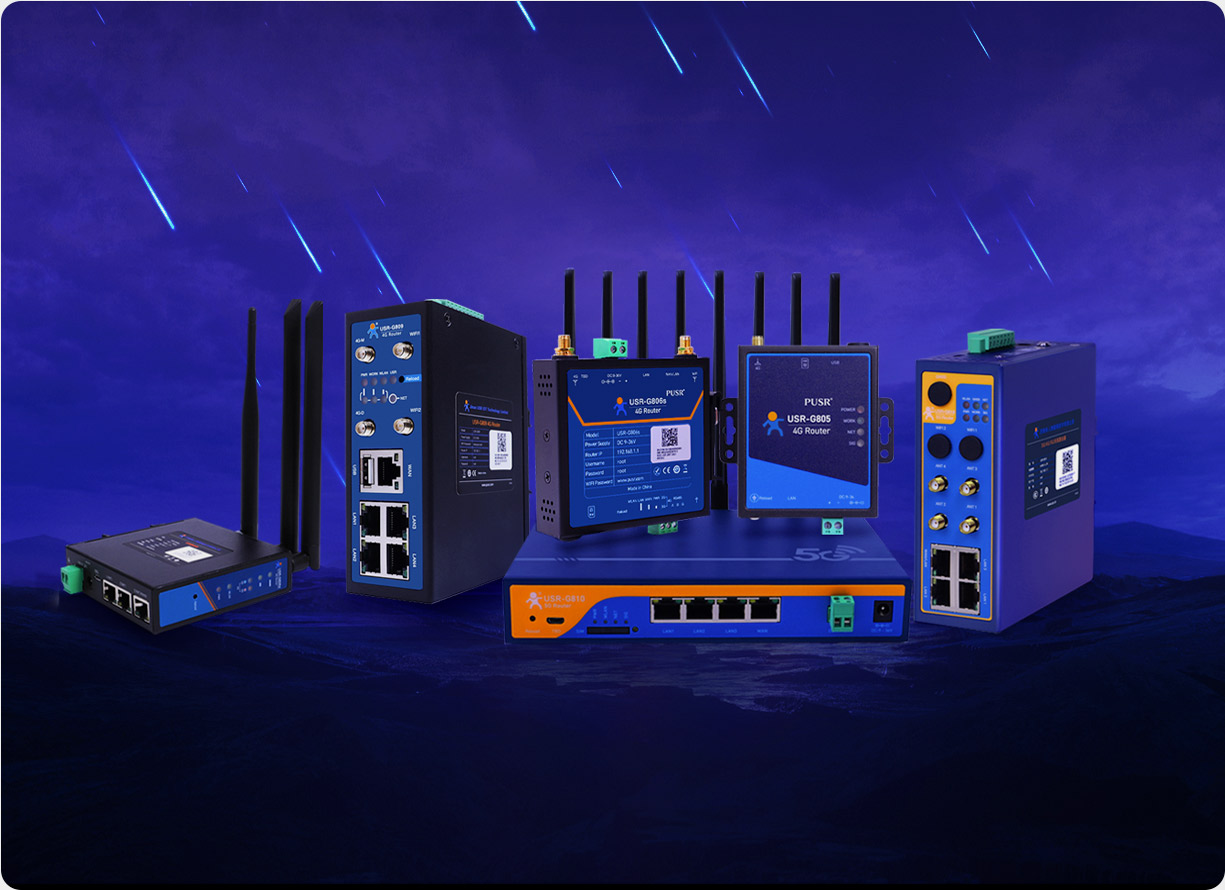
Industrial LTE router are built for exactly these environments. Below are the key dimensions to verify during the selection process, with real examples from PUSR products for reference.
Consumer-grade routers typically specify an operating temperature of 0°C ~ 40°C. That works fine in an air-conditioned room, but the inside of an outdoor cabinet can easily exceed 60°C during summer sun exposure, and drop below -20°C in winter in unheated areas.
When selecting a router, check thefull operating temperature rangelisted on the product datasheet—not the "average" figure in a marketing brochure. Industrial-grade routers usually specify a range of -40°C ~ 75°C or -40°C ~ 85°C, and are aged-tested and stability-verified across that entire range.
For example, PUSR's 5G cellular router USR-G816 is designed for an operating temperature of -35°C ~ 75°C, with a metal housing and efficient thermal dissipation structure ensuring stable operation even under extreme temperatures. The USR-G806w operates from -20°C ~ 70°C, suitable for scenarios with moderate temperature swings.
Hardware Watchdog is a baseline feature of industrial LTE routers. It automatically resets the device when the software freezes or the system hangs, without requiring human intervention.
Key checks:
Both USR-G816 and USR-G806w are equipped with hardware watchdogs, supporting uninterrupted long-term operation and preventing downtime caused by system anomalies.
Industrial sites contain numerous sources of electromagnetic interference—frequency converters, motors, radio transmitters, and even lightning-induced surges. Without proper EMC (Electromagnetic Compatibility) testing and protection design, routers may experience unstable signals, data transmission errors, or damaged ports.
What to look for:
PUSR industrial LTE routers undergo rigorous EMC testing, supporting protection against electrostatic discharge (ESD), electrical fast transient bursts (EFT), and surges, ensuring stable operation in high-EMI environments.
Network continuity is the core requirement in industrial scenarios. When a single link breaks, the business stops. Industrial LTE routers typically offer multiple redundancy methods:
These features are usually configurable in the setup interface, including switching strategies and latency thresholds. Before field deployment, set reasonable thresholds based on the criticality of your business.
Data transmitted in industrial environments typically involves production control information, video surveillance, or remote equipment commands—security cannot be overlooked.
Security feature checklist:
PUSR's remote management platform allows remote parameter configuration, device rebooting, and firmware upgrades for routers, and can push network anomaly alerts via email or SMS, helping teams stay ahead of issues before they escalate.
Space in outdoor cabinets and field installations is often limited, and the installation method directly affects wiring and maintenance convenience.
Common installation methods:
For physical interfaces, choose based on on-site equipment needs:
The USR-G806w supports both DIN rail and wall mounting, provides 1 WAN port and 2 LAN ports (or 3 LAN ports as an option), and includes a serial port for IoT device integration—well suited for small-to-medium enterprises and projects. If your application requires higher bandwidth and more flexibility, the 5G router USR-G816 offers greater scalability and higher data throughput.
Long-term stability can't be confirmed by "running it for a few days and seeing what happens." A comprehensive evaluation should cover the following areas:
PUSR products have obtained EU EN 18031 cybersecurity standard certification, and have long-running customer cases across multiple industries worldwide, supporting stable industrial IoT deployments at the product level.
When selecting an industrial LTE router, verify the following in order:
① Does the operating temperature range match the environmental conditions at the installation site?
② Are hardware watchdogs and EMC protection adequate?
③ Does it support multi-link redundancy (dual SIM, WAN Failover)?
④ Do security features and remote management capabilities meet business needs?
⑤ Do physical interfaces and installation methods match the on-site layout? ⑥ Can the chipset and certifications support long-term stable operation?
Going through these six items systematically eliminates most devices that aren't suitable for industrial scenarios, reducing downstream maintenance costs and downtime risk.
Industrial-grade routers are fundamentally different in design standards. They use metal enclosures, wide-temperature components, industrial-grade EMC protection, and support 7×24-hour uninterrupted operation, along with enterprise features such as hardware watchdogs, dual SIM hot standby, and remote management. Consumer routers are typically designed for home or office use, have narrow operating temperature ranges, lack redundancy and remote management capabilities, and tend to become unstable or fail in industrial environments.
Yes. Industrial LTE routers are specifically designed for outdoor and harsh environments. The metal enclosure, combined with dust and moisture protection, typically supports an operating temperature range of -40°C ~ 85°C, and passes lightning, ESD, and surge protection tests. With high-gain external antennas, stable connections can be maintained even in remote areas with weak signals.
Industrial LTE routers typically support standard Mini SIM or Nano SIM cards, and most models support dual SIM hot standby. For data plans, M2M (Machine-to-Machine) dedicated data packages from carriers are recommended. Compared with consumer SIMs, M2M plans offer better pricing, higher data allowances, and greater stability. Actual data requirements vary by application—telemetry data may only need tens of MB per month, while video surveillance could require tens or even hundreds of GB.
Yes. Most industrial LTE routers support remote configuration, monitoring, and firmware upgrades via a Web management interface or cloud-based management platform. Administrators can view device status, signal strength, and data usage from a remote location, perform remote reboots, and receive alerts when network anomalies occur. This approach significantly reduces the frequency and cost of field maintenance visits.
For most industrial applications, 4G LTE bandwidth is more than sufficient. LTE Cat 4 offers up to 150 Mbps downstream, which handles SCADA communication, sensor data collection, and standard video surveillance without issue. If your deployment requires extremely high bandwidth (such as real-time HD video backhaul or edge computing) or ultra-low latency, a 5G router is the better choice. Additionally, 4G networks have wider global coverage, are mature technology, and have a lower upfront cost.
Most industrial LTE routers support Power-on-Resume (PoR) functionality. This means that when power is restored after an unexpected outage, the router automatically boots up and restores its previous network configuration without requiring manual reconfiguration. Combined with a hardware watchdog, the device can recover normal operation after an abnormal restart.
Connection capacity depends on the router's hardware configuration and wireless standards. Industrial-grade routers typically support 30 ~ 50 simultaneous device connections, and high-end models can support over 100. Wi-Fi performance (such as whether dedicated FEM power amplifier chips are included and antenna gain) also directly affects actual coverage and connection stability.
Industrial-grade routers are designed for a service life of 5 ~ 10 years. Compared with the 2 ~ 3 year lifecycle of consumer routers, industrial products use long-life-cycle components, pass stricter reliability tests, and receive longer firmware update and technical support cycles, resulting in a lower total cost of ownership (TCO) overall.