Deploying surveillance cameras on a construction site is nothing like installing cameras in a standard office. Construction environments are harsh — heavy dust, extreme temperature swings, unstable power supply — and many projects start with consumer or commercial PoE switches only to run into problems by the first summer or winter: cameras dropping offline, ports burning out, entire link segments failing. Once you go back and replace everything, the cost has already multiplied several times over.
Choosing an industrial PoE switch isn't about buying the most expensive option — it's about picking the right one. Here's a practical, engineering-driven selection guide for construction site deployments.
A common first step for integrators is to count cameras and match ports — 8 cameras means an 8-port switch, 16 means 16 ports. The port count looks right, but in practice things break down during use: everything works fine during the day, then at night when infrared and full-color illuminators activate simultaneously, some cameras reboot unexpectedly.
The root cause is insufficient PoE power budget. The 802.3af (PoE) standard delivers a maximum of 15.4W per port, while 802.3at (PoE+) delivers up to 30W. Modern 4-megapixel full-color cameras typically draw over 15W at peak (nighttime), so af-standard ports simply cannot handle them.
What to do: List every connected device's model and peak power draw (use the manufacturer's maximum rating, not the typical value), sum them up, and leave a 20% to 30% buffer. If the switch's total PoE budget is too low, adding more ports doesn't help.
A 4-megapixel camera's single stream typically runs between 8Mbps and 16Mbps. For 8-megapixel cameras or those with AI processing, the bitrate is even higher. A 24-port 100Mbps switch connected to multiple cameras above 4MP will quickly exceed its uplink bandwidth — frame drops, lagging live views, and lost NVR recordings are the most common symptoms.
Rule: For surveillance deployments with cameras at 4MP resolution and above, every port must be gigabit. There is no workaround.
Standard commercial switches typically list an operating temperature range of 0°C to 40°C. What happens on a construction site? Inside a shipping container used as a equipment room, summer internal temperatures can easily exceed 50°C. In winter, temporary outdoor cabinets in northern regions can drop to well below zero. Under such conditions, consumer-grade capacitors and chips age rapidly, and unexpected reboots become routine.
This is where industrial switches fundamentally differ. The PUSR USR-ISG, for example, operates across a -40°C to +85°C range. Its fanless aluminum housing uses natural convection for cooling — no moving parts to wear out, no noise, and no single point of failure. That temperature margin is not just a spec; it's exactly what construction sites demand.
Most construction site cameras are mounted on temporary poles or in open enclosures, exposed directly to lightning induction and power surges. Many projects ignore this during installation, assuming "as long as the switch powers on, it's fine." Then a thunderstorm hits and dozens of ports go dead simultaneously.
Industrial switches are built to handle this far better than commercial gear. The USR-ISG features 6KV industrial-grade lightning protection on both power and network interfaces, and has passed 6KV common-mode surge impact testing. In practical terms, even if a nearby strike induces a surge into the cabling, the switch ports can absorb it without damage.
Don't forget complementary measures: outdoor cabinets must be properly grounded, and a dedicated gigabit surge protector ahead of the switch completes the dissipation path.
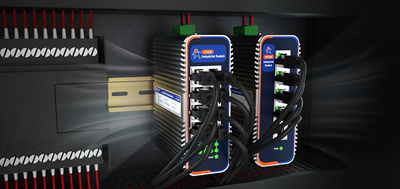
On construction sites, switches are typically housed in temporary cabinets or control enclosures. Traditional switches require screws to secure them to a panel, which is cumbersome and time-consuming. Industrial switches generally support DIN-rail mounting — simply clip them onto the rail, and removal is just as quick.
The USR-ISG uses a standard DIN-rail mounting design with an aluminum alloy housing and IP40 dust-proof rating. Its compact footprint saves valuable cabinet space. For construction environments where equipment is frequently reconfigured or relocated, mounting convenience matters more than it might in a permanent installation.
Construction sites commonly experience unstable mains power — intermittent outages and voltage fluctuations. When a standard switch loses power and reboots, every connected camera goes offline simultaneously, creating a blind spot during that window.
Industrial switches support dual power inputs (DC 9.6–60V range). With two independent power feeds connected, the device continues operating if one supply fails, dramatically reducing the risk of downtime from a single point of failure. Additional protections include reverse polarity and short-circuit safeguards, meaning wiring mistakes won't fry the board.
Construction sites often have relatively few devices and simple topologies, so unmanaged switches are usually sufficient — plug and play, zero configuration. For larger projects spanning multiple zones, or where remote management features are needed (VLAN segmentation, per-port PoE control, remote camera reboot when a unit freezes), a managed switch becomes worthwhile.
The USR-ISG is designed as an unmanaged switch, which covers the needs of small to medium construction projects. If ring topology redundancy (ERPS protocol) or advanced network management is required later, managed models are available from the same product family.
When selecting an industrial PoE switch for a construction site, confirm these seven items:
The core principle is simple: the right fit matters more than the highest spec. Construction sites don't need fancy features — they need reliable operation in harsh conditions.