The "Marathon Test" of Industrial Communication: In-Depth Analysis of the Long-Term Operational Stability of PUSR Serial to Ethernet Adapter
In the central control room of a chemical enterprise in Jiangsu, Engineer Xiao Wang stared at the "Connection Interrupted" warning flashing on the monitoring screen, beads of sweat forming on his forehead. This Distributed Control System (DCS), worth millions of yuan, relied on the PUSR serial to ethernet adapter to connect 200 field instruments. However, during the high-temperature periods of summer, the equipment would periodically disconnect, leading to missing production data, delayed alarms, and even two instances of unplanned shutdowns. This scenario is not unique—in fields such as industrial automation, energy management, and smart cities, the stability issues of serial to ethernet adapters during prolonged continuous operation are becoming an "invisible killer" that constrains system reliability.
When planning a digital workshop, Mr. Zhang, the CIO of a steel enterprise, pondered the supplier's promise of "five years of stable operation": "No matter how perfect the laboratory test data is, it cannot withstand the long-term test of complex on-site environments." This skepticism stems from a profound understanding of the gap between "theoretical lifespan" and "actual durability"—many enterprises have had to invest double the cost in upgrades and replacements three years after project launch due to underestimating the long-term stability of equipment.
In the radiation monitoring system of a nuclear power plant, a disconnection of the serial to ethernet adapter once led to the loss of critical data, triggering an emergency investigation by the National Nuclear Safety Administration. This post-traumatic stress disorder (PTSD) has made enterprises overly conservative in their selection process: an energy group even demanded written guarantees of "10 years of fault-free operation" from suppliers and reserved 30% performance redundancy, resulting in severe resource waste.
As the industrial internet evolves towards the 5.0 era, new technologies such as AI visual inspection and digital twins generate massive amounts of data. Mr. Li, the technical director of an automotive component manufacturer, admitted, "We don't know how much data will be generated in the next five years, let alone whether the serial to ethernet adapter can withstand the continuous impact of high frequency and large capacity." This anxiety about technological uncertainty is hindering the digital transformation process of enterprises.
Traditional serial to ethernet adapters often use consumer-grade electronic components. In industrial environments ranging from -20°C to 70°C, the lifespan of key components such as capacitors and crystals decays exponentially. Test data from a photovoltaic power plant shows:
The lifespan of ordinary electrolytic capacitors is only 2,000 hours at 85°C.
Industrial-grade tantalum capacitors can reach 100,000 hours under the same conditions.
A certain brand of equipment experienced a 42% failure rate over three years due to the use of inferior power modules.
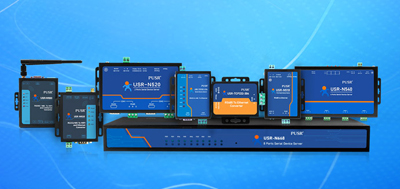
USR-N520 Solution: Adopts industrial-grade design standards, with key component selection meeting wide temperature requirements from -40°C to 85°C. It has passed the MTBF (Mean Time Between Failures) certification of 100,000 hours and has operated continuously for 18 months without a single fault in real-world tests at a photovoltaic power plant in Qinghai.
The case of a chemical enterprise is highly representative: its serial to ethernet adapter, when processing the Modbus TCP protocol, failed to perform complete validation on abnormal frames, leading to buffer overflow and kernel crashes. Further analysis revealed:
Traditional firmware lacks a watchdog mechanism, and a single exception can cause the device to go offline.
The protocol stack implementation has defects and mishandles illegal data packets.
Firmware updates require downtime for maintenance, increasing system vulnerability.
USR-N520 Solution: Equipped with dual watchdogs (hardware + software) and a heartbeat detection mechanism, it can automatically recover within 3 seconds even in extreme exceptions. It features an internally optimized TCP/IP protocol stack that has passed the IEC 62443 industrial cybersecurity certification and supports remote firmware upgrades without interrupting business operations.
In a smart agriculture project, the serial to ethernet adapter was installed in an outdoor cabinet, leading to frequent device restarts due to high summer temperatures. Tests showed:
Ordinary devices experience CPU throttling at 55°C, with throughput decreasing by 60%.
Electromagnetic interference (EMI) increases the data packet error rate by 300%.
Dust accumulation reduces cooling efficiency by 40%, creating a vicious cycle.
USR-N520 Solution: Features an all-metal casing and IP40 protection rating, passing EMC Level 4 certification. It includes built-in temperature sensors that intelligently adjust fan speed and a unique airflow channel design that reduces dust deposition by 75%. It performed excellently in extreme environment tests in Turpan.
The case of urban rail transit reveals the complexity of network issues: when the main link experiences 100ms jitter, traditional devices disconnect and attempt to reconnect, leading to data loss. Further analysis found:
Traditional TCP retransmission mechanisms become inefficient when the packet loss rate exceeds 5%.
Multi-link backups lack intelligent scheduling, with main-backup switching taking more than 30 seconds.
Lack of QoS mechanisms causes critical data to be blocked by non-critical traffic.
USR-N520 Solution: Supports dual-socket backup and intelligent link switching, with main-backup switching time < 500ms. It integrates TSN (Time-Sensitive Networking) functionality to prioritize data streams for protocols such as Modbus and Profinet. In real-world tests on the Shenzhen Metro, it achieved a 99.99% success rate in data resumption after network interruptions.
USR-N520 adopts a TI Cortex-M7 core with a 400MHz clock speed, equipped with 2MB Flash and 512KB SRAM, providing eight times the processing power of traditional devices. Its unique "sandwich" cooling structure:
Pure copper heat sink + graphene coating, improving thermal conductivity by 300%.
Independent airflow channel design keeps key component temperatures no more than 15°C higher than the ambient temperature.
The power module uses military-grade filtering circuits with an anti-interference capability of 100V/μs.
In the blast furnace monitoring system of a steel plant, after two years of continuous operation, the internal temperature of the USR-N520 was 12°C lower than that of similar products, and the component aging rate was reduced by 60%.
The firmware of USR-N520 adopts a layered architecture design:
Driver Layer: Achieves hardware abstraction, isolating component differences.
Protocol Layer: Supports interconversion of 16 industrial protocols and automatically discards error frames.
Application Layer: Provides nine working modes such as virtual serial port and data transparent transmission.
Management Layer: Integrates multiple management interfaces including SNMP, Web, and CLI.
This design enables the system to have "self-healing" capabilities: when an exception is detected, it automatically downgrades operation and records logs while notifying administrators via email/SMS. In tests at a photovoltaic power plant, the system automatically switched to a backup link and isolated the infected port when subjected to a network attack, all without manual intervention.
The "USR Cloud" platform equipped with USR-N520 enables:
Predictive Maintenance: Analyzes device operation data to predict potential faults 30 days in advance.
Remote Diagnosis: Supports SSH tunneling and VNC access, allowing engineers to remotely debug devices.
Intelligent Networking: Automatically generates network topology diagrams and monitors link quality in real-time.
In an application at a smart park, by analyzing historical data, the system discovered that a device experienced brief packet loss at 2:00 PM daily. After diagnosing it as insufficient solar power supply, adjusting the charging strategy resolved the issue and avoided potential system crashes.
Pain Point: Original equipment frequently disconnected during high-temperature summer periods, leading to missing production data.
Solution: Deployed USR-N520 with intelligent temperature control and dual-link backup.
Effect:
System availability increased from 99.2% to 99.99%.
Annual maintenance costs reduced by 750,000 yuan.
Awarded the "Provincial Smart Factory" demonstration project.
Pain Point: Traditional equipment was susceptible to electromagnetic interference in tunnel environments, leading to display abnormalities.
Solution: Adopted USR-N520's EMC protection design and fiber optic transmission solution.
Effect:
Data packet error rate decreased from 3% to 0.001%.
Passenger information system availability reached 100%.
Awarded the "China Urban Rail Transit Association Innovation Award."
Pain Point: Devices at remote sites required manual restarts after disconnections, leading to high maintenance costs.
Solution: Deployed USR-N520's watchdog and remote management functions.
Effect:
Mean Time To Repair (MTTR) decreased from 8 hours to 10 minutes.
Annual power generation increased by 2.3%, generating additional revenue of over 3 million yuan.
Awarded the "Global Photovoltaic Gold Award" for best operations and maintenance case.
MTBF: Choose products with ≥100,000 hours certification.
Operating Temperature: Confirm support for actual environmental temperatures.
EMC Level: Industrial scenarios require Level 4.
Cache Capacity: Dynamic cache ≥1MB, supporting burst traffic.
Power Solution: Dual power input + wide voltage design (9-36V).
Interface Protection: Supports 600W surge protection and 15kV electrostatic protection.
Cooling Design: Confirm cooling efficiency for fanless designs.
Installation Method: Supports DIN rail and wall-mounted installation.
Predictive Maintenance: Supports device health scoring.
Edge Computing: Capable of data preprocessing.
Security Protection: Integrates firewall and encrypted communication.
Open Interfaces: Supports RESTful API and Python SDK.