Industrial LTE Router: The "Smart Eye" for Distribution Automation in Smart Grids
In a distribution room of an industrial park in Zhejiang, Lao Zhang, the operation and maintenance team leader, is fretting over a red alarm on the monitoring screen—a 10 kV feeder has tripped due to overload, but the system only shows the faulty area, not the specific fault point. He has to lead his team to inspect the 3-km-long line pole by pole in 40℃ heat, taking 6 hours to find the insulator struck by lightning. Such scenes play out daily in tens of thousands of distribution rooms nationwide. According to State Grid statistics, traditional distribution fault location averages over 2 hours, with annual economic losses exceeding RMB 10 billion.
As smart grids evolve toward "self-awareness, self-decision-making, and self-healing," industrial LTE router are becoming a key technological enabler. They serve not only as a "highway" for data transmission but also as the "smart eye" for distribution automation, shifting grids from "passive response" to "proactive prediction."
Traditional distribution rooms rely on manual inspections and local meters, leading to significant data collection delays. A provincial grid company survey revealed that 78% of distribution rooms still use mechanical meters, with manual meter reading cycles as long as 24 hours, causing delays in detecting equipment overload and line aging. In summer 2024, a chemical park in Jiangsu suffered equipment burnout due to undetected transformer oil temperature anomalies, resulting in direct losses exceeding RMB 10 million.
Moreover, data silos are prevalent. Distribution automation terminals (modem/FTU) lack effective coordination with dispatch systems and energy management systems, leaving dispatch centers with only regional outage information during faults, unable to pinpoint fault locations. A city power bureau once delayed fault location, extending a 30,000-household outage to 8 hours, drawing widespread social attention.
Manual inspections dominate traditional distribution O&M but are inefficient and costly. In a second-tier city with 1,200 distribution rooms, weekly inspections require annual labor costs exceeding RMB 20 million. In remote mountainous areas or offshore wind farms, a single inspection can take days, with O&M costs accounting for up to 35% of total costs.
Lengthy fault handling processes exacerbate efficiency issues. Traditional workflows—from user repair requests to dispatch orders, on-site inspections, and repairs—average over 4 hours. A car manufacturer once halted production due to a distribution fault, losing RMB 500,000 per hour, with fault location and repair taking 6 hours, resulting in direct losses exceeding RMB 3 million.
Distribution systems involve high-voltage equipment and complex electromagnetic environments, demanding high communication stability and security. Traditional industrial LTE router have notable weaknesses in anti-interference capabilities and protection levels:
Electromagnetic interference: High-voltage equipment in substations generates strong electromagnetic fields, causing router communication interruptions or data errors. A steel company once suffered a plant-wide blackout due to router anti-interference failures triggering misoperations in the distribution automation system.
Environmental adaptability: Outdoor distribution boxes can reach 70℃ with humidity exceeding 90%, causing traditional routers to fail due to poor heat dissipation or component aging. A wind farm lost wind turbine monitoring data due to router failure in high temperatures, nearly causing equipment damage.
Cybersecurity: Distribution systems directly impact civilian power supply safety, but traditional routers lack encryption mechanisms, making them vulnerable to hacking. In 2023, a local grid suffered a 2-hour regional outage due to router security vulnerabilities.
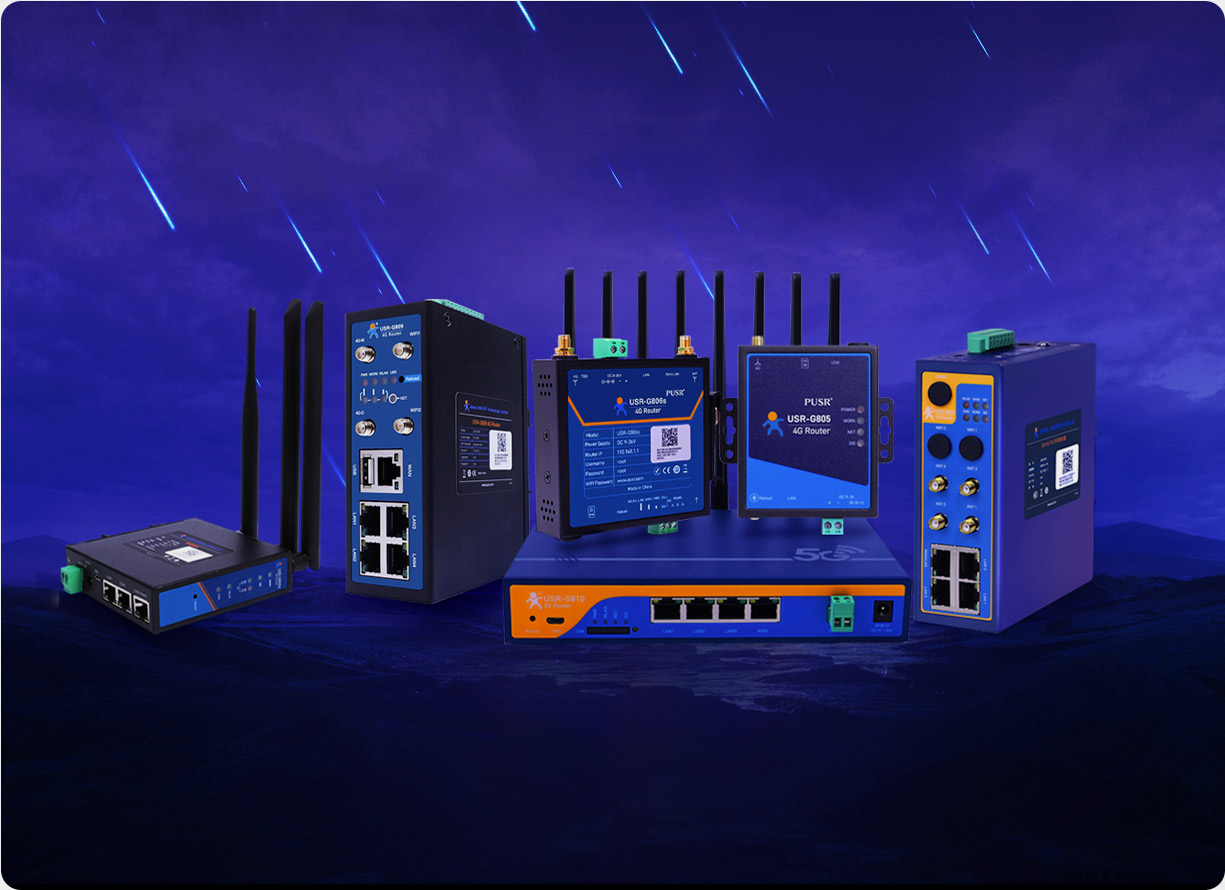
Industrial LTE router enable precise fault location and rapid response through "edge computing + protocol conversion." Take the USR-G809s as an example: its built-in high-performance processor and 30+ industrial protocol stacks allow real-time analysis of current, voltage, and harmonic data from DTU/FTUs, while machine learning algorithms establish equipment health models. When anomalies occur, the router triggers alerts within 10 ms and pushes fault location and type information to the dispatch center with pole-level accuracy.
After deploying USR-G809s, a provincial grid company reduced fault location time from 2 hours to 15 minutes, cutting annual outage hours by over 2,000. During Typhoon Bebinca in 2024, the system located 32 line faults, avoiding losses exceeding RMB 50 million.
Industrial LTE router support multi-mode communication (5G/4G/LoRa/Wi-Fi 6) to meet diverse monitoring needs:
Urban distribution rooms: Wi-Fi 6 and wired network redundancy ensure data transmission stability.
Remote mountainous lines: LoRa low-power wide-area networks provide kilometer-level coverage with 10-year battery life.
Offshore wind farms: 5G private networks and satellite communication create a "sea-land-air" three-dimensional monitoring system.
After deploying USR-G809s, an offshore wind farm achieved real-time data backhaul for wind turbine status and submarine cable temperatures via 5G+LoRa hybrid networking. The system reduced submarine cable fault detection time from 72 hours to 2 hours, saving over 30 million kWh of annual generation losses.
To withstand harsh distribution environments, the USR-G809s features an all-metal chassis and IP67 protection, operating stably from -40℃ to 75℃. Its built-in three-proof coating and high-voltage-resistant capacitors resist salt spray, dust, and electromagnetic interference. For security, the router supports VPN encrypted tunnels, firewalls, and intrusion detection, with end-to-end data encryption via Chinese national cryptographic algorithms.
After deploying USR-G809s, a chemical park resisted multiple cyberattacks without data leaks. Its explosion-proof design meets Ex d IIB T4 standards for safe use in flammable/explosive environments.
Industrial LTE router significantly cut O&M costs. After deploying USR-G809s, a city power bureau:
Reduced manual inspection frequency from weekly to monthly, saving over RMB 15 million annually in labor costs.
Cut fault handling time from 4 hours to 30 minutes, reducing annual outage losses by over RMB 80 million.
Extended equipment lifespan by 20% through predictive maintenance, saving over RMB 20 million annually in replacement costs.
Time-series data collected by industrial LTE router can train equipment health prediction models. By analyzing transformer oil temperature and load data from USR-G809s, one enterprise built an AI prediction model for 72-hour fault warnings with 92% accuracy. After implementation, transformer fault rates dropped 60%, saving over RMB 5 million annually in repair costs.
Industrial LTE router vendors are collaborating with PLC manufacturers and cloud service providers to build ecosystems. For example, the USR-G809s comes pre-installed with protocol libraries for mainstream PLCs like Siemens S7 and Mitsubishi FX, with open API interfaces supporting integration with MES/ERP systems. A car manufacturer achieved a 40% shorter design verification cycle and 25% higher capacity by implementing digital twins for its stamping line via this router.
With the convergence of 5G-A, AI, and digital twin technologies, industrial LTE router will evolve into "intelligent hubs":
5G-A integrated sensing and communication: Enable millimeter-level positioning and environmental sensing via the 6 GHz band, supporting autonomous drone inspections.
AIoT fusion: Embed lightweight AI models for autonomous fault diagnosis and self-healing.
Digital twins: Build virtual grids based on real-time data for simulation-based dispatch planning.
A provincial grid company has launched a "Transparent Grid" project, aiming to achieve holographic grid state perception and intelligent control via USR-G809s and digital twin technologies. Scheduled for completion in 2027, the project expects to reduce outage time by 90%, lower line losses by 15%, and save over RMB 1 billion annually in electricity costs.
When Lao Zhang stands before the monitoring screen again, the numbers are no longer cold data but an "electrocardiogram" of equipment health—the USR-G809s is collecting real-time operational data from 128 distribution rooms, predicting risks via AI algorithms. An alert pops up: abnormal transformer oil temperature in a park's distribution room. With a mouse click, Lao Zhang remotely activates cooling fans, averting a potential accident.
This is not just a technological triumph but a conceptual revolution. Industrial LTE router have transcended their role as "connecting devices" to become the "nerve center" of smart grids. With millisecond-level responsiveness, military-grade reliability, and ecosystem-level openness, they are redefining the boundaries of distribution automation. For enterprises exploring digital transformation, choosing a true industrial LTE router is not just an equipment investment but a reliable "digital insurance policy" for the grid's future.