The "Protocol Bridge" in Smart Energy PV Power Plants: industrial panel pc Resolves Compatibility Challenges Between Modbus TCP and IEC 61850
At 2 a.m., a piercing alarm suddenly echoes through the monitoring center of a PV power plant in northwest China—inverter data is interrupted, and the plant's power curve drops to zero. Operation and maintenance personnel rush into the equipment room and discover a communication failure between the inverters using the Modbus TCP protocol and the dispatch platform adhering to the IEC 61850 standard, resulting in a data island that leaves the entire plant "blind." This scenario is not an isolated case: according to statistics, among global PV power plant outages caused by protocol incompatibility, 70% occur in hybrid systems combining Modbus and IEC 61850, with each fault resulting in an average power generation loss of 5,000 kWh and direct economic losses exceeding 20,000 yuan.
Customer Pain Points:
Data Discontinuity Anxiety: Protocol incompatibility leads to a "language barrier" between the monitoring system and equipment, preventing real-time transmission of critical data and affecting power generation efficiency evaluation and fault fault warning.
System Expansion Dilemma: New PV power plants need to connect to grid dispatch platforms, but legacy equipment only supports Modbus TCP, making upgrades costly and time-consuming.
Security and Compliance Concerns: The IEC 61850 standard mandates data encryption and access control, while Modbus TCP lacks security mechanisms, making it vulnerable to cyberattacks.
Modbus TCP has become the "default language" for PV inverters, combiner boxes, and other equipment due to its simplicity, openness, and ease of implementation. Its advantages include:
Lightweight Design: Data frames contain only core information such as function codes and register addresses, ensuring high communication efficiency.
Strong Device Compatibility: Over 90% of industrial equipment worldwide supports the Modbus protocol, creating a robust ecosystem.
Low Cost: No specialized hardware is required; ordinary Ethernet modules can facilitate communication.
However, the "simplicity" of Modbus TCP also poses risks:
Lack of Standardized Models: Data definitions rely on vendor-specific customization, making data mapping between different devices difficult.
Absence of Security Mechanisms: Plaintext transmission and lack of identity authentication make it susceptible to tampering or theft.
Insufficient Real-Time Performance: Based on a polling mechanism, latency can reach seconds in high-concurrency scenarios.
As the "universal language" in power system automation, IEC 61850 enables seamless interoperability between devices through standardized data models and service interfaces. Its core value lies in:
Object-Oriented Modeling: Device functions are abstracted into logical nodes (LNs), such as "MMXU" for measurement units and "GGIO" for general input/output, eliminating data ambiguity.
Real-Time Communication Guarantees: Supports GOOSE (Generic Object Oriented Substation Event) for rapid messaging and MMS (Manufacturing Message Specification) for millisecond-level control instruction transmission.
Comprehensive Security Framework: Provides mechanisms for access control, data encryption, and identity authentication to meet power industry security and compliance requirements.
However, the "complexity" of IEC 61850 also presents challenges:
High Implementation Costs: Requires specialized hardware support, and deployment and maintenance demand professional teams.
Compatibility Barriers: Legacy equipment must connect via protocol conversion gateways, increasing system complexity.
Amid the protocol compatibility challenges in PV power plants, the industrial panel pc USR-SH800 serves as a "translator" between Modbus TCP and IEC 61850 by leveraging "edge computing + protocol conversion," enabling seamless data flow.
USR-SH800 achieves full-stack compatibility from the physical layer to the application layer through its built-in WukongEdge edge application platform, which integrates a protocol conversion engine and data modeling tools:
Physical Layer Adaptation: Supports 2 RS485 ports, 2 RS232 ports, and 2 Ethernet ports, enabling simultaneous connection to Modbus TCP inverters and IEC 61850 dispatch platforms.
Data Link Layer Conversion: Parses Modbus TCP's TCP/IP data frames into application-layer data and then encapsulates them into IEC 61850's MMS or GOOSE messages.
Application Layer Modeling: Uses drag-and-drop configuration tools to map Modbus register addresses to IEC 61850 logical nodes (e.g., mapping inverter power values to "MMXU.PhV.mag"), eliminating data ambiguity.
Security Enhancement: Supports SSL/TLS encrypted communication and includes built-in firewalls and access control lists (ACLs) to meet power industry security and compliance requirements.
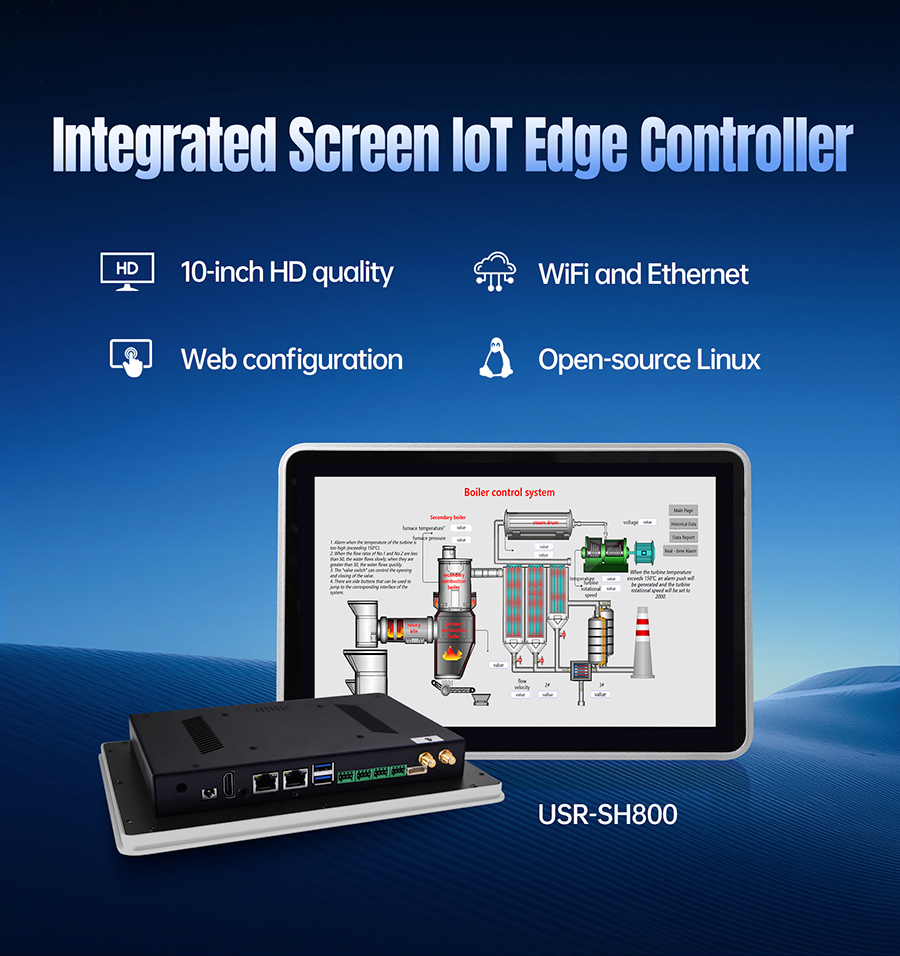
USR-SH800 not only facilitates protocol conversion but also builds a "smart hub" for PV power plants through its edge computing capabilities:
Real-Time Data Acquisition: Supports millisecond-level data refresh rates, ensuring that the dispatch platform receives synchronized inverter status and power generation data from the field.
Anomaly Warning and Diagnosis: Based on threshold comparison and trend analysis algorithms, it continuously monitors equipment operating parameters to detect potential faults in advance (e.g., overheating inverters or declining module efficiency).
Intelligent Control Strategies: Automatically adjusts inverter output power based on dispatch instructions and local rules, enabling "source-grid-load-storage" coordinated control. For example, during peak grid load periods, it reduces power output from non-critical inverters to alleviate grid pressure.
Local Configuration and Visualization: Includes built-in Web configuration tools that support custom monitoring interfaces, allowing operation and maintenance personnel to view plant operating status in real time via a 10.1-inch touchscreen without relying on cloud platforms.
The protocol conversion capabilities of USR-SH800 have been validated in multiple PV projects worldwide:
100MW PV Power Plant in Northwest China: By connecting 200 Modbus TCP inverters to the IEC 61850 dispatch platform via USR-SH800, the plant achieved real-time power generation monitoring and rapid fault localization, reducing fault response time from 2 hours to 10 minutes.
Distributed PV Cluster in East China: Deployed USR-SH800 across 30 rooftop PV sites to build a regional energy management platform, enabling centralized data acquisition and analysis through protocol conversion, optimizing power generation plans, and increasing annual power generation by 5%.
Island Microgrid Overseas: Combined with USR-SH800's edge computing capabilities, it achieved coordinated control of PV, energy storage, and diesel generators, ensuring power supply reliability in off-grid mode with a system availability rate of 99.9%.
The protocol conversion solution provided by USR-SH800 not only resolves technical challenges but also drives digital transformation in PV power plants through the following value propositions:
Cost Reduction and Efficiency Improvement:
Avoid Equipment Replacement Costs: Legacy Modbus devices can be directly connected to new systems without upgrades.
Reduce Operation and Maintenance Manpower: Local configuration and intelligent warning functions decrease on-site inspection frequency, lowering operation and maintenance costs by 40%.
Security and Compliance:
Meet Power Industry Security Standards: Prevent cyberattacks through SSL/TLS encryption and access control.
Comply with IEC 61850 Certification Requirements: Support MMS and GOOSE services to ensure system interoperability.
Ecosystem Expansion:
Support Multi-Protocol Access: In addition to Modbus TCP and IEC 61850, it is compatible with industrial protocols such as OPC UA and Profinet, reserving space for future device expansion.
Seamless Cloud Integration: Supports platform access to MQTT, Alibaba Cloud, Huawei Cloud, and others, enabling in-depth data value mining.
As PV power plants evolve toward "intelligence, intensification, and platformization," the demand for protocol compatibility will become increasingly urgent. The evolution path of USR-SH800 is clear:
AI-Empowered Protocol Optimization: Analyze historical communication data through machine learning to automatically optimize protocol conversion rules, reducing latency and packet loss rates.
Digital Twin Integration: Combine 3D modeling with real-time data to create a "digital twin" of PV power plants, enabling remote operation and maintenance and predictive maintenance.
Open Ecosystem Construction: Provide SDKs and API interfaces to support third-party developers in creating customized applications, fostering an "Android ecosystem" for the PV industry.
In the wave of smart energy, the protocol compatibility challenge between Modbus TCP and IEC 61850 essentially represents a clash between "traditional industry" and "digital power." The industrial panel pc USR-SH800, centered on "edge computing + protocol conversion," not only resolves technical data island issues but also facilitates the transition of PV power plants from "device connectivity" to "value creation" through intelligent control and ecosystem expansion. When every ray of sunlight can be converted into clean power through protocol bridges, the future of smart energy is within reach.