Industrial Router Selection Guide: In-Depth Analysis of Communication Protocol and Interface Requirements Across Different Industries
In the wave of Industry 4.0, industrial routers have become a bridge connecting the physical and digital worlds. However, faced with complex and diverse application scenarios across different industries, how to accurately select industrial routers to avoid project delays and cost overruns caused by protocol incompatibility and interface mismatch has become a common challenge for many enterprises. This article will start from industry pain points, deeply analyze the core requirements for communication protocols and interfaces in different scenarios, and provide practical selection strategies to help you overcome the selection dilemma.
A certain automobile manufacturing enterprise once selected a router that did not support the Profinet protocol, resulting in the inability of newly purchased German-imported robots to communicate with the existing PLC system. The project was delayed by three months, with direct losses exceeding RMB 2 million. Such cases reveal that protocol compatibility is the primary threshold for industrial router selection.
In a smart warehousing project, a logistics enterprise was unable to simultaneously connect the AGV scheduling system, environmental monitoring sensors, and video surveillance equipment due to the router only being equipped with two LAN ports. This forced the addition of switch layers, resulting in a 40% increase in network latency and a 25% rise in equipment failure rates.
In a pasture in Inner Mongolia, during a severe winter at -30°C, three consecutive devices failed due to internal condensation caused by insufficient router protection levels. Livestock positioning data was interrupted for up to 72 hours, with direct economic losses exceeding RMB 500,000. Extreme environmental adaptability has become a "life-and-death line" for outdoor scenario selection.
Core Requirements:
Protocols: Profinet (real-time cycle <1ms), EtherCAT (synchronization accuracy ±1μs), OPC UA (cross-platform data integration)
Interfaces: 4×GE electrical ports (connecting PLCs/robots), 1×SFP optical port (workshop-level backbone network), 2×RS485 (interfacing with legacy equipment)
Case: A certain home appliance factory adopted the USR-G809s router supporting TSN (Time-Sensitive Networking), achieving nanosecond-level synchronization between multi-axis robots and vision systems, with a product defect rate reduction of 18%.
Core Requirements:
Protocols: IEC 60870-5-104 (power dispatching), DNP3 (distribution network automation), Modbus TCP (equipment monitoring)
Interfaces: 2×GE electrical ports (redundant links), 1×4G/5G (wireless backup), hardware-level VLAN isolation (preventing virus spread)
Case: A certain wind farm improved its annual availability to 99.99% through the dual-SIM card redundancy design of the USR-G809s, automatically switching when a single operator's signal was interrupted.
Core Requirements:
Protocols: MQTT (lightweight data transmission), LoRaWAN (low-power wide-area network), HTTP API (cloud platform integration)
Interfaces: 1×WAN port (connecting 4G/5G), 4×LAN ports (connecting sensor gateways), Wi-Fi 6 (mobile terminal access)
Case: A certain cotton field in Xinjiang achieved wireless coverage of soil moisture sensors within a 20-kilometer radius using the LoRa expansion module of the USR-G809s, reducing wiring costs by 80%.
Core Requirements:
Protocols: TCP/IP (video stream transmission), UDP (real-time AGV control), SNMP (network management)
Interfaces: 8×GE electrical ports (dense device access), 2×SFP+ optical ports (10-gigabit uplink), PoE power supply (direct connection of IP cameras)
Case: JD.com's Asia No. 1 Warehouse supported the simultaneous transmission of 1080P video streams from 50 AGVs through the 2.5G electrical ports of the USR-G809s, shortening path planning response time to 30ms.
Core Requirements:
Protocols: IEEE 1588 (clock synchronization), AUTOSAR (vehicle network), CAN bus (vehicle control)
Interfaces: 1×10G SFP+ (roadside unit backbone network), 2×GE electrical ports (traffic signal controllers), 5G private network (vehicle-road communication)
Case: The digital road project in Xiong'an New Area adopted the 5G+TSN integrated solution of the USR-G809s, achieving microsecond-level synchronization between autonomous vehicles and roadside equipment, with trajectory tracking errors <0.2 meters.
Equipment List Review: List the communication protocol types of all devices to be connected.
Protocol Support Confirmation: Consult the router's technical documentation to verify whether it natively supports or can support through firmware upgrades.
Interoperability Testing: Build a typical topology in a laboratory environment to verify the data transmission stability of key protocols.
Basic Requirements: The number of LAN ports ≥ the number of devices × 1.2 (reserve 20% expansion space).
Advanced Requirements: The proportion of interfaces supporting PoE power supply ≥ 30% (reduce power wiring).
Future Requirements: Reserve 1-2 SFP optical ports or 5G module slots (to cope with bandwidth upgrades).
Temperature Testing: Continuous operation for 72 hours in an environment ranging from -40°C to 75°C.
Protection Testing: IP67-rated devices must pass dust chamber and spray tests.
Electromagnetic Compatibility: Pass the IEC 61000-4-6 conducted immunity test (prevent inverter interference).
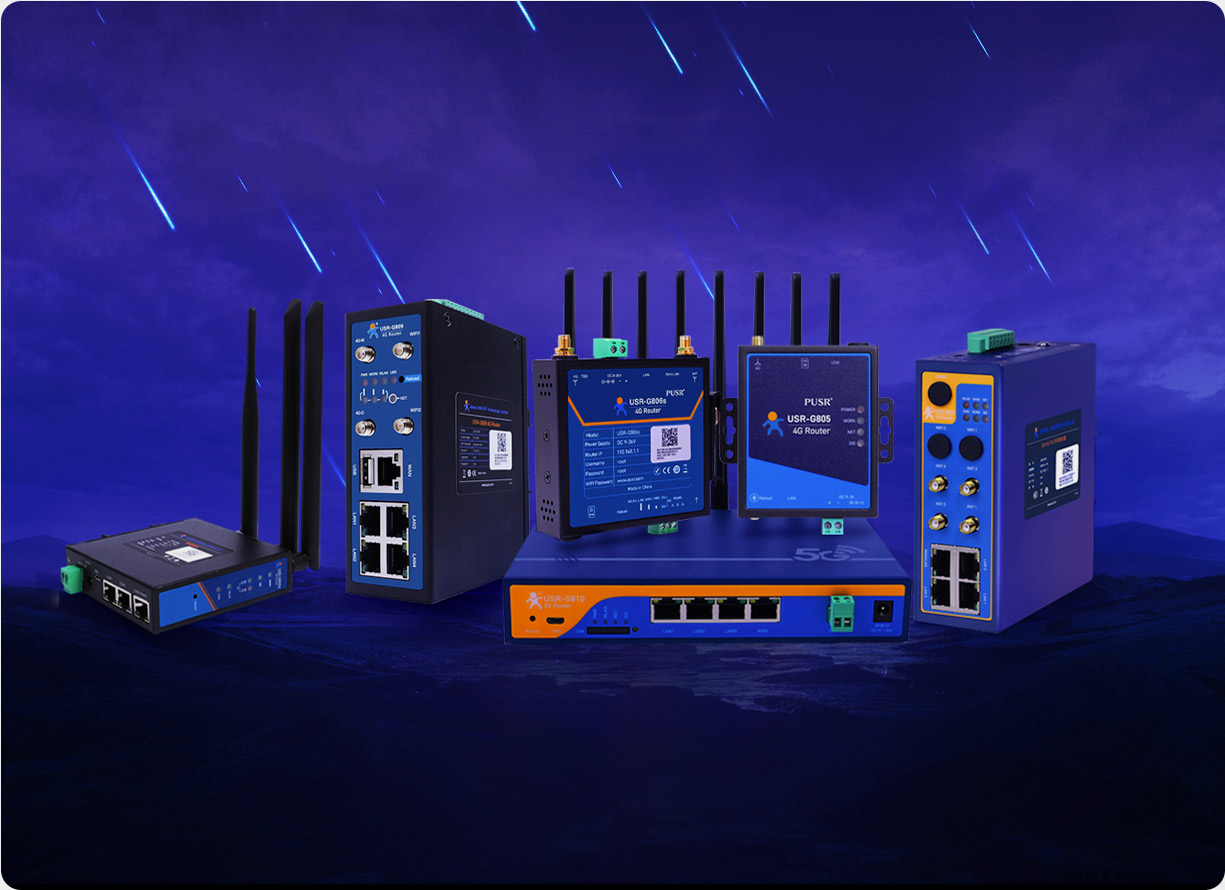
Among numerous industrial routers, the USR-G809s stands out with its characteristics of "full protocol compatibility, full interface coverage, and full environmental adaptability":
Protocol Support: Natively integrates 32 industrial protocols such as Profinet, EtherCAT, and OPC UA, covering over 90% of industrial scenarios.
Interface Configuration: 8×GE electrical ports + 2×10G SFP+ optical ports + 2×RS485 + 1×5G module slot, supporting PoE++ power supply.
Environmental Design: IP67 protection level, wide temperature operation from -40°C to 85°C, and passing IEC 61000-4-8 electromagnetic compatibility certification.
Reliability Assurance: Dual-SIM card redundancy + dual power inputs + hardware watchdog, with an MTBF (Mean Time Between Failures) exceeding 500,000 hours.
Practice in a certain new energy vehicle factory has proven that after adopting the USR-G809s, equipment communication failure rates decreased by 76%, network expansion costs were reduced by 45%, and project delivery cycles were shortened by 30%.
Misconception 1: "The more protocols, the better."
Truth: Protocol support needs to match the scenario. Redundant protocols increase firmware complexity and security risks. It is recommended to prioritize devices that support 2-3 core protocols for the scenario.
Misconception 2: "The more interfaces, the stronger."
Truth: Interface type is more important than quantity. For example, in energy scenarios, it is necessary to prioritize ensuring the number of optical ports and serial ports, while in logistics scenarios, more electrical ports and PoE power supply interfaces are needed.
Misconception 3: "Low-priced devices offer high cost-effectiveness."
Truth: Industrial routers need to consider the total cost of ownership (TCO) over their entire lifecycle. A certain enterprise once selected low-priced devices, resulting in maintenance costs exceeding three times the purchase price within three years, ultimately forcing a complete replacement.
The selection of industrial routers is essentially customizing a digital nerve center for business scenarios. When faced with the three core challenges of protocol compatibility, interface expandability, and environmental adaptability, please remember: there is no perfect router, only the most suitable solution. By deeply understanding industry requirements, establishing a scientific evaluation system, and selecting devices like the USR-G809s that have undergone rigorous verification, you will not only solve immediate connection problems but also lay a solid foundation for your enterprise's digital transformation.
In the vast expanse of the Industrial Internet of Things, the correct selection decision is the ark that carries you through data storms and reaches the intelligent shore.