Industrial Router: The "Nerve Center" and Cornerstone of Collaborative Control in Automobile Manufacturing Automation Lines
In the automated production lines of automobile manufacturing, every second of stagnation means rising costs, and every coordination failure of equipment can trigger a chain reaction of quality crises. When a leading auto company suffered body steel plate deformation due to robot cluster synchronization errors, leading to a 4-hour production line shutdown and direct losses exceeding 2 million yuan, the industry finally realized: In industrial scenarios requiring millisecond-level responses, the stability of communication networks and collaborative control capabilities have become the "lifelines" determining production success or failure.
Automobile manufacturing production lines are the epitome of industrial complexity: welding robots, painting robotic arms, AGV trolleys, visual inspection systems, and other equipment need to interact with data in real-time, while the fragility of traditional network architectures is fully exposed:
Network disconnections: Electromagnetic interference and metal frame reflections cause Wi-Fi signal attenuation exceeding 30dB. Tests by an auto company show that ordinary routers disconnect on average every 15 minutes, each disconnection causing a 2-minute production line halt.
Data silos: Devices from different manufacturers use 7 protocols such as Modbus, Profinet, and EtherCAT, with data conversion delays generally exceeding 100ms. An auto parts factory needs to deploy 3 additional protocol conversion gateways, increasing costs and fault points.
Clock drift: Unsynchronized robot clusters accumulate errors of up to 3 seconds daily. In high-speed assembly scenarios, a 0.1-second error can cause part misalignment, leading to a 5% scrap rate on a semiconductor packaging line.
Behind surface issues lie more fatal systemic risks:
Quality runaway: In IGBT module assembly, a 0.2mm welding offset can cause product failure. A photovoltaic company had to rework 8 million yuan worth of inverters due to synchronization errors.
Efficiency collapse: For every 1ms increase in robot cluster synchronization errors, the production line rhythm decreases by 0.5%. A mobile phone assembly line thus lost 12% of its capacity, with annual losses exceeding 120 million yuan.
Safety disasters: In collaborative robot scenarios, a 50ms synchronization delay can trigger collision accidents. A car welding workshop once experienced a conflict between robots and manual workstations due to network delays, resulting in serious work-related injuries.
Faced with these pain points, decision-makers in automobile manufacturing companies are undergoing cognitive upgrades:
From "post-mortem firefighting" to "pre-emptive warning": Instead of relying on manual inspections to detect network issues, real-time monitoring of millisecond-level delay fluctuations is now required.
From "single-point optimization" to "system reconstruction": No longer satisfied with replacing more expensive routers, they demand comprehensive solutions including time synchronization, protocol conversion, and edge computing.
From "local operation and maintenance" to "cloud-based intelligent control": They hope to achieve remote configuration, firmware upgrades, and fault prediction through cloud platforms, reducing operation and maintenance costs by over 60%.
In automobile manufacturing, the time synchronization accuracy of robot clusters needs to be within ±50μs. This requires Industrial Router to achieve three major technological breakthroughs:
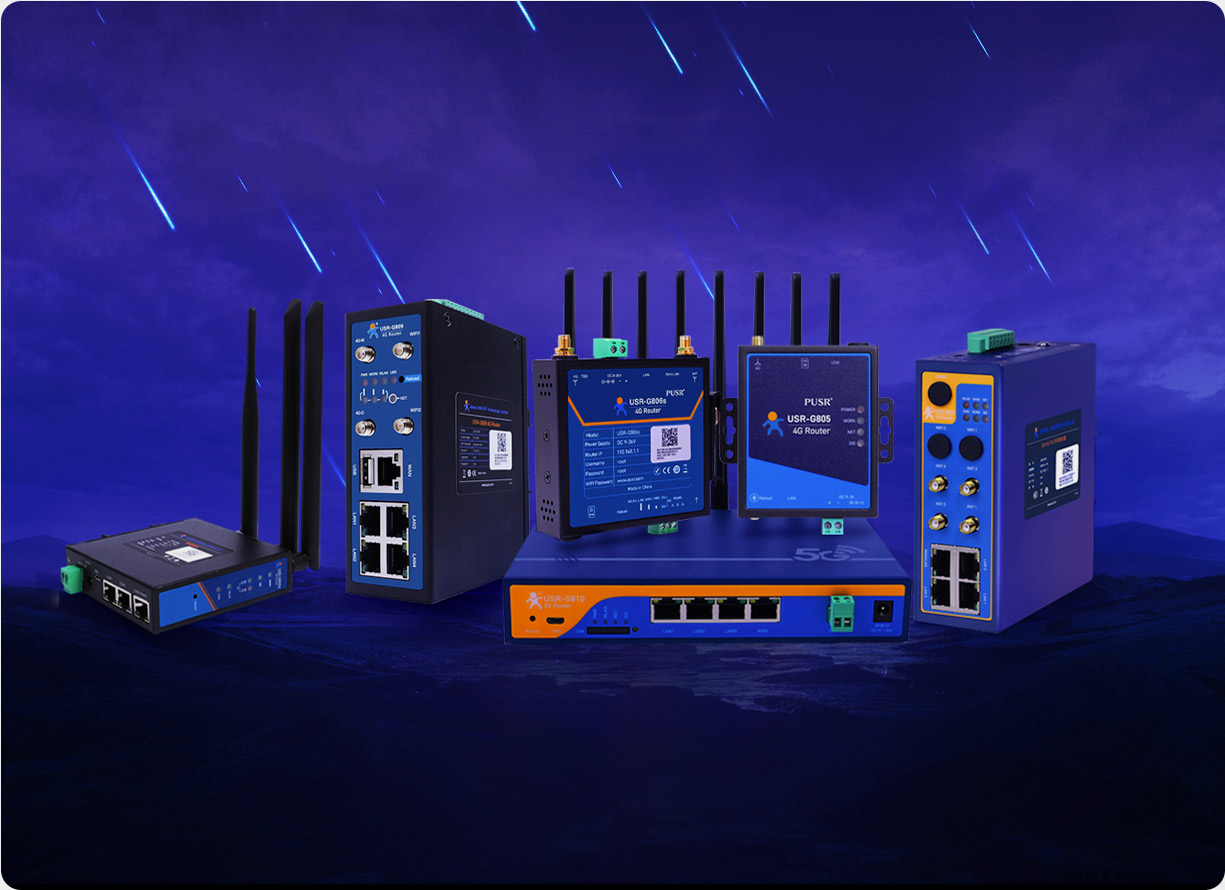
PTP Precision Time Protocol: Through hardware timestamps and transparent clock technology, network transmission delay compensation accuracy is improved to the nanosecond level. The USR-G809s industrial router supports the IEEE 1588v2 protocol, enabling sub-microsecond synchronization across subnets.
GPS/Beidou dual-mode time service: Built-in high-precision atomic clock module maintains synchronization accuracy within 12 hours even during network interruptions. Tests by an aerospace company show that in environments without GPS signals, the clock drift rate of the USR-G809s is only 0.01ppm/day.
Dynamic frequency compensation: By monitoring environmental temperature changes, the crystal oscillator frequency is automatically adjusted. Under extreme temperatures of -40℃ to 85℃, the clock stability of the USR-G809s is improved by 3 orders of magnitude compared to ordinary devices.
The equipment protocol complexity of automobile manufacturing production lines far exceeds that of traditional factories, requiring industrial routers to have:
Protocol parsing engine: Built-in with 20+ industrial protocol libraries such as Modbus TCP/RTU, Profinet, and EtherCAT, with conversion delays <5ms. The USR-G809s uses a quad-core processor to simultaneously handle 128 protocol conversion channels.
Data preprocessing: Data cleaning, compression, and feature extraction are performed on the router's edge side. A 3C assembly line reduced uploaded data volume by 80% and network load by 65% through the edge computing function of the USR-G809s.
Security isolation: Prevent unauthorized device access through VLAN division and IP/MAC binding. The USR-G809s supports IPsec VPN and firewall functions, resisting DDoS attacks and protocol vulnerability exploitation.
In real-time control scenarios of automobile manufacturing, network jitter needs to be controlled within ±50μs. Industrial routers achieve deterministic transmission through the following technologies:
TSN Time-Sensitive Networking: Supports the IEEE 802.1Qbv time-aware shaper, reserving dedicated time slots for critical data. The USR-G809s can provide end-to-end delay guarantees of 100μs.
5G URLLC Ultra-Reliable Low Latency: Under the 3GPP R16 standard, 5G air interface latency can be reduced to 1ms. The USR-G809s supports 5G SA standalone networking,in conjunction with MEC edge computing, enabling localized processing at the production line level.
Dual-link hot backup: Automatic switching time between primary and backup links <20ms. After deploying the USR-G809s, a car welding line achieved 99.999% network availability, with annual downtime <5 minutes.
The USR-G809s industrial router adopts a fully industrial-grade design:
Environmental adaptability: Operating temperature range of -35℃ to 75℃, humidity tolerance of 95%RH, passing the IEC 60068-2-6 vibration test (5Hz to 500Hz, 5g).
Electromagnetic compatibility: Passes the IEC 61000-4-6 radio frequency field induction immunity test (10V/m), maintaining stable operation in strong electromagnetic environments.
Protection level: Standard version with IP30 protection, optional IP67 outdoor version supporting IP67 waterproof and dustproof and -40℃ low-temperature startup.
Core performance indicators of the USR-G809s:
Network performance: 5G actual download speed of 700Mbps, upload speed of 150Mbps; supports dual-band Wi-Fi 6 (AX1800), with a single AP coverage radius of 200 meters.
Interface configuration: 3× Gigabit LAN + 1× Gigabit WAN/LAN, supports RS232/485 serial ports, optional GNSS positioning and eSIM modules.
Edge computing: Quad-core 1.8GHz processor, 512MB DDR4 memory, 8GB eMMC storage, supports Python secondary development.
The USR-G809s has validated its value in multiple automobile manufacturing scenarios:
Welding workshop: In the welding line of a new energy vehicle company, the USR-G809s achieved microsecond-level synchronization of 12 welding robots, reducing the weld rejection rate from 3% to 0.2%, saving over 5 million yuan in rework costs annually.
Final assembly workshop: A joint venture brand's final assembly line reduced the collaboration delay between AGV trolleys and assembly robots from 200ms to 30ms through the TSN network of the USR-G809s, improving overall handling efficiency by 35%.
Painting workshop: In high-temperature and high-humidity environments, the IP67 protection level and anti-corrosion design of the USR-G809s ensured stable communication between painting robots and visual inspection systems, reducing painting defect rates from 1.5% to 0.3%.
Future industrial routers will feature:
Intelligent traffic scheduling: Predict data bursts through machine learning and dynamically adjust QoS strategies.
Predictive maintenance: Predict equipment failures 30 days in advance based on vibration and temperature sensor data.
Digital twins: Create virtual network mirrors in the cloud for configuration optimization and fault simulation.
It is predicted that by 2028, the global industrial router market size will exceed 8 billion US dollars, with the automobile manufacturing sector accounting for 40%. In addition to traditional fuel vehicles, new energy, autonomous driving, and vehicle-road coordination industries will also become major growth points.
The procurement decisions of automobile manufacturing companies are undergoing fundamental changes:
TCO Total Cost of Ownership: Instead of simply comparing device prices, they evaluate maintenance, upgrade, and downtime losses over 5 years.
Ecosystem compatibility: Require routers to support open standards such as OPC UA and MQTT for easy integration with MES and SCADA systems.
Sustainability: Focus on device energy efficiency and carbon footprint. The USR-G809s consumes 40% less power than similar products, meeting ESG requirements.
In the automated production lines of automobile manufacturing, industrial routers have evolved from simple network devices into the "nerve centers" of production systems. Through precision time synchronization, multi-protocol conversion, and deterministic transmission technologies, the USR-G809s is redefining industrial communication standards. When every action of robot clusters can be coordinated with microsecond-level precision, and when production line data can be fed back to the cloud in real-time for intelligent optimization, automobile manufacturing companies can truly achieve the dream of a "lights-out factory"—not as a showcase of technology, but as a return to the essence of manufacturing: using certainty to combat uncertainty and defining competitiveness with precision.