February 28, 2026 Industrial Routers: Digital Key for Smart Mfg. Equipment's Interconnectivity

Industrial Routers: The "Digital Key" to Unraveling the Dilemma of Interconnectivity and Data Transmission in Smart Manufacturing Equipment

In the automated production line of an automotive component factory in Jiangsu, 200 CNC machine tools were trapped in "data islands" due to incompatible protocols. The Profinet protocol of German equipment, the CC-Link protocol of Japanese equipment, and the Modbus protocol of domestic PLCs could not communicate with each other, resulting in a production data acquisition delay of up to 5 seconds and equipment utilization rates below 65%. Similar scenarios are unfolding across 32,000 manufacturing enterprises nationwide: according to the Ministry of Industry and Information Technology, 68% of discrete manufacturing enterprises face equipment interconnectivity barriers, while 43% of process manufacturing enterprises struggle with insufficient real-time data transmission. As smart manufacturing transitions from concept to reality, equipment interconnectivity and real-time data transmission have emerged as a "digital divide" confronting manufacturing enterprises.

1. Tracing the Dilemma: The "Three Gates of Data Transmission" in Smart Manufacturing

1.1 Protocol Barriers: The "Tower of Babel" of Equipment Languages

On the production line of an electronics contract manufacturing factory, German robotic arms use the EtherCAT protocol, Korean visual inspection systems adopt the EtherNet/IP protocol, and domestic AGV trolleys rely on the Modbus TCP protocol. This "multinational equipment" phenomenon necessitates data acquisition through protocol conversion gateways, not only increasing hardware costs but also causing 15%-20% data transmission delays. A case study of a machine tool enterprise revealed that system integration cycles due to protocol incompatibility extended to 8 months, three times longer than scenarios with a single protocol.

1.2 Environmental Constraints: The "Forbidden Zones" of Data Transmission in Industrial Settings

In the reactor monitoring scenario of a chemical enterprise in Shandong, extreme temperatures ranging from -20°C to 80°C and a strong electromagnetic interference environment reduced the mean time between failures (MTBF) of ordinary commercial routers to less than 300 hours. The blast furnace monitoring system of a steel enterprise even experienced data transmission interruptions due to router housing deformation caused by high temperatures. Harsh industrial conditions such as dust, vibration, and salt spray are becoming "invisible killers" of real-time data transmission.

1.3 Security Anxieties: The "Sword of Damocles" Hanging Over Industrial Data

The PLC system of an automotive final assembly line was once infiltrated by malicious code due to unencrypted transmission, resulting in a 12-hour production halt and direct economic losses exceeding RMB 10 million. Data from the National Engineering Research Center for Cybersecurity of Industrial Control Systems indicates a 137% year-on-year increase in industrial cyberattacks in 2024, with 72% targeting data transmission links. As manufacturing enterprises pursue interconnectivity, they are falling into the security paradox of "the more connected, the more vulnerable."

2. The Path to Breakthrough: The "Three-Dimensional Empowerment" of Industrial Router

2.1 Protocol Breakthrough: Creating a "Universal Translator" for Equipment Interconnectivity

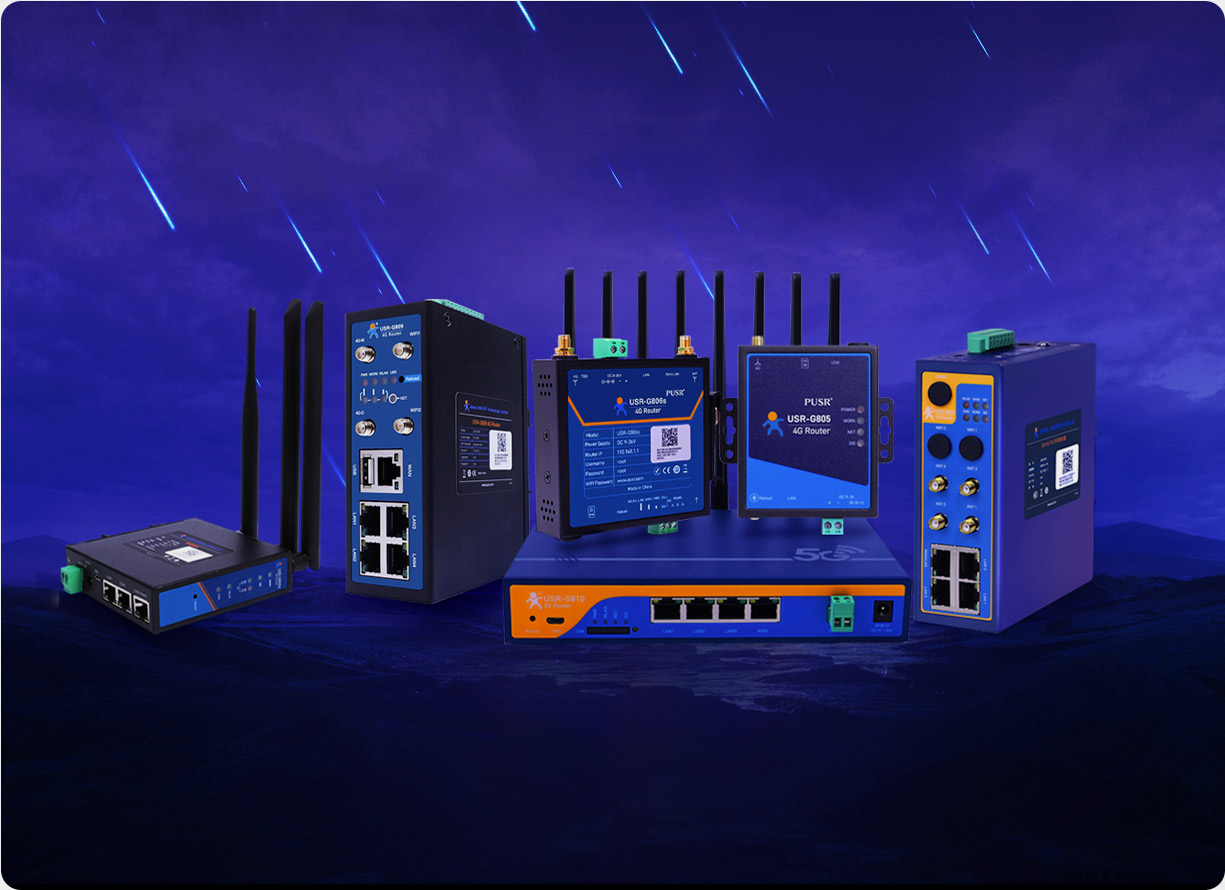
The practices of a home appliance enterprise provide a model for breaking the impasse: by deploying USR-G809s industrial router supporting over 20 industrial protocols, seamless interconnection was achieved among robotic arms (Profinet), injection molding machines (CC-Link), and AGVs (MQTT). The router's built-in protocol auto-adaptation engine compressed protocol conversion time from 500ms in traditional solutions to under 20ms, boosting equipment utilization at an automotive component factory from 65% to 83%.
Technical Analysis:

  • Protocol Library Support: Covers mainstream industrial protocols such as Modbus RTU/TCP, OPC UA, and EtherNet/IP.
  • Dynamic Mapping Technology: Automatically generates protocol conversion rule tables through device fingerprinting.
  • Edge Computing Preprocessing: Performs data cleaning and compression at the router level to reduce cloud load.

2.2 Environmental Adaptation: Forging an "Iron Army" of Data Transmission for Industrial Settings

In the underground monitoring system of a coal mine in Inner Mongolia, USR-G809s industrial router withstood extreme temperature differentials from -40°C to 75°C. Its industrial-grade design incorporates three core technologies:

  • Wide-Temperature Components: Utilizes automotive-grade chips with an operating temperature range extended to -40°C to 85°C.
  • Electromagnetic Compatibility Design: Passes IEC 61000-4-6 Level 3 anti-interference certification, enabling stable operation in 10V/m electromagnetic fields.
  • Protection System: IP67 protection rating combined with anti-salt spray coating adapts to 95% humidity environments.
    The reliability of these routers was validated by a wind power enterprise: at a 4,500-meter altitude wind farm, USR-G809s achieved a 99.99% data transmission success rate, three orders of magnitude higher than traditional solutions.

2.3 Security Reinforcement: Building a "Digital Fortress" for Data Transmission

In response to industrial cyberattacks, USR-G809s adopts a "defense-in-depth" strategy:

  • Transmission Encryption: Supports AES-256 encryption algorithms and IPsec VPN, certified by the National Commercial Cryptography Product Certification.
  • Access Control: Implements device authentication based on digital certificates, coupled with MAC address binding and 802.1X authentication.
  • Security Auditing: Built-in logging system records all data access behaviors and supports integration with SIEM systems.
    A case study of a precision manufacturing enterprise showed that after deploying this solution, industrial cyberattack interception rates increased to 98.7%, and data leakage risks decreased by 90%.

3. Scenario Revolution: The "Value Explosion" of Industrial Router

3.1 Discrete Manufacturing: From "Information Islands" to "Digital Twins"

In a 3C product factory in Suzhou, USR-G809s industrial router connected over 3,000 IoT nodes, enabling:

  • Production Line-Level Interconnectivity: Real-time synchronization of data from robotic arms, visual inspection systems, and AGVs.
  • Millisecond-Level Response: Ensures priority transmission of control instructions with delays <10ms through QoS policies.
  • Predictive Maintenance: Reduces unplanned downtime by 65% through fault prediction models based on equipment operation data.
    This solution elevated the factory's Overall Equipment Effectiveness (OEE) from 68% to 89% while reducing unit production energy consumption by 18%.

3.2 Process Manufacturing: Breaking the "Black Box Production" Dilemma

A chemical enterprise's reactor monitoring system achieved the following through USR-G809s:

  • Multi-Parameter Fusion: Connects over 200 sensors for temperature, pressure, and flow, with a sampling frequency of 100ms/cycle.
  • Edge Decision-Making: Runs PID control algorithms at the router level for local closed-loop control.
  • Safety Early Warning: Provides 2-hour advance warnings of equipment abnormalities through threshold comparison and pattern recognition.
    After system deployment, product quality fluctuation rates decreased by 42%, and safety incident rates dropped by 76%.

3.3 Remote Operations and Maintenance: From "On-Site Repairs" to "Preventive Services"

The global service network of a machine tool manufacturer underwent a qualitative transformation with USR-G809s:

  • Direct Equipment Connection: Enables real-time data acquisition from over 100,000 in-service machines via 4G/5G networks.
  • Remote Diagnosis: Combines AR technology to allow experts to remotely guide on-site repairs, reducing average repair times by 72%.
  • Service Monetization: Generates RMB 230 million in annual revenue by developing predictive maintenance services based on equipment operation data.
    This model reduced customer equipment downtime from 48 hours annually to 12 hours while increasing service satisfaction to 98.6%.

4. Future Prospects: The "Evolution" of Industrial Router

With the integration of technologies such as 5G-A, Time-Sensitive Networking (TSN), and digital twins, industrial router are evolving into "intelligent edge gateways":

  • Time-Sensitive Networking (TSN): Achieves microsecond-level synchronization to meet hard real-time requirements for motion control.
  • AI Empowerment: Incorporates lightweight AI models for intelligent functions such as data anomaly detection and automatic protocol identification.
  • Digital Twin Connector: Serves as a bridge between the physical and digital worlds, supporting real-time updates of equipment digital twins.
    A pilot project on an automotive final assembly line demonstrated that adopting next-generation intelligent routers reduced production line changeover times from 45 minutes to 8 minutes while tripling customization capabilities.

5. The First Principle of Smart Manufacturing: Freedom of Data Transmission

When a home appliance enterprise achieved "data homogeneity and standardized uniformity" across 20 global bases through USR-G809s industrial router, and when a photovoltaic enterprise reduced power plant operation and maintenance costs by 58% using this solution, it became clear: equipment interconnectivity and real-time data transmission are no longer technological options but survival imperatives for smart manufacturing. In this data-driven industrial transformation, industrial router are playing a pivotal role as "digital connectors." They not only establish physical connections between equipment but also construct a "digital highway" for data flow, transforming smart manufacturing from concept to reality and from ideal to industry.

REQUEST A QUOTE
Industrial loT Gateways Ranked First in China by Online Sales for Seven Consecutive Years **Data from China's Industrial IoT Gateways Market Research in 2023 by Frost & Sullivan
Subscribe
Copyright © Jinan USR IOT Technology Limited All Rights Reserved. 鲁ICP备16015649号-5/ Sitemap / Privacy Policy
Reliable products and services around you !
Subscribe
Copyright © Jinan USR IOT Technology Limited All Rights Reserved. 鲁ICP备16015649号-5Privacy Policy