Revolution in Wind Farm Operation and Maintenance: How Industrial VPN Router Crack the Dilemma of Wind Turbine Monitoring and Usher in a New Era of Predictive Maintenance
Deep in the Xilingol Grassland of Inner Mongolia, Wang, the operation and maintenance supervisor of a wind farm, is staring at the monitoring screen with a furrowed brow: On the screen, the vibration data of Wind Turbine No. 12 suddenly soars to the warning level. However, when he retrieves the historical data, he finds that the data has fluctuated abnormally over the past three months without triggering any alerts. Meanwhile, at another wind farm in the Gobi Desert of Hami, Xinjiang, the operation and maintenance team is braving the 40°C heat and driving 200 kilometers just to confirm whether a "gearbox temperature anomaly" reported by a wind turbine is a genuine fault or a sensor false alarm. These scenarios are a microcosm of the current state of operation and maintenance in Chinese wind farms: With an installed capacity exceeding 400 million kilowatts, how to achieve "precise monitoring and early warning" for tens of thousands of wind turbines scattered across deserts, plateaus, and islands has become a key proposition for the industry's transition from "scale expansion" to "quality and efficiency."
Traditional wind farms rely on SCADA systems for centralized monitoring, but due to limitations in network bandwidth and transmission delays, data update frequencies are generally 5-15 minutes per cycle. According to statistics from a wind power group, 68% of faults in its wind farms are recorded by the system 30 minutes after they occur, while the fault development cycle for key components of wind turbines (such as gearboxes and generators) is typically only 2-4 hours. This lag directly leads to:
Minor faults escalating into major accidents: A wind farm failed to timely monitor micro-cracks in a blade, and three months later, the cracks expanded, causing the blade to fracture and resulting in direct losses exceeding 2 million yuan.
A surge in unplanned downtime: According to State Power Investment Corporation, unplanned downtime caused by monitoring lag accounts for 42% of annual downtime, resulting in an annual loss of 1.5 billion kilowatt-hours of generated electricity.
Soaring maintenance costs: Emergency maintenance costs are 3-5 times higher than planned maintenance costs. One wind farm exceeded its annual maintenance budget by 80% due to sudden faults.
Wind farms generate terabytes of data every day, but traditional systems can only process structured data (such as temperature and rotational speed), with less than 10% utilization of unstructured data like vibration and sound. More critically, different wind turbine manufacturers use varying data formats and communication protocols, leading to:
Difficulties in cross-platform analysis: When integrating data from 10 wind farms, a wind power group had to develop 23 protocol conversion interfaces, taking 18 months.
Inefficient fault pattern recognition: Traditional threshold alarms can only detect 30% of known faults and are helpless against 70% of early anomalies.
Difficulties in knowledge accumulation: Operation and maintenance experience relies on individuals. After a senior engineer left a wind farm, the time to handle similar faults increased from 2 hours to 8 hours.
The average distribution radius of Chinese wind farms reaches 50 kilometers, with the cost of a single operation and maintenance visit in remote areas (including transportation and accommodation) exceeding 5,000 yuan. Morely, there are:
Skills gaps among personnel: Young operation and maintenance personnel have insufficient understanding of the fault characteristics of older models (such as doubly-fed wind turbines), with a misjudgment rate of 25% in one wind farm.
High safety risks: Work at heights and extreme weather conditions result in an operation and maintenance accident rate three times higher than in other industries, with three fatal accidents occurring in one enterprise in the past three years.
Diseconomies of scale: When the number of wind farms exceeds 20, the management costs of traditional operation and maintenance models grow exponentially, with the operation and maintenance cost ratio of one group soaring from 15% to 28%.
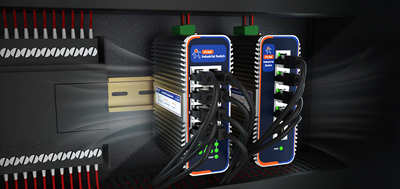
Industrial VPN router achieve millisecond-level data collection through three technological breakthroughs:
Edge computing capabilities: Equipped with high-performance processors (e.g., the USR-G806w uses an ARM Cortex-A72 architecture), they can complete data cleaning and feature extraction locally. Tests at one wind farm show that data processing delays are reduced from 3 seconds to 80 milliseconds.
Multi-protocol support: Compatible with over 20 industrial protocols such as Modbus, IEC 61850, and OPC UA, one enterprise improved data integration efficiency by 70% by standardizing protocols.
High-precision synchronization: Supporting the IEEE 1588 Precision Time Protocol ensures that time stamp errors for data from multiple wind turbines are less than 1μs, providing an accurate basis for vibration analysis.
The communication environment in wind farms is complex, ranging from strong electromagnetic interference inside towers to sandstorms in the Gobi Desert and high salt spray on islands. Industrial VPN routers address these challenges through four designs:
Industrial-grade protection: With an IP67 protection rating (e.g., the USR-G806w), they are dustproof and waterproof. Field tests at an offshore wind farm show that device lifespan in salt spray environments is extended from 3 years to 8 years.
Anti-interference design: Metal casings and electromagnetic shielding layers can resist 100V/m electromagnetic interference. Tests at a wind farm near a substation show that data packet loss rates are reduced from 15% to 0.2%.
Multi-network redundancy: Supporting 5G/4G/fiber/LoRa multi-link backup, one Gobi wind farm improved its online rate from 92% to 99.9% by adopting a "fiber main link + 5G backup" approach.
Wide temperature operation: With a working range of -40°C to 75°C, they cover all climate zones in China. One wind farm in Heilongjiang operates stably at -35°C.
Industrial VPN routers are not just data channels but also gateways to intelligent analysis:
AI model deployment: Supporting lightweight AI frameworks like TensorFlow Lite, they can run vibration analysis, temperature prediction, and other models locally. One wind farm improved the accuracy of gearbox fault prediction from 65% to 92% by deploying an LSTM model.
Knowledge graph construction: Structuring fault characteristics, maintenance records, and equipment profiles, one enterprise reduced fault location time from 2 hours to 15 minutes through knowledge graphs.
Digital twin integration: Interacting in real-time with digital twins of wind turbines, one wind farm compressed the time to formulate maintenance plans from 4 hours to 30 minutes by simulating equipment states under different operating conditions.
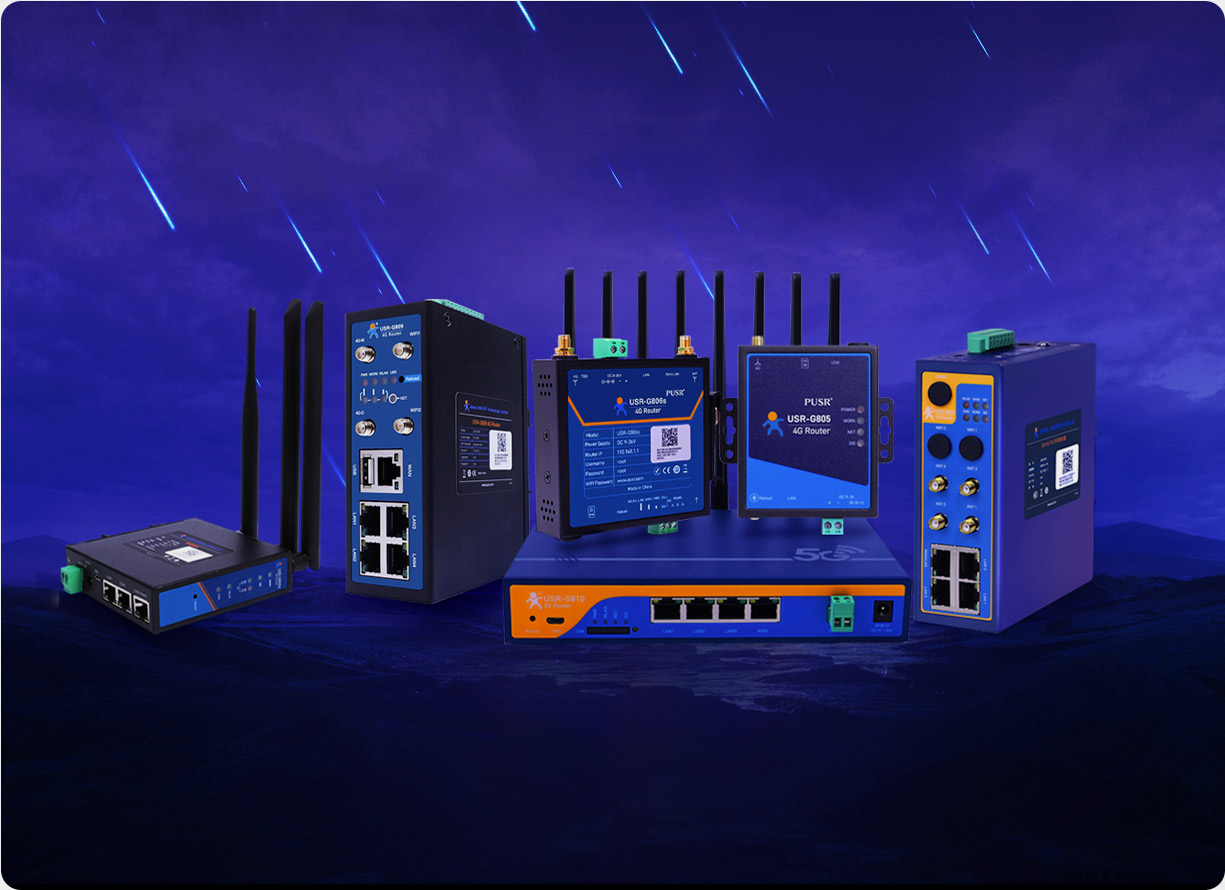
Among numerous industrial VPN routers, the USR-G806w stands out as the preferred choice for wind farms due to five characteristics:
Superior environmental adaptability: With IP67 protection and a metal casing, it adapts to harsh environments such as sand, salt spray, and strong electromagnetic fields. After deployment at an offshore wind farm, the device failure rate dropped from 1.2 times per month to 0.1 times.
Low-latency communication: Supporting 5G SA mode, it achieves end-to-end delays of less than 20ms, meeting real-time requirements for pitch control. Tests at one wind farm show that pitch response time is shortened from 100ms to 35ms.
Edge AI capabilities: Equipped with an NPU accelerator, it can run lightweight AI models. One enterprise reduced the false alarm rate from 30% to 5% by deploying a vibration analysis algorithm on it.
Security protection: Supporting national cryptographic SM2/SM4 encryption and passing Level 3 certification under the Cybersecurity Classification Protection 2.0 standard, one wind farm reduced the risk of data leakage by 95% when transmitting dispatch instructions using it.
Simplified operation and maintenance: Through the Youren Cloud Platform, it enables remote configuration and firmware upgrades. One group reduced its operation and maintenance personnel by 40% and saved 800,000 yuan in annual operation and maintenance costs per farm.
The predictive maintenance system supported by industrial VPN routers enables:
Remaining useful life prediction: By analyzing vibration, temperature, and other data, it predicts the remaining useful life of key components such as gearboxes and generators. One wind farm optimized its spare parts inventory based on this, reducing capital occupation by 35%.
Health assessment: Establishing an equipment health index (PHM), one enterprise reduced the proportion of high-risk equipment from 18% to 5% through health grading management.
Maintenance window optimization: By intelligently scheduling maintenance times based on power generation plans, weather forecasts, and other data, one wind farm reduced unplanned downtime by 60% and increased annual power generation by 2.3%.
Data collected by industrial VPN routers can be used to build operation and maintenance resource scheduling models:
Intelligent task assignment: Automatically allocating tasks based on fault type, location, and skill requirements, one enterprise shortened operation and maintenance response times from 2 hours to 40 minutes using this feature.
Route planning: Optimizing inspection routes by combining Geographic Information System (GIS) data, one wind farm reduced inspection mileage by 35% and vehicle fuel consumption by 22%.
Skill inheritance: Transforming expert experience into decision rules, one enterprise tripled the fault handling efficiency of new employees through a knowledge base.
Data collected by industrial VPN routers can be transformed into value-added services:
Carbon trading support: By accurately monitoring power generation, equipment efficiency, and other data, it provides credible evidence for carbon trading. One wind farm increased its annual carbon revenue by 1.2 million yuan.
Insurance pricing reference: Providing equipment health data to insurance companies to lower premium rates, one enterprise reduced its premiums by 15% through data sharing.
Performance benchmarking services: Establishing a benchmarking database for wind farm performance to provide clients with comparative analysis, one consulting firm increased its annual revenue by 5 million yuan using this service.
As wind turbines in Jiuquan, Gansu, rotate day and night in the Gobi Desert, and those in Pingtan, Fujian, continuously generate electricity in the sea breeze, industrial VPN routers are silently safeguarding the "hearts" of these clean energy sources. They are not just channels for data transmission but also the cornerstone of intelligent operation and maintenance. By constructing a closed-loop system of "real-time perception-intelligent analysis-precise decision-making," they enable wind farms to transition from "passive emergency repairs" to "proactive prevention" and from "scale expansion" to "quality and efficiency." This is not just a technological upgrade but also the wind power industry's most resolute response to the "dual carbon" goals: empowering every wind turbine with digital technology and ensuring that every kilowatt-hour of electricity carries the promise of sustainable development.