Guide to Avoiding Pitfalls in IoT Router Selection: A Practical Comparison of 4G and 5G in Smart Manufacturing Scenarios
In the wave of smart manufacturing, zero production line downtime, real-time data interaction, and collaborative equipment operation have become core indicators of a company's competitiveness. However, when engineers face the decision-making process of selecting between 4G and 5G IoT routers, they often find themselves lost in the fog of "technical parameter sheets": Is the millisecond-level latency of 5G truly necessary? Can the mature 4G solutions meet the demands? Is the high cost of 5G worth it? This article will unveil the logic behind the selection through a practical comparison of three major technical bottlenecks, helping companies avoid "technical traps" and find the most suitable solution for their specific scenarios.
In the stamping workshop of an automotive parts company, the production line built a decade ago faced difficulties in connecting equipment to the network due to the lack of reserved network cables. Redoing the cabling would result in a loss of hundreds of thousands of yuan for a single day of production halt. Initially, the company chose an ordinary IoT router, attempting to achieve data transmission through a 4G network, but encountered three fatal issues:
Signal attenuation due to metal interference: The dense steel structure in the workshop caused the 4G signal strength to plummet from -60 dBm to -110 dBm, resulting in frequent equipment disconnections.
Interface loosening caused by vibrations: The vibrations from the stamping equipment caused the Ethernet port crystal heads of the router to loosen, requiring manual plugging and unplugging three times a month.
Overheating due to dust intrusion: Metal dust accumulated at the router's cooling vents, causing the device temperature to frequently exceed 70°C and triggering protective shutdowns.
These scenarios are not isolated cases. In smart manufacturing, the real need of companies is not just to "connect equipment" but to do so "stably, in real-time, and securely." The cost of a poor selection often leads to production line shutdowns, data loss, soaring maintenance costs, and even impacts on order delivery.
In the AGV scheduling system of a smart factory, 50 AGVs need to receive task instructions and feedback location information in real-time. If a 4G network is used, the end-to-end latency typically ranges between 50-100 ms, leading to a "lag effect" in AGV path planning: When two AGVs meet at an intersection, the delayed instructions may cause both to attempt to turn simultaneously, increasing the risk of collision. In contrast, 5G networks compress latency to 1-10 ms through edge computing and network slicing technologies, enabling synchronized "instruction-execution" responses.
Practical Data Comparison4G Solution: An AGV manufacturing company initially used 4G routers. As the number of devices increased to 60, scheduling latency rose by 30%, and the failure rate increased by 15%.
5G Solution: After switching to 5G routers, a single device could stably support over 200 equipment connections, with latency reduced to within 5 ms, significantly improving AGV operation smoothness.
4G Suitable Scenarios: Monitoring and data collection scenarios with low real-time requirements (e.g., environmental sensors, non-critical equipment status monitoring).
5G Suitable Scenarios: Scenarios requiring millisecond-level responses, such as AGV scheduling, robot collaboration, and remote control.
In the automated operations of a port container terminal, quayside cranes need to operate stably in environments with salt spray corrosion, strong electromagnetic interference, and frequent movement. The initially adopted 4G routers, due to insufficient protection levels, encountered the following issues:
Salt spray corrosion: Rust on the casing, oxidation of interfaces, and white salt crystal formation on the PCB board.
Electromagnetic interference: Transient electromagnetic pulses generated by high-frequency welding caused signal interruptions.
Mobile switching: Brief network interruptions occurred when the equipment moved within the port area due to base station switching, affecting control instruction transmission.
Practical Solutions
4G Optimization Solution: Using IP67-rated routers, applying three-proof treatment (moisture, mold, and salt spray resistance) to the PCB board, and adding metal shielding covers; however, costs increased by 40%, and electromagnetic interference issues were not completely resolved.
5G Solution: 5G routers enhance signal penetration and anti-interference capabilities through millimeter-wave technology and Massive MIMO antenna arrays; they also support dual-SIM card intelligent backup, enabling millisecond-level switching to a backup link when the primary card signal is interrupted.
Selection Recommendations
4G Suitable Scenarios: Indoor scenarios with mild environments and minimal interference (e.g., offices, light industrial workshops).
5G Suitable Scenarios: Extreme environments such as ports, mines, and power plants, or core production processes with extremely high stability requirements.
Scenario Challenge: Economic Viability of Large-Scale Equipment Connections
A smart city project required connecting over 1,000 smart streetlights. If a 5G solution was adopted, it would necessitate the construction of dedicated base stations and incur high data traffic costs; while the 4G solution, although lower in cost, suffered from insufficient bandwidth, causing video surveillance footage to stutter and affecting urban management efficiency.
| Cost Item | 4G Solution (USR-G806w) | 5G Solution (USR-G816) |
| Hardware Cost | 40%-60% Lower | Higher |
| Network Construction Cost | No private network required | Base station construction or private network leasing required |
| Operation and Maintenance Cost | Lower | Higher (requires professional team) |
| Long-Term Benefits | Meets basic needs | Supports value-added applications such as AI analysis and predictive maintenance |
Selection Recommendations
4G Suitable Scenarios: Scenarios with limited budgets, fewer devices, and low demand for value-added functions.
5G Suitable Scenarios: Scenarios with a large number of devices, requiring long-term operational optimization, and planning to deploy AI or big data analytics.
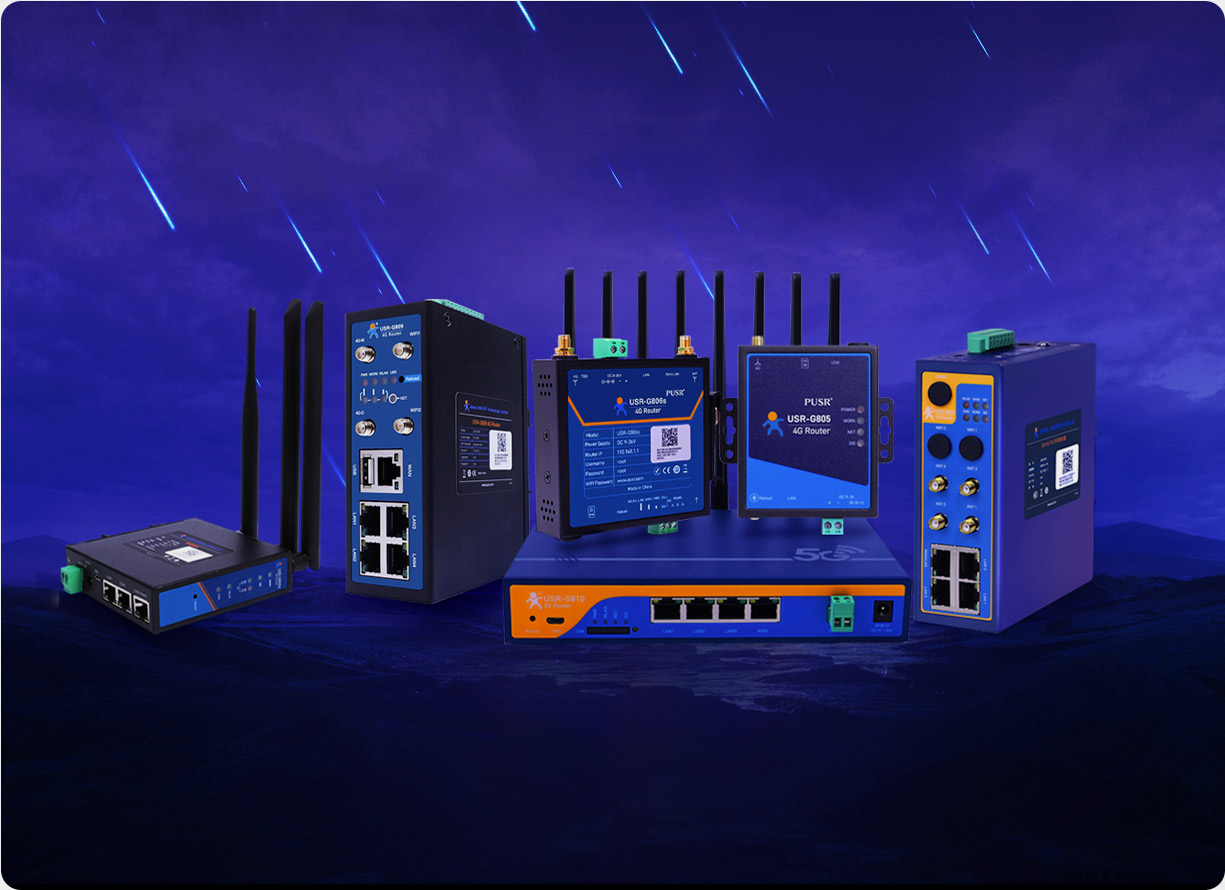
Product Recommendations: The Practical Value of USR-G806w and USR-G816
Core Advantages:
Stable and reliable: IP30 protection rating, wide temperature and voltage design, adaptable to environments from -20°C to +70°C.
Flexible networking: Supports 4G/Wi-Fi/wired multi-network backup to avoid single points of failure.
Cost-optimized: Hardware costs are 40%-60% lower than 5G, suitable for budget-sensitive scenarios.
Typical Scenarios:
Connecting equipment in stamping workshops (resolving metal interference and vibration issues).
Data backhaul from base stations in remote areas (replacing wired networks and reducing construction costs).
Core Advantages:
Millisecond-level latency: Supports 5G SA/NSA networking with latency as low as 1 ms.
Large-capacity connections: A single device can stably support over 200 equipment connections.
High reliability: Dual-SIM card intelligent backup ensures continuous link operation.
Typical Scenarios:
AGV scheduling and robot collaboration (achieving millisecond-level responses).
Automated operations at ports (resisting salt spray corrosion and electromagnetic interference).
In smart manufacturing, 4G and 5G are not opposing forces but complementary tools. Companies should follow the "scenario-driven" principle when making selections:
If the scenario has extremely high requirements for real-time performance and stability and has sufficient budget, 5G is the better choice.
If the scenario primarily involves basic monitoring and data collection and requires cost control, 4G still offers good cost-effectiveness.
Ultimately, the success of selection lies not in piling up technical parameters but in precisely matching production needs and resolving the company's real pain points. As the head of a smart factory once said, "We don't need the fastest network; we just need the network to be always online when we need it."