Is the traffic of industrial LTE router exceeding the limit? In-depth Analysis of Time-Period-Based Traffic Control Strategy Configuration
In today's rapid development of the Industrial Internet of Things (IIoT), as the core hub for device networking, the traffic management capability of industrial LTE router directly impacts production efficiency and data security. However, in field deployments, issues such as network congestion, data delays, and even device disconnections often arise due to traffic exceeding limits, with 80% of failures stemming from improper configuration of traffic control strategies. This article provides an in-depth analysis from four perspectives: pain points in industrial scenarios, principles of time-period-based traffic control, configuration methods, and case applications, offering enterprises a systematic solution to help build an efficient and stable industrial communication network.
In smart manufacturing scenarios, devices such as PLCs, sensors, and robots on production lines need to upload data to the MES system in real time. If all devices transmit data simultaneously during daytime production peaks, the traffic surge may exceed the router's outlet bandwidth, leading to packet loss and communication interruptions. For example, a certain automobile manufacturing plant, lacking traffic control configuration, experienced a surge in network delay from 50ms to 3 seconds when equipment in the welding workshop started up simultaneously, causing welding robots to malfunction and resulting in annual losses exceeding one million yuan.
In industrial networks, non-critical services such as video surveillance and remote maintenance often consume a large amount of bandwidth, while critical services like equipment status monitoring and control commands fail to transmit in a timely manner due to insufficient bandwidth. A certain chemical enterprise's SCADA system once experienced a 10-minute delay in real-time data collection due to employees downloading large files via VPN during non-working hours, nearly causing a safety accident.
Multinational enterprises need to achieve 24-hour uninterrupted production, but simultaneous operation of equipment in different time zones may lead to traffic overlap. For example, a certain photovoltaic enterprise's European plant and Asian headquarters are interconnected via VPN. When equipment in Europe uploads data during the day (Asia's nighttime), the nighttime backup tasks at the Asian headquarters are frequently interrupted due to insufficient bandwidth, compromising data integrity.
By dividing a day into multiple time periods (such as production peaks, maintenance troughs, and nighttime backup periods) and allocating independent bandwidth quotas for each period, dynamic traffic allocation is achieved. Its technical implementation relies on the router's traffic policing (CAR) and queue scheduling (QoS) mechanisms:
Traffic Policing (CAR): Drops or limits the speed of data packets exceeding the bandwidth quota for a specific time period to ensure traffic does not exceed limits.
Queue Scheduling (QoS): Places data packets of different priorities into different queues, with high-priority queues (such as control commands) being forwarded first during traffic congestion.
Division by Business Type: Allocate production data transmission, video surveillance, remote maintenance, and other services to different time periods to avoid business conflicts.
Division by Device Type: Set exclusive time periods for devices such as PLCs, sensors, and robots to ensure bandwidth for critical equipment.
Division by Geographic Location: Allocate independent time periods for devices in different workshops to avoid cross-workshop traffic interference.
By configuring a traffic burst buffer, traffic that briefly exceeds the time-period quota is allowed to pass, preventing communication interruptions due to instantaneous traffic surges. For example, a certain steel enterprise sets the buffer to 20% of the time-period quota. When the instantaneous traffic exceeds the quota during equipment startup, the buffer can absorb the excess traffic, ensuring stable communication.
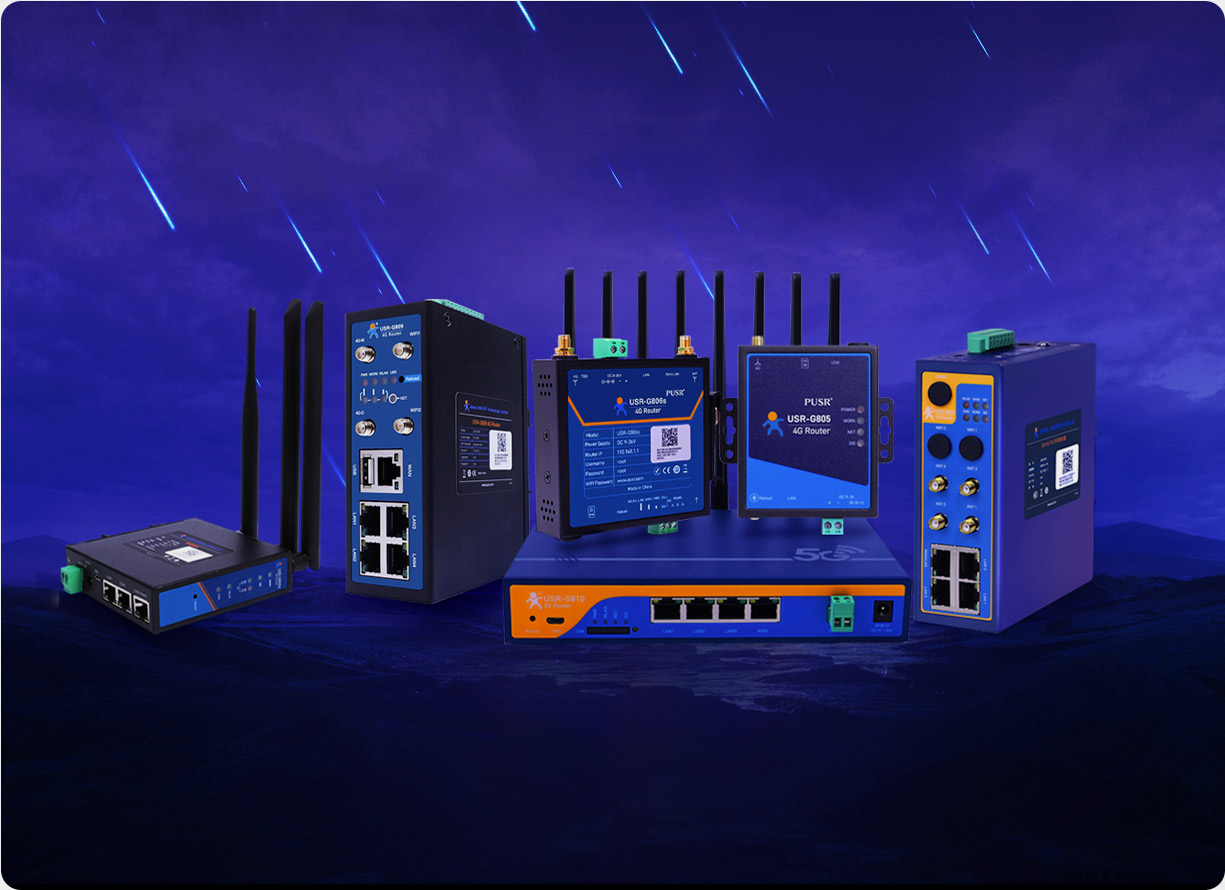
While addressing the issue of traffic exceeding limits, enterprises need to choose an industrial LTE router with high-precision traffic control capabilities. The USR-G809s, as a 4G routing gateway designed specifically for industrial scenarios, offers the following advantages in its time-period-based traffic control function:
The management interface of the USR-G809s supports custom time-period division, allowing users to set multiple time periods according to production plans (such as "08:00-12:00 Production Peak," "12:00-13:00 Lunch Break Trough," "13:00-18:00 Production Peak," and "18:00-08:00 Nighttime Backup") and allocate independent bandwidth quotas for each period. For example, setting the bandwidth for production peaks at 10Mbps and for nighttime backups at 2Mbps ensures that critical services receive priority resources.
The USR-G809s supports QoS policies based on port, IP address, and protocol type, allowing high-priority queues to be set for critical services (such as Modbus TCP control commands) to ensure priority forwarding during traffic congestion. For example, a certain photovoltaic enterprise set the priority of PLC control commands to "highest" through QoS policy configuration, ensuring that the delay of control commands remained below 50ms even when the network load reached 90%.
The USR-G809s has built-in traffic statistics functionality, displaying real-time traffic usage for each time period and generating visual reports through the U-iot Cloud platform. Users can view network status anytime via mobile phones or PCs, promptly detecting traffic anomalies. For example, a certain chemical enterprise discovered abnormal traffic from a device during nighttime backups through monitoring. After investigation, it was found that the device had been misconfigured to operate around the clock, and timely adjustments saved 30% of bandwidth costs.
The USR-G809s adopts an industrial-grade design with the following characteristics:
Wide Temperature Operation: Supports environmental temperatures from -20°C to 70°C, adapting to high-temperature workshops and low-temperature warehouses;
Wide Voltage Power Supply: Supports DC 9-36V input, adapting to voltage fluctuations in industrial sites;
Multiple Protections: Built-in electrostatic protection (IEC 61000-4-2 Level 3), surge protection (IEC 61000-4-5 Level 3), and pulse group protection (IEC 61000-4-4 Level 3), ensuring stable operation in environments with severe electromagnetic interference.
Pain Point: The 20 PLCs and 50 sensors on the production line need to upload data to the MES system in real time, but traffic exceeding limits during daytime production peaks causes data delays, affecting production rhythm.
Solution:
Configure time-period-based traffic control: Divide the day into "08:00-18:00 Production Peak (bandwidth 10Mbps)" and "18:00-08:00 Maintenance Trough (bandwidth 2Mbps)";
Set QoS policy: Set the priority of PLC control commands to "highest" to ensure their bandwidth;
Deploy USR-G809s: Monitor traffic usage in real time through the U-iot Cloud platform and adjust quotas promptly.
Effect: Data delay during production peaks decreased from 3 seconds to 50ms, saving annual downtime losses exceeding 2 million yuan.
Pain Point: Globally distributed photovoltaic power stations need to upload power generation data to the headquarters in real time, but simultaneous uploads from power stations in different time zones cause network congestion at the headquarters, compromising data integrity.
Solution:
Configure cross-time-zone time-period-based traffic control: Allocate independent upload time periods for power stations in Europe, Asia, and the Americas (such as Europe 08:00-10:00, Asia 10:00-12:00, and the Americas 12:00-14:00);
Set traffic burst buffer: Allow traffic that briefly exceeds the quota to pass, avoiding instantaneous congestion;
Deploy USR-G809s: Achieve stable transmission via 4G networks and support dual-SIM redundancy backup.
Effect: Data integrity increased from 90% to 99.9%, and maintenance efficiency improved by 40%.
The issue of traffic exceeding limits in industrial LTE routers is essentially a contradiction between resource allocation and business demands. The time-period-based traffic control strategy, through its "time-division scheduling and dynamic allocation" mechanism, provides enterprises with a low-cost and high-efficiency solution. The USR-G809s industrial LTE router, with its flexible time-period configuration, powerful QoS scheduling capability, and industrial-grade reliability, becomes the preferred choice for enterprises to build a stable industrial communication network.
Immediately consult about the USR-G809s industrial LTE router to obtain a customized traffic control solution, allowing your industrial network to bid farewell to traffic exceeding limits and focus on core business growth!