December 15, 2025
Is there an abnormality in the serial port service of the cellular wifi router
Is there an abnormality in the serial port service of the cellular wifi router? In-depth Analysis of Key Points for Selecting RS485/232 Conversion Modules
In today's world where industrial automation and the Internet of Things (IoT) are deeply integrated, the cellular wifi router serves as the core hub for device networking. The stability of its serial port service directly impacts critical aspects such as production data acquisition and remote equipment control. However, in field deployments, abnormalities such as serial port communication interruptions, data garbling, and protocol incompatibility frequently occur, with 80% of the failures stemming from improper selection of RS485/RS232 conversion modules. This article provides systematic guidance for enterprises from three perspectives: technical principles, key selection points, and failure case studies with solutions, aiming to assist in constructing a highly reliable industrial communication network.
1. Core Pain Points of Industrial Serial Port Communication: Why Do Conversion Modules Become "Invisible Killers"?
1.1 Data Distortion Caused by Electromagnetic Interference
Industrial sites are filled with strong interference sources such as frequency converters, servo motors, and high-voltage cables. RS232, which uses single-ended signal transmission, has weak anti-interference capabilities, leading to a soaring bit error rate when transmitting over distances exceeding 10 meters. Although RS485's differential balanced transmission technology can resist common-mode interference, if the conversion module lacks isolation circuitry, interference can still infiltrate through power or signal lines, causing communication interruptions. For example, in the welding workshop of an automobile manufacturing plant, the failure to use an isolated conversion module resulted in frequent packet loss between the PLC and robot controller, leading to production line shutdowns and losses of up to 50,000 yuan per hour.
1.2 Device "Disconnection" Due to Protocol Incompatibility RS232 and RS485 have fundamental differences in electrical characteristics and communication protocols. Directly mixing them can cause logical inversions (e.g., the logical "0" in RS232 corresponds to the A>B voltage in RS485). In a monitoring system of a photovoltaic power station, mistakenly connecting RS232 devices directly to an RS485 bus caused the bus to collapse, resulting in a 12-hour interruption of data acquisition across the entire station.
1.3 Signal Reflection Caused by Topological Defects RS485 buses must strictly adhere to the principle of terminal resistance matching (120Ω matching resistor). If not configured or configured incorrectly, signal reflections at the bus ends can form standing waves, leading to shortened communication distances and a sharp increase in bit error rates. In the SCADA system of a chemical enterprise, the failure to install terminal resistors on a 1200-meter-long bus reduced the communication rate from 100kbps to 30kbps, with data update delays exceeding 5 seconds.
2. Five Core Points for Selecting RS485/232 Conversion Modules
2.1 Isolation Strength: The "Lifeline" in Industrial Scenarios
Key Indicators: Isolation withstand voltage (≥3000Vrms), isolation type (opto-isolator/magnetic isolation). Selection Recommendations:
For scenarios with severe electromagnetic interference (e.g., power and metallurgy): Prioritize opto-isolator modules with withstand voltages meeting the IEC 61000-4-5 standard Level 3 (8kV contact discharge/15kV air discharge).
For high-precision control scenarios (e.g., semiconductor manufacturing): Choose magnetic isolation modules with lower transmission delays (<10ns) to avoid signal distortion. Case Study: After adopting the MOXA UPort 485I isolated module in the blast furnace monitoring system of a steel enterprise, the communication bit error rate dropped from 10-4 to 10-9, and the annual failure rate decreased by 90%.
2.2 Protection Level: The "Protective Shield" for Extreme Environments
Key Indicators: ESD protection (contact discharge ≥8kV/air discharge ≥15kV), surge protection (withstanding 6kV under a 10/700μs waveform), and pulse group protection (IEC 61000-4-4 Level 3). Selection Recommendations:
For outdoor or explosive environments: Choose modules with an IP67 protection rating, providing dustproof, waterproof, and corrosion-resistant capabilities.
For lightning-prone areas: Select modules with built-in gas discharge tubes (GDT), which have three times the surge withstand capability of TVS diodes. Data: In a wind farm, deploying unprotected conversion modules inside the tower led to a 40% equipment damage rate due to lightning strikes; after switching to lightning-proof modules, the damage rate dropped to 2%.
2.3 Protocol Compatibility: Breaking Down Device "Language Barriers"
Key Indicators: Supported protocols (Modbus RTU/ASCII, Profibus-DP, DNP3, etc.), baud rate range (1200bps-115200bps), and adjustable data bits/stop bits/parity bits. Selection Recommendations:
For retrofitting old equipment: Choose modules that support custom protocols, allowing simulation of the original communication format through configuration software.
For mixed use of equipment from multiple brands: Select modules with powerful protocol conversion capabilities (e.g., supporting Modbus RTU to TCP/IP conversion) to achieve interconnection of heterogeneous networks. Case Study: A water utility group connected 200 smart water meters from different manufacturers to a monitoring system via an RS485 bus. By using conversion modules that supported automatic Modbus protocol mapping, the debugging time was reduced from 2 weeks to 3 days.
2.4 Topological Flexibility: The "Transformer" for Complex Wiring
Key Indicators: Number of bus nodes (standard RS485 supports 32 nodes, extended versions up to 128 nodes), branch length (≤3 meters), and repeater functionality. Selection Recommendations:
For large factories: Choose modules with repeater functionality to extend communication distances through cascading (each repeater can extend by 1200 meters).
For mobile device access: Select modules that support star topologies to avoid network-wide failures caused by a single node failure in bus topologies. Data: A logistics warehouse reduced its communication network cable length from 5 kilometers to 2 kilometers and cut costs by 60% by using conversion modules with repeater functionality.
2.5 Diagnostic Functions: The "Black Box" for Rapid Fault Location
Key Indicators: LED indicators (TX/RX/Power status), self-diagnostic functions (bus short-circuit/open-circuit alarms), and log recording (communication records saved for ≥30 days). Selection Recommendations:
For unattended scenarios: Choose modules that support SMS/email alarms to push fault information in real-time.
During the debugging phase: Select modules with debugging interfaces to monitor bus voltage, current, and other parameters in real-time via PC software. Case Study: By deploying conversion modules with self-diagnostic functions in an oil field SCADA system, the fault location time was reduced from 4 hours to 10 minutes, and annual operation and maintenance costs decreased by 500,000 yuan.
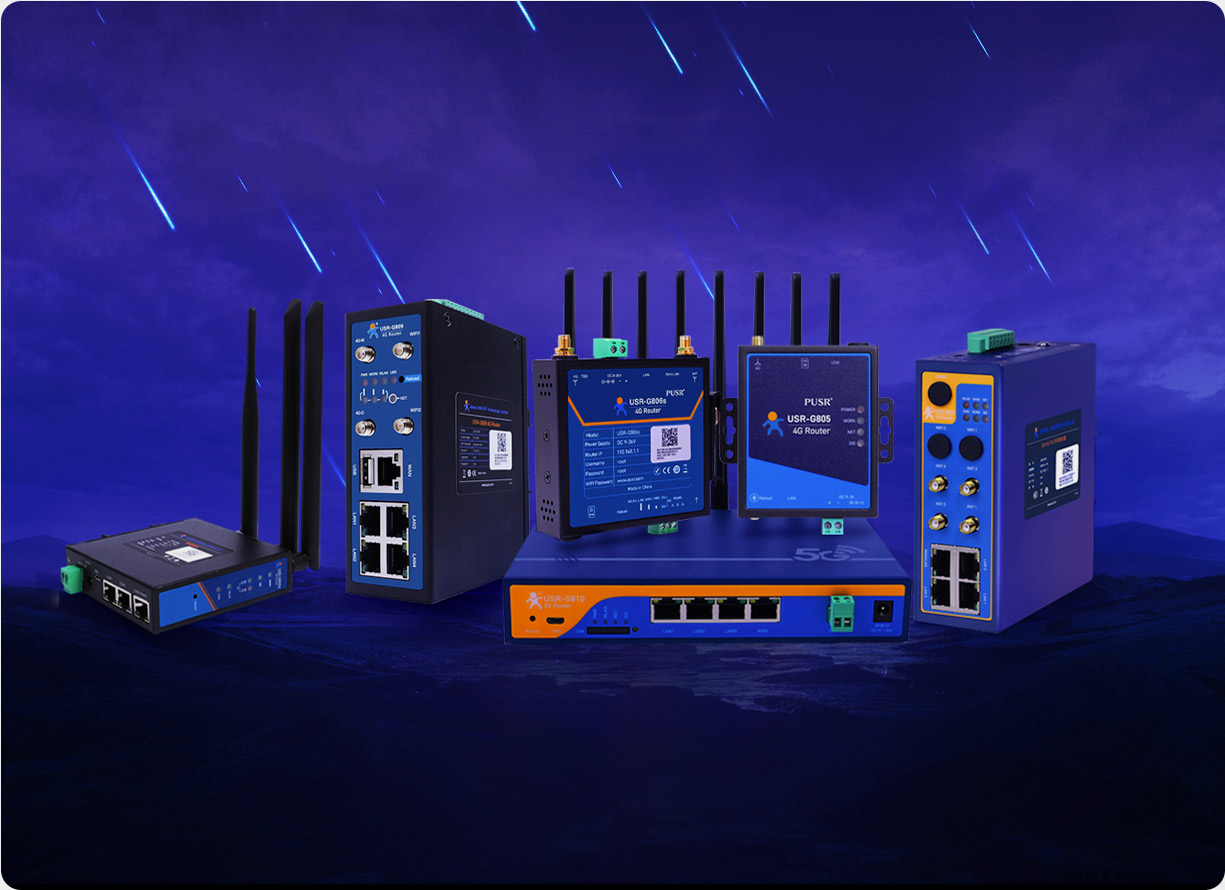
3. USR-G809s Cellular Wifi Router: The "All-in-One Manager" for Serial Port Services
While addressing serial port communication abnormalities, enterprises must also consider the overall stability of the cellular wifi router. The USR-G809s, a 4G routing gateway designed specifically for industrial scenarios, integrates RS232/RS485 serial ports, Ethernet, Wi-Fi, DI/DO control, and other functions into one device. Its serial port service module strictly adheres to the aforementioned selection criteria:
Isolation Protection: Built-in opto-isolator circuitry with a 3000Vrms isolation withstand voltage, passing the IEC 61000-4-5 Level 3 lightning protection certification.
Protocol Support: Supports automatic Modbus RTU/TCP conversion, with a baud rate range of 1200bps-230400bps, compatible with 99% of industrial equipment.
Topology Optimization: Supports 485 bus automatic direction control (ADCM), eliminating the need for additional terminal resistor configuration.
Intelligent Diagnostics: Real-time monitoring of serial port status via the USR Cloud platform, automatic SMS alarms upon fault occurrence, and triggering DO relays for emergency braking. Typical Application Scenarios:
Smart Agriculture: Connect soil moisture sensors, weather stations, and other RS485 devices via the USR-G809s to upload data to the cloud platform for precision irrigation.
Smart Manufacturing: Deploy the USR-G809s in CNC machines and robots to enable remote program burning and fault diagnosis via RS232 interfaces.
Energy Management: Connect smart meters and gas meters to the USR-G809s via an RS485 bus to build an energy monitoring network, reducing energy consumption by over 15%.
4. Selection Is Not the Endpoint; Stability Is the Goal
The stability of the cellular wifi router's serial port service is the "last mile" of device networking. Enterprises must comprehensively evaluate conversion modules from five dimensions: isolation strength, protection level, protocol compatibility, topological flexibility, and diagnostic functions, to avoid communication failures caused by improper selection. The USR-G809s cellular wifi router, with its all-in-one functionality and high-reliability design, provides enterprises with a one-stop serial port communication solution, helping to build an efficient and stable industrial IoT. Immediately consult about the USR-G809s cellular wifi router to obtain a customized network deployment plan, enabling your industrial communication to bid farewell to abnormalities and focus on core business growth!
Industrial loT Gateways Ranked First in China by Online Sales for Seven Consecutive Years **Data from China's Industrial IoT Gateways Market Research in 2023 by Frost & Sullivan
We use cookies to ensure that we give you the best
experience on our website. If you continue to use this site we will assume that you are happy with it.