February 23, 2026
Key Design of Industrial Switches Passing MT2099 Explosion-Proof Certification
Smart Mine Underground Communication: Key Design of Industrial Switches Passing MT2099 Explosion-Proof Certification - A Way Out of the Dilemma
In the wave of smart mines, underground communication systems, like the "nerve network" of mines, bear the core missions of data transmission, equipment linkage, and safety warnings. However, as 5G private networks, IoT devices, and intelligent technologies advance deep underground, a hidden pain point emerges like a reef - explosion-proof certification. For mining enterprises, it's not just a compliance "entry ticket" but a life-and-death line concerning personnel safety, equipment security, and production continuity. This article takes MT2099 explosion-proof certification as a starting point, analyzes the key design logic of industrial switche in underground communication, addresses customers' deep-seated pain points in technology selection, safety concerns, and cost trade-offs, and offers practical solutions.
1. Unspoken Customer Pains: Three Dilemmas Behind Explosion-Proof Certification
1.1 Safety Anxiety: Every Signal Interruption Is a Life-and-Death Game
The underground environment is an "extreme laboratory" - explosive mixtures of gas and coal dust, high humidity and strong corrosive gases, and roadway deformation caused by ground pressure. These factors make traditional communication equipment in mines like "time bombs." A large coal mine once had a local gas explosion due to insufficient explosion-proof rating of a switch at the mining face, resulting in 3 injuries and equipment damage exceeding 5 million yuan. Such accidents have made mining enterprises attach unprecedented importance to explosion-proof certification. However, there's still a cognitive gap between "meeting standards" and "true safety." Customers worry not only about whether equipment passes certification but also about its ability to operate continuously and stably under complex conditions to avoid chain reactions caused by signal interruptions or equipment failures.
1.2 Technology Fog: The "Impossible Trinity" of Explosion-Proof Design and Communication Performance
The essence of explosion-proof certification is to isolate electrical sparks from explosive environments through structural, material, and circuit designs. However, this goal often conflicts with the core performance of industrial switches:
Heat Dissipation: Explosion-proof enclosures need to be sealed, but heat generated by high-power chip operation, if not dissipated in time, can cause device shutdown.
Signal Attenuation: Metal explosion-proof enclosures shield wireless signals, affecting the penetration of high-frequency communications like 5G/Wi-Fi.
Size Limitations: Underground space is narrow, requiring compact equipment design. But explosion-proof structures often demand larger sizes to accommodate explosion-proof chambers. Customers face a dilemma when selecting equipment: choosing high explosion-proof rated devices may sacrifice communication stability; choosing high-performance devices may fail to pass certification. This "can't-have-it-all" situation makes technology decisions extremely difficult.
1.3 Cost Black Hole: Dual Pressures of Certification Cycle and Hidden Expenses
The explosion-proof certification process is complex and costly. Taking the MT2099 standard as an example, equipment needs to go through type testing, factory inspection, and document review, with a certification cycle of 6 - 12 months. Direct costs (testing fees, inspection fees) account for 10% - 15% of equipment R&D costs. More hidden are indirect costs: if the initial certification fails, rectification requires re-submission for inspection, potentially doubling time costs and technology investments. Additionally, explosion-proof equipment maintenance requires professional teams, further increasing the total lifecycle cost. With limited budgets, customers often delay technology upgrades due to "fear of trouble" or "fear of overspending," missing the window for intelligent transformation.
2. A Way Out: Key Design Logic under MT2099 Certification
To address the above pain points, industrial switch design should target the "safety-performance-cost" golden triangle and achieve a dynamic balance through technological innovation. The following analyzes the core design logic for passing MT2099 certification from four dimensions: structure, material, circuit, and system.
2.1 Structural Innovation: A "Contradictory Unity" of Explosion-Proof and Heat Dissipation
The core of explosion-proof design is the "explosion-proof chamber," which isolates electrical components from explosive environments using high-strength metal enclosures, preventing external gas ignition even if internal electrical sparks occur. However, traditional explosion-proof structures have two major flaws: large size and poor heat dissipation. A brand of industrial switches breaks this dilemma with "modular explosion-proof + phase-change heat dissipation" technology:
Modular Design: Modules such as power supply, main control, and interfaces are independently packaged, each equipped with an independent explosion-proof chamber. This reduces the size of individual modules and lowers the risk of fault propagation.
Phase-Change Heat Dissipation Material: Graphene composite phase-change material is filled inside the explosion-proof chamber. When the chip temperature rises, the material absorbs heat and undergoes a phase change (solid to liquid),导出 (conducting) heat out through the heat dissipation fins on the chamber surface. Heat dissipation efficiency is 3 times higher than traditional air cooling. Such design enables the equipment to meet MT2099 explosion-proof requirements while operating stably for long periods in high-temperature environments up to 60°C, suitable for high-temperature scenarios like underground mining faces and transportation roadways.
2.2 Material Revolution: From "Passive Explosion-Proof" to "Active Explosion Suppression"
Traditional explosion-proof materials (such as aluminum alloy and stainless steel) resist explosion impacts with high strength but are heavy and costly. New-generation industrial switches use "lightweight + explosion-suppressing" composite materials:
Carbon Fiber Reinforced Composite Material: It's 40% lighter than aluminum alloy but has 2 times higher impact resistance, suitable for scenarios with strong underground vibrations (such as near tunneling machines).
Nano Explosion-Suppressing Coating: Nano-scale ceramic coating is sprayed on the inner wall of metal enclosures. When internal electrical sparks occur, the coating absorbs energy and suppresses flame propagation, reducing explosion risk by 80%. A mining enterprise's test shows that switches using such materials have no deformation on the enclosure and intact internal circuits in coal dust explosion tests, while traditional equipment has cracks on the enclosure.
2.3 Circuit Optimization: A "Double Insurance" of Low Power Consumption and High Reliability
Underground power supply systems are complex with frequent voltage fluctuations. If switch power consumption is too high, it may cause fires due to overloading; if circuit design is unreliable, it may generate electrical sparks due to short circuits. MT2099 certification requires equipment to have "intrinsic safety" characteristics, limiting circuit energy to ensure that no energy sufficient to ignite explosive gases is generated under any fault conditions. Key designs include:
Wide Voltage Input Technology: Supports DC12 - 48V wide voltage input, adapting to different underground power supply scenarios (such as batteries and generators), preventing equipment damage due to voltage instability.
Multi-Level Protection Circuit: Integrates over-voltage, over-current, surge, and electrostatic discharge (ESD) protection. The single-port surge protection level reaches 6000V, far exceeding industry standards.
Low Power Consumption Chip: Uses an ARM Cortex-A53 quad-core processor, with power consumption 60% lower than traditional x86 chips. Combined with intelligent sleep technology, power consumption can drop below 5W during idle times. Such design enables the equipment to meet explosion-proof requirements while reducing annual power consumption by over 3000 degrees compared to traditional equipment, directly lowering operating costs.
2.4 System Collaboration: From "Single-Point Explosion-Proof" to "Full-Chain Safety"
MT2099 certification not only focuses on the equipment itself but also requires it to work in coordination with the entire communication system to avoid safety risks caused by network interruptions or data leaks. Key designs include:
Redundant Networking Technology: Supports the ERPS ring network protocol, automatically switching to a backup path within 50ms in case of link failures, ensuring "zero-interruption" communication.
Encrypted Data Transmission: Uses the AES-256 encryption algorithm to end-to-end encrypt sensitive data such as underground equipment status and environmental parameters, preventing illegal interception or tampering.
Remote Operation and Maintenance Platform: Monitors equipment temperature, humidity, voltage, and other parameters in real-time through a cloud platform, providing early warnings of potential faults, reducing underground inspection frequencies, and lowering personnel safety risks. After deploying such a system, a coal mine has seen a 90% drop in underground communication failures, a 50% increase in equipment maintenance efficiency, and a reduction in annual downtime from 72 hours to 8 hours.
3. USR-ISG Industrial Switch: A "Balance Master" of Explosion-Proof Certification and Performance
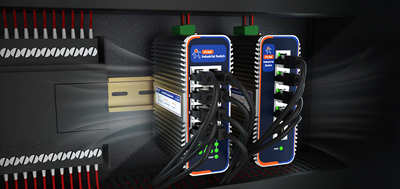
Among the industrial switches passing MT2099 certification, the USR-ISG series stands out with its "full-scenario adaptability and high cost-effectiveness." Its core advantages are:
Full-Scenario Explosion-Proof Ratings: Offers dual-certified models of ExdIMb (explosion-proof type) and ExibIMb (intrinsic safety type), suitable for different risk areas such as mining faces, transportation roadways, and substations.
The "Golden Ratio" of Performance and Cost: Features gigabit speed, -40°C - 85°C wide temperature range, and PoE power supply functions, but is 30% cheaper than international brands with a certification cycle shortened to 4 months.
"Turnkey" Service: Provides full-process support from scheme design, equipment installation to operation and maintenance training, eliminating the need for customers to build their own explosion-proof technology teams. A gold mine case is representative: The mine originally used switches from an international brand but was ordered to rectify by the safety supervision department due to insufficient explosion-proof ratings. After switching to USR-ISG, it not only passed MT2099 certification but also reduced underground monitoring latency from 200ms to 50ms through ring network redundancy design, enabling precise control of unmanned mining vehicles and increasing annual output by 15%.
4. Explosion-Proof Certification Is Not the End but the Starting Point of Intelligence
For mining enterprises, MT2099 explosion-proof certification is the "safety bottom line" for underground communication, but the real value lies in building an efficient, reliable, and intelligent communication network through certified equipment. When industrial switches no longer compromise performance due to explosion-proof designs and safety anxieties turn into technology trust, the "nerve network" of smart mines can truly operate smoothly. At this point, customers will no longer focus on "whether equipment is explosion-proof" but on "how to achieve production efficiency improvements through explosion-proof equipment" - this is the ultimate mission of technology breakers.
Industrial loT Gateways Ranked First in China by Online Sales for Seven Consecutive Years **Data from China's Industrial IoT Gateways Market Research in 2023 by Frost & Sullivan
We use cookies to ensure that we give you the best
experience on our website. If you continue to use this site we will assume that you are happy with it.