Lightning Protection Design Standards for Cellular Router: In-Depth Analysis of Survivability under 8kV Surge Impact
In today's era of rapid development in the industrial internet and smart manufacturing, cellular router serve as critical hubs for connecting devices and transmitting data, with their stability directly determining the continuity and safety of production lines. However, lightning, as the most destructive electromagnetic interference source in nature, accounts for over 30% of industrial equipment damage cases caused by lightning strikes each year, with router failures due to inadequate lightning protection design being particularly prominent. This article will provide an in-depth analysis of the logic behind building lightning protection capabilities for cellular router from dimensions such as lightning protection design standards, 8kV surge impact testing principles, typical failure scenarios, and solutions, helping enterprises mitigate risks and achieve worry-free production.
Surge pulses generated by lightning can infiltrate cellular router through three paths:
Power Line Coupling: High voltage induced by lightning is conducted through power lines to the interior of the router, directly breaking down the power module;
Signal Line Induction: Signal lines such as twisted pairs and coaxial cables generate transient overvoltages during lightning strikes, damaging LAN/WAN interfaces;
Antenna Radiation: The antenna of a router deployed outdoors receives the electromagnetic field from lightning, introducing interference through the radio frequency circuit.
A case study from an automobile manufacturing plant is highly representative: The routers on its production line, lacking signal surge protectors, experienced LAN interface burnout due to overvoltage induced by twisted pairs during a thunderstorm, causing a 2-hour shutdown of the entire line and direct economic losses exceeding 500,000 yuan.
The lightning protection design of cellular router must meet two core objectives:
Hardware Protection: Ensure that the device is not damaged under an 8kV surge impact, with key components (such as power modules and communication interfaces) functioning normally;
Data Continuity: Maintain network connectivity under lightning interference, avoiding data interruption or loss, and ensuring that production processes are unaffected.
The IEC 61000-4-5 standard developed by the International Electrotechnical Commission (IEC) serves as the authoritative basis for lightning protection testing of industrial equipment, with core parameters including:
Voltage Waveform: 1.2/50μs (rise time of 1.2 microseconds, half-peak time of 50 microseconds), simulating high voltage induced by lightning;
Current Waveform: 8/20μs (rise time of 8 microseconds, half-peak time of 20 microseconds), simulating lightning strike current impact;
Testing Levels: Industrial equipment typically needs to pass 4kV (communication ports) and 6kV (power ports) tests, while high-demand scenarios (such as outdoor base stations) require reaching 8kV.
Testing involves injecting simulated lightning strike pulses into router ports using a surge generator, divided into two modes: line-to-line (differential mode) and line-to-ground (common mode). Each port must withstand at least 5 positive/negative polarity impacts. Performance criteria are divided into four categories:
Class A: The device functions completely normally;
Class B: Function is temporarily lost but can recover automatically;
Class C: Recovery requires manual intervention (such as restarting);
Class D: Device damage or data loss (unqualified).
Actual testing data from a third-party testing institution shows that under an 8kV common mode impact, a router without lightning protection design has a residual voltage at the LAN interface as high as 6.2kV, far exceeding its tolerance threshold (usually 1.5kV), resulting in interface chip burnout; while a router optimized for lightning protection can control the residual voltage within 0.8kV, fully meeting Class A standards.
The lightning protection design of cellular router needs to establish a "three-level protection system":
First Level (Power Inlet): Use gas discharge tubes (GDT) or metal oxide varistors (MOV) to discharge most of the surge energy;
Second Level (Interface Circuit): Use transient voltage suppressor diodes (TVS) or semiconductor discharge tubes (TSS) to further clamp the residual voltage;
Third Level (Chip Level): Suppress high-frequency interference through components such as magnetic beads and common-mode inductors to protect core chips.
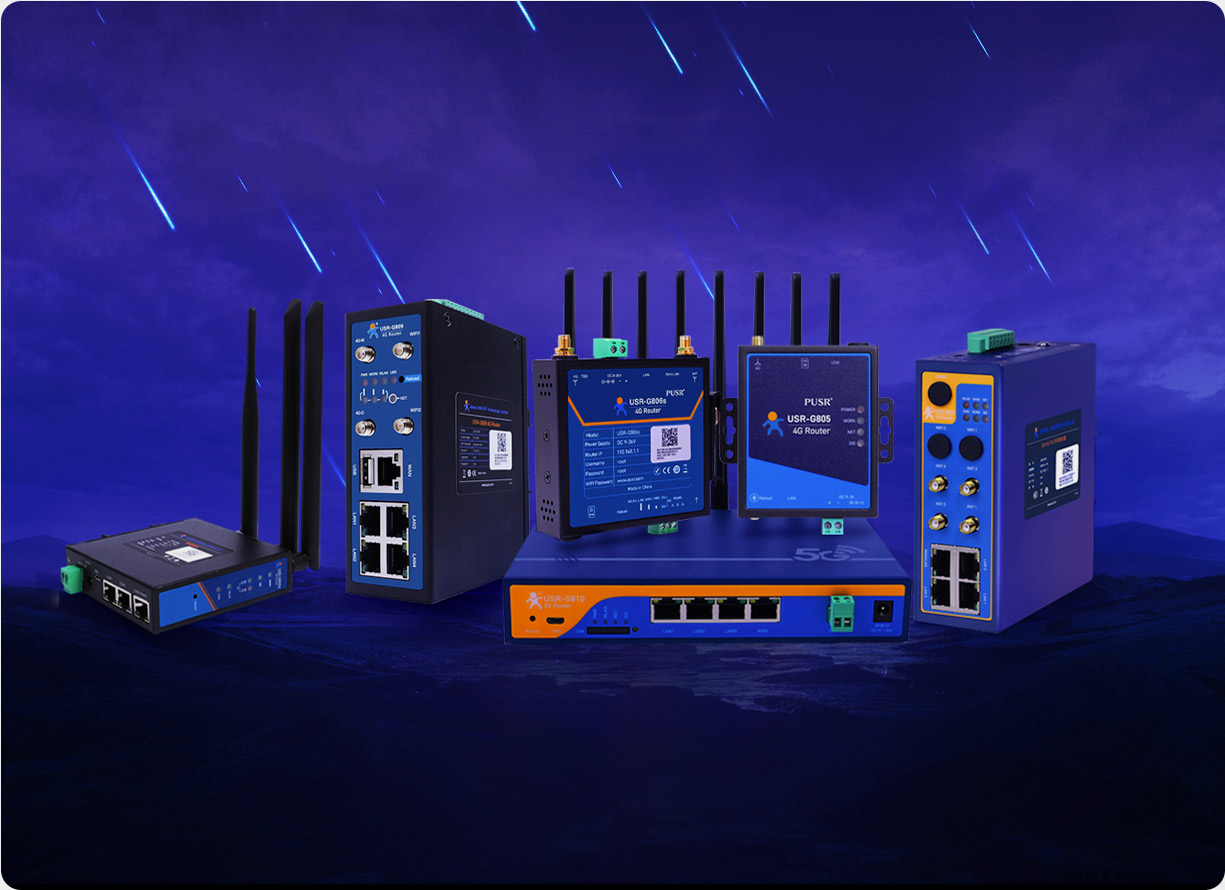
Taking the USR-G806w cellular router as an example, its power module adopts a three-level protection of GDT+MOV+TVS, with a residual voltage of only 0.7kV in an 8kV surge test, far below the industry average (1.2kV), ensuring zero damage to the power circuit.
Grounding is a critical aspect of lightning protection design and must meet the following requirements:
Independent Grounding Electrode: Avoid sharing grounding with the building's lightning protection system to prevent ground potential counterattacks;
Equipotential Bonding: Connect the metal casing, rack, grounding wires, etc., of the router through copper bars to eliminate potential differences;
Low-Impedance Grounding: The grounding resistance must be ≤4Ω to ensure rapid discharge of surge currents.
Practice at a chemical enterprise shows that by optimizing the grounding system (reducing the grounding resistance from 10Ω to 2Ω), the failure rate of routers during lightning strikes drops from 3 times per month to zero, reducing annual maintenance costs by 80%.
The lightning protection of signal lines requires selecting dedicated protection devices based on the transmission medium:
Network Signals (RJ45): Use network signal surge protectors that support 1000Mbps transmission rates with insertion loss ≤0.5dB;
Control Signals (RS485/RS232): Use lightning protection modules with dual protection for differential and common modes, matching ±12V voltage levels;
Antenna Interfaces (SMA/N-type): Install antenna feed signal surge protectors with working frequency bands covering LTE/5G and a voltage standing wave ratio <1.2:1.
The LAN port of the USR-G806w is equipped with a built-in network signal surge protector, with an insertion loss of only 0.3dB under an 8kV common mode impact, ensuring zero packet loss in data transmission.
The USR-G806w cellular router is designed specifically for harsh environments, with its lightning protection capabilities passing multiple authoritative certifications:
Power Port: 8kV surge impact test (IEC 61000-4-5), residual voltage 0.7kV, meeting Class A standards;
Signal Port: LAN port supports 6kV surge protection, WAN port supports 4kV protection, both passing third-party testing;
Electrostatic Protection: Contact discharge ±8kV, air discharge ±15kV, adapting to high-dust and strong electrostatic scenarios.
In addition to lightning protection capabilities, the USR-G806w also optimizes several key characteristics for industrial scenarios:
Wide Temperature Design: Operating temperature range of -40℃ to 75℃, adapting to extreme environments such as outdoors and workshops;
Dual-Link Backup: Supports intelligent switching among 4G/wired/WiFi networks, with network recovery time <2 seconds;
Remote Operation and Maintenance: Realizes device status monitoring, parameter configuration, and firmware upgrades through the U-IoT Cloud platform, reducing on-site maintenance costs.
Smart Warehousing: After deploying the USR-G806w, a logistics enterprise reduced the number of communication interruptions of AGV trolleys during thunderstorms from 5 times per month to zero, improving scheduling efficiency by 40%;
Energy Monitoring: Through the lightning protection design of the USR-G806w, a photovoltaic power plant improved the stability of inverter data transmission by 90%, reducing annual power generation losses by 150,000 kWh;
Smart Manufacturing: A automobile parts factory utilized the VLAN function of the USR-G806w to isolate quality inspection equipment from the production line network, reducing the failure rate caused by data congestion by 70%.
In the era of the industrial internet, lightning protection design is no longer just a "compliance item" to meet standards but also a "value-added item" that enhances device reliability, reduces operation and maintenance costs, and ensures production safety. The USR-G806w cellular router, through technical paths such as a multi-level protection architecture, optimized grounding system, and specialized signal line protection, constructs a full-scenario protection system ranging from 8kV surge impacts to daily electrostatic interference, providing industrial customers with a promise of "zero lightning strike losses."