Load Balancing Strategy for Industrial Router with Multiple WAN Ports: How to Optimize Multi-Link Bandwidth Utilization?
In today's rapid development of the Industrial Internet of Things (IIoT), enterprise demand for network bandwidth has evolved from "just enough" to "efficient utilization." Industrial router with multiple WAN ports aggregate the bandwidth of multiple broadband lines into a "virtual high-speed channel" through load balancing technology, becoming a core solution to address pain points in industrial scenarios such as bandwidth bottlenecks, network redundancy, and cross-operator access latency. However, if improperly configured, multi-WAN routers may fall into traps like "failed bandwidth aggregation, single-link congestion, and cross-network access lag." This article will deeply analyze how to maximize multi-link bandwidth utilization through load balancing strategies from three dimensions—technical principles, strategy optimization, and practical cases—and recommend a battle-tested industrial-grade solution: the USR-G806w.
Traditional single-WAN routers are limited by the bandwidth ceiling of a single broadband line (e.g., 100Mbps fiber). In contrast, multi-WAN routers, through load balancing technology, can aggregate the bandwidth of multiple broadband lines (e.g., 100Mbps fiber + 50Mbps 4G) into a "virtual total bandwidth" of 150Mbps. For example, a manufacturing enterprise's remote monitoring system for CNC machines requires simultaneous transmission of multiple high-definition video streams. Single-link bandwidth insufficiency caused stuttering, but after deploying a dual-WAN router and enabling bandwidth proportion-based load balancing, the total bandwidth increased to 180Mbps, improving video transmission smoothness by 60%.
In industrial scenarios, network interruptions can lead to severe consequences such as production line shutdowns and equipment malfunctions. The failover function of multi-WAN routers automatically switches to a backup link (e.g., 4G) when the primary link fails (e.g., fiber is severed), ensuring business continuity. Test data from an auto parts factory showed that the USR-G806w switched to a 4G backup link in just 2 seconds during a simulated fiber outage, with no impact on production line data flow.
Domestic network interconnections between different operators (Telecom, Unicom, Mobile) have bandwidth bottlenecks, resulting in high latency and packet loss for cross-network access. The ISP routing function of multi-WAN routers intelligently identifies the operator to which the target IP of a data packet belongs and automatically selects the corresponding line for forwarding. For example, a chain retail enterprise's stores accessed Telecom and Unicom broadband via a dual-WAN router. After enabling ISP routing, video stream latency when accessing Telecom servers dropped from 120ms to 35ms, and inventory management system response speed improved by 40%.
Root Cause: The TCP/IP protocol restricts a single network connection (e.g., a webpage load or a video stream) to transmission via only one path. Thus, multi-WAN ports cannot increase single-task speed but can optimize total bandwidth utilization in multi-user/multi-task scenarios.
Optimization Solution:
Scenario Adaptation: Multi-WAN ports offer limited value for single-user light internet use (e.g., web browsing only) but significantly enhance experiences in multi-person households, small offices, or P2P download scenarios (e.g., Thunder, BT).
Policy-Based Routing: Fix latency-sensitive applications (e.g., gaming, video conferencing) to low-latency lines. For example, force traffic to Tencent gaming servers to use Telecom lines to avoid cross-network latency.
Root Cause: If traffic is not allocated based on bandwidth proportions, high-speed lines may be underutilized while low-speed lines become overloaded. For example, using an "equal distribution" strategy for a 100Mbps fiber and a 10Mbps 4G line results in fiber bandwidth utilization below 50% and frequent packet loss on the 4G line due to overload.
Optimization Solution:
Bandwidth Proportion-Based Load Balancing: Set weights according to the actual bandwidth of each WAN port (e.g., fiber:4G = 10:1) to ensure high-speed lines handle more traffic. A logistics enterprise's warehouse management system improved fiber bandwidth utilization to 90% and kept 4G bandwidth utilization below 70% using this strategy, enhancing data synchronization efficiency by 35%.
Connection Count Balancing: Allocate traffic based on connection counts, suitable for scenarios with significant connection count differences. For example, a smart agriculture project used connection count balancing to assign sensor data (high connection count) to the 4G line and surveillance video (low connection count) to the fiber, preventing latency increases on the 4G line due to excessive connections.
Root Cause: Multi-WAN routers must simultaneously handle traffic distribution, NAT translation, and line status detection, requiring high CPU and memory performance. Low-end routers may experience a more than 50% drop in forwarding performance when multi-WAN is enabled.
Optimization Solution:
Hardware Selection: Choose models supporting hardware NAT acceleration and dual-core CPUs or higher (e.g., the USR-G806w uses dual Qualcomm chips, improving anti-interference by 50% and enhancing WiFi signal penetration).
Simplified Networking: Avoid mixing different line types (e.g., fiber + 4G + ADSL). If mixing is unavoidable, use 4G only for failover, not load balancing.
Root Cause: Without priority settings for critical business (e.g., ERP systems, video conferencing), they may be crowded out by non-critical business like P2P downloads.
Optimization Solution:
Smart QoS: Set priority queues based on application types (web, gaming, video) to ensure critical business bandwidth. For example, a manufacturing enterprise set ERP system traffic priority to the highest level, maintaining stable ERP response speeds even during large file downloads by other departments.
Host Bandwidth Control: Limit bandwidth upper limits for non-critical devices (e.g., employee mobile phones). For example, restrict each device's maximum downstream bandwidth to 2Mbps to prevent individual devices from consuming excessive resources.
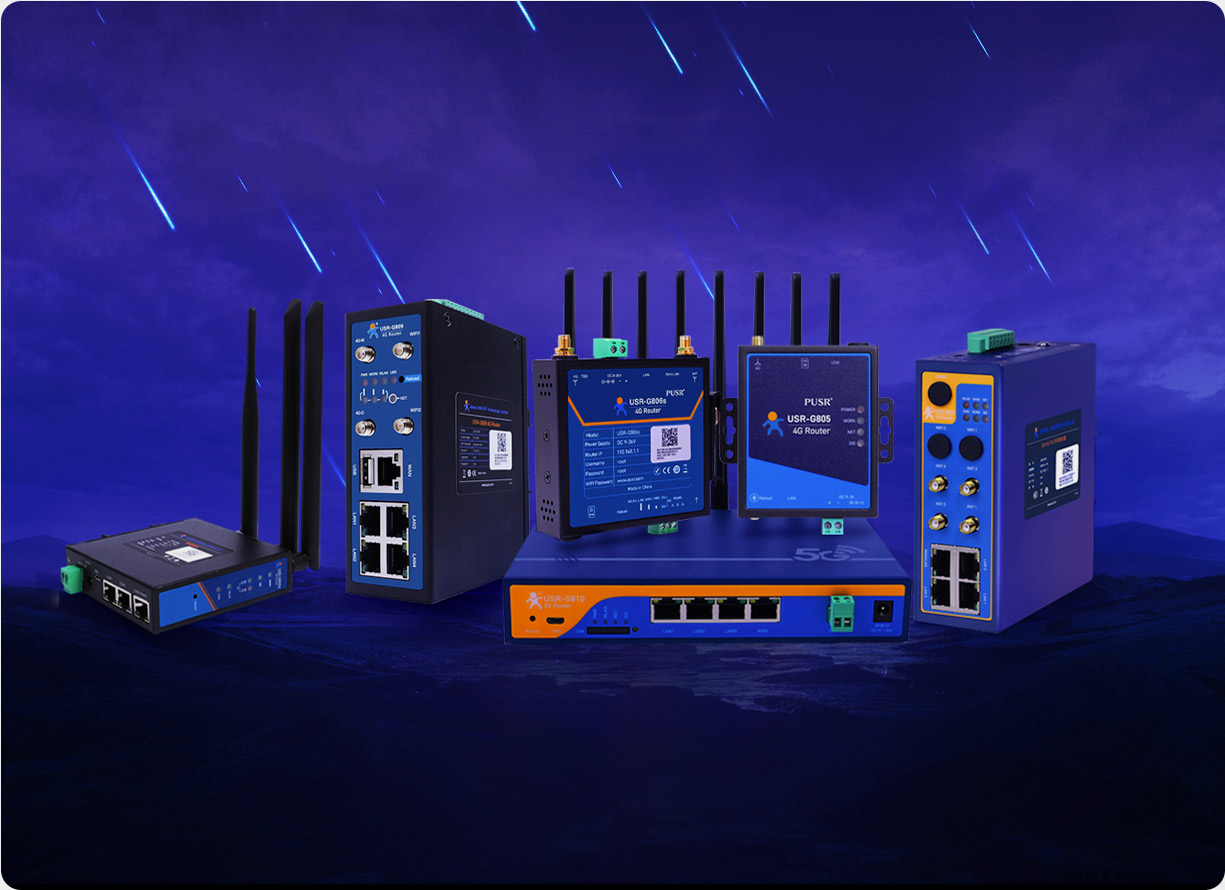
Among numerous multi-WAN industrial router, the USR-G806w stands out as an ideal choice for addressing industrial network pain points due to its comprehensive load balancing capabilities and industrial-grade reliability. Below, we analyze its core advantages from three dimensions:
The USR-G806w supports various load balancing strategies, including bandwidth proportion-based, connection count balancing, and ISP routing, allowing flexible configuration based on actual needs:
Bandwidth Proportion-Based Balancing: Suitable for multiple lines from the same operator (e.g., two Telecom fibers), distributing traffic according to bandwidth proportions to prevent line congestion.
ISP Routing: Built-in operator IP address database automatically identifies the operator to which the target IP of a data packet belongs and selects the corresponding line for forwarding, resolving cross-network access latency issues.
Policy-Based Routing: Supports fine-grained routing based on source/destination IP and port numbers, e.g., fixing all traffic accessing the company's intranet to the fiber line to ensure data security.
The USR-G806w supports dual-link backup for wired (Ethernet port) and 4G connections, automatically switching to the backup link in case of primary link failure, with a switchover time of just 2 seconds. A smart grid project used this function to ensure real-time transmission of power monitoring data via 4G during fiber outages, preventing scheduling instruction delays.
The USR-G806w features an all-metal enclosure with an IP30 protection rating, supports wide temperature operation from -40℃ to 75℃, and includes power reverse connection protection, surge protection (Level 3), and electrostatic discharge protection (Level 3). Test data from a steel enterprise showed that the USR-G806w operated fault-free for 14 months in high-temperature (60℃), high-dust environments, while traditional routers had an average lifespan of less than six months.
Bandwidth Aggregation: Confirm whether the router supports true bandwidth aggregation (not just failover) and test multi-link concurrent transmission speeds.
Strategy Richness: Choose models supporting multiple strategies like bandwidth proportion-based, connection count balancing, ISP routing, and policy-based routing to adapt to different scenarios.
Protection Rating: Select an IP protection rating (e.g., IP30, IP54) based on the actual environment to prevent damage to internal components.
Temperature Range: Ensure the device supports the actual scenario's temperature range (e.g., -40℃ to 75℃) to avoid failures due to excessive heat or cold.
Cloud Management: Support remote configuration, monitoring, and fault alarms via cloud platforms (e.g., USR Cloud) to reduce on-site maintenance costs.
VLAN Segmentation: Support multi-VLAN segmentation to isolate different device groups (e.g., production equipment, surveillance systems) and prevent data congestion.
The load balancing technology of multi-WAN industrial routers provides efficient and reliable transmission guarantees for industrial networks through bandwidth aggregation, redundancy backup, and cross-operator optimization. However, its value realization highly depends on the rationality of strategy configuration. Enterprises must select appropriate load balancing strategies based on their scenarios (e.g., multi-person office, remote maintenance, cross-network access) and pair them with industrial-grade devices (e.g., USR-G806w) to ensure stability.Immediate Consultation: Click the link below to obtain detailed parameters and customized solutions for the USR-G806w, ensuring your industrial network remains rock-solid in complex environments!